One of the most memorable love stories in literary history has been Wuthering Heights, the novel that has been a monumental landmark on the wrathful, destructive power of love, revenge and the battle of classes. The masterpiece of Emily Brontë, whose unique work against the inhuman moors of Yorkshire is much more than a mere love story, is actually a deep look at human nature perverted by fate and passion. Our trip immerses us in the society of the inhabitants of two estates, the coarse Wuthering Heights and the cultured Thrushcross Grange. The key to this storm is the mysterious character of heathcliff in wuthering heights, a gloomy, brooding character whose savage, almost feral character marks the tragedy that develops. Beside him is the free-spirited, obstinately-minded Catherine Earnshaw who is tied to him by a bond that cuts across social norms and death as well. This guide will also seek to unravel the layers involved in these renowned personalities and supporting cast of Linton, Hareton and the trustworthy narrator, Nelly Dean.
Historical & Cultural Context
In order to appreciate the wuthering heights characters with sheer feelings and the dramatic struggles, you must examine the world out of which it was born. The novel was written in the middle of the 19th century, during the so-called Victorian Era when society was very strict and determined to adhere to the rules and manners of the day:
Victorian Era Background
The novel was published at the time of the long reign of Queen Victoria, when society believed heavily in social order, morality, and strict class divisions.
- Publication Context (1847): Wuthering Heights was first published in 1847. The author had to adopt the male name Ellis Bell to have a fair hearing in the male-dominated literature industry. Her sisters, Charlotte and Anne, put in place male pen names to publish their own renowned works as well.
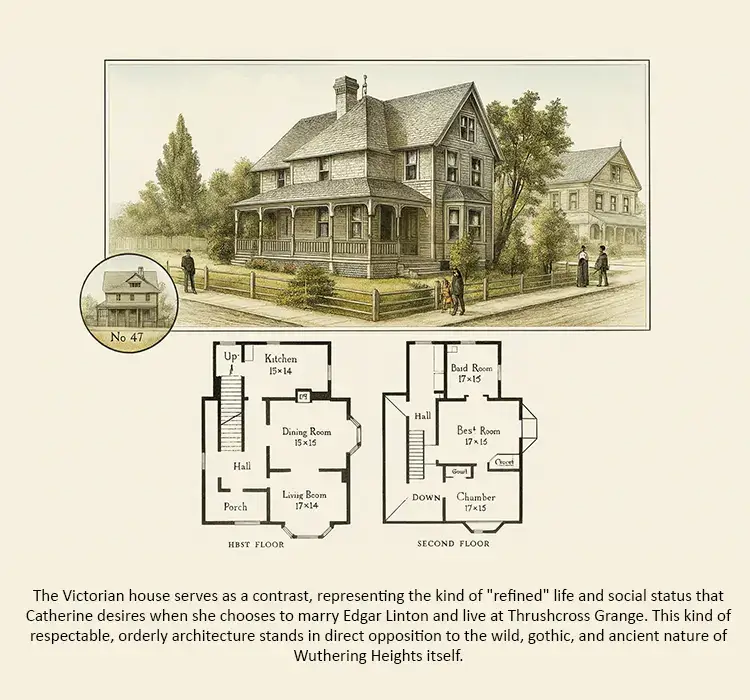
- Victorian Social Norms and Expectations: Society had been extremely concerned with respectability and marriage. It was necessary to climb on the social ladder or retain your position. This pressure is best demonstrated by the way Catherine marries the rich man Edgar Linton despite her love for the lowly-status Heathcliff. The outsider, Heathcliff, as a dark and unknown force, threatens the notion of a stable and orderly society.
- Gender Roles and Women Writers: Female writers were not always taken seriously and they had to write moral, soft stories. Brontue could write the scandalous, morally obscure, and dark narrative with the help of a pseudonym and be regarded as too wild and scandalous to be written by a woman.
Emily Brontë's Life and Influences
The weird and overwhelming atmosphere of the novel and wuthering heights characters is deeply grounded in the life of the author herself and the environment where she spent her life. Emily Brontie was born into a small village in Yorkshire where she led a rather solitary life with her sisters and brother. Haworth Parsonage was their home. The solitude and tragic situations that the family underwent such as premature death and loss added to the dark somber mood of the novel.
- Yorkshire Landscape and Its Influence: The Yorkshire moors are not only a setting they are characters of the novel. The barbaric and wild nature of the terrain translates to the unbridled, wild nature of the heathcliff character wuthering heights and Catherine. The Heights has a gloomy backdrop and the Grange is a home just like the wild nature and the civilized world.
- Literary Influences and Romantic Tradition: Brontue, despite being a Victorian author, owes a lot of her work to the preceding Romantic tradition. This culture cherished passion, sublime nature, the solitary genius and liberty of the personality over social conventions. Wuthering Heights exploits these Romantic concepts to their utmost limits and examines the obsessive love that is entirely beyond the civilized range.
Character Analysis & Relationships
The timelessness of Wuthering Heights is due to its highly complex characters. They are not good or bad, but they are strong destructive emotions which clash to give the drama of the novel. The fundamental motivations and changes of these individuals are the key to the tragic depth of understanding the story in which all of the relationships are a struggle between pure emotion and the strict rules of society.
Main Characters Deep Dive
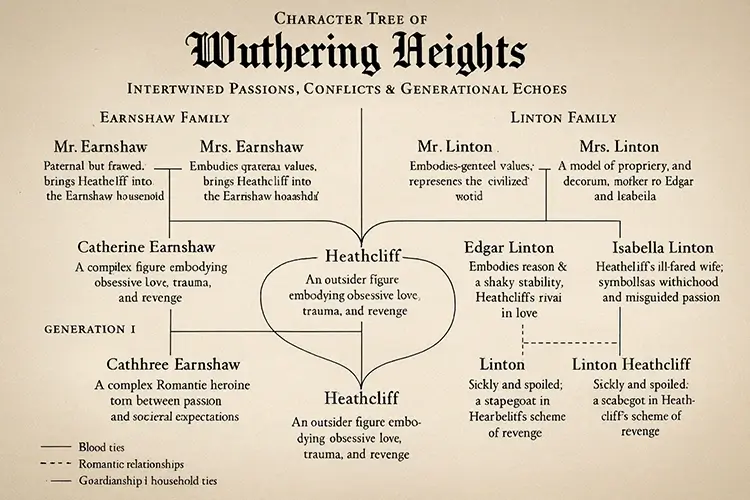
Wuthering Heights is all about the high intensity drama that is surely fuelled by the four main characters Heathcliff, Catherine Earnshaw, Edgar Linton and Nelly Dean. These wuthering heights characters are essentially interconnected in a devastating quadrangle that characterizes the plot as well as themes:
Heathcliff
The character of heathcliff in wuthering heights starts as an enigmatic and adopted boy whose origin is not known. He is the quintessential Byronic hero, a dark, passionate, and rebellious man who is out of place. He is motivated primarily by his obsessive love for Catherine which is fierce. His love is substituted with the one-founded desire to avenge her after she rejects him. This causes him to change from a shy outsider to a mean, rich and manipulative monster who treats people including his own son and the next generation as an instrument to his hate.
Heathcliff in Wuthering Heights: Character Analysis Summary Table | Category | Analysis |
| Literary Role | Byronic Hero and Anti-Hero. He drives the entire plot through his obsessive love and calculated revenge. |
| Transformation | Begins as a vulnerable, passionate outsider (waif). Transforms into a wealthy, cruel tyrant, driven solely by hate and a desire for control over those who wronged him. |
| Core Motivation | Possession of Catherine, both spiritually and physically. After her death, his motivation becomes the meticulous destruction of the Earnshaw and Linton lines to replicate his own suffering. |
| Key Conflict | His intense, natural passion conflicts directly with the social prejudice he faces. This conflict is externalized as his lifelong feud with Edgar Linton. |
| Significance | Represents untamed nature, the primitive heart, and the destructive power of love when twisted by bitterness. He is both the greatest victim and the greatest villain of the story. |
Catherine Earnshaw
The split personality is characteristic of Catherine. Her love for Heathcliff is deep and almost primal because she thinks that they are one soul. However, her characters from wuthering heights cannot help the temptation of social ambition. She then decides to get married to the rich and respectable Edgar Linton, because she is sure that this decision will carry her high and she will be able to take care of Heathcliff in future. This is a deadly choice, created through the wish to achieve a status, which separates her and Heathcliff and her the one who provokes the following tragedy.
Catherine Earnshaw in Wuthering Heights: Character Analysis | Category | Analysis |
| Literary Role | Tragic Heroine. Her fatal decision is the catalyst for the novel's cycle of suffering. |
| Internal Conflict | Self-Division. She believes her soul is Heathcliff's, embodying wild passion and freedom, but her ego craves the wealth and status offered by Edgar Linton. |
| Core Motivation | To achieve social elevation and respectability while simultaneously preserving her spiritual bond with Heathcliff. She fails at both. |
| Key Decision | Her choice to marry Edgar, believing it will somehow raise Heathcliff's status and thus allow them to be together. This decision shatters her life. |
| Significance | Embodies the struggle between nature (Heathcliff) and society (Edgar). Her death, driven by her own emotional chaos, confirms that her attempt to reconcile these two opposing worlds was impossible. |
Edgar Linton
Another wuthering heights main characters is Edgar, he is a symbol of civilization and sophistication. He is well behaved, well educated, polite and well mannered, the ideal Victorian gentleman who is the proprietor of the beautiful, tidy Thrushcross Grange. He is the complete opposite of the wildness of Heathcliff and Wuthering Heights. He attempts to control the wildness of Catherine, which fails to ruin his life, as he attempts to marry her, make sure that his quiet and stable life does not seem to be any match to the wild passion that exists between Catherine and Heathcliff, and that ruins his life.
Edgar Linton in Wuthering Heights: Character AnalysisV | Category | Analysis |
| Literary Role | The Foil to Heathcliff and the embodiment of Victorian respectability. |
| Defining Traits | Refinement, gentleness, civility, and order. He is a loving husband and father but is fundamentally passive and weak when confronted by intense passion. |
| Core Motivation | To maintain domestic tranquility and provide stability for Catherine. He loves her according to social norms, but fails to grasp the depth of her soul's connection to Heathcliff. |
| Key Conflict | His stable, conventional love is utterly powerless against the savage, untamed passion shared by Catherine and Heathcliff. |
| Significance | Represents society, class, and civilization. His destruction shows the vulnerability of order when faced with the chaotic, destructive force of raw human emotion. |
Nelly Dean
From the wuthering heights character list, Nelly Dean is the major narrator of the novel and a key domestic servant who is the witness to nearly all significant events of both generations. Her view is that of an intelligent, down-to-earth woman in the labor market. Although she is a reliable source of information, there are occasions when her credibility is called into question. She does not merely report, she gives her views, she even takes sides, and even joins some of the events that are taking place that is the reader is viewing the story through the moral prism that is her own.
Nelly Dean in Wuthering Heights: Narrator Character Analysis | Category | Analysis |
| Literary Role | The Primary Narrator and a voice of commonsense morality. |
| Perspective | As a housekeeper who has served both families, her perspective is intimate yet biased. She sees everything but understands through a conventional, working-class lens. |
| Reliability | Questionable. She occasionally intervenes, passes judgments, and selects the details she shares, meaning the reader must constantly filter the events through her perspective and moral code. |
| Significance | She is the bridge between the past and the present, the wildness of Wuthering Heights and the refinement of Thrushcross Grange. Her storytelling is how the reader accesses the whole history. |
Secondary Characters
As the strong feelings of Heathcliff and Catherine lead over the novel the actions and fate of the secondary characters preserve and fulfill the tragic cycle of events:
Hindley Earnshaw
Catherine's older brother from the wuthering heights summary character map. He greatly disliked Heathcliff since his arrival considering him a competitor to his father. Following the death of his father Hindley wants to take revenge by treating Heathcliff in the most inhumane way. After the death of his wife Hindley starts to be an alcoholic, gambler and debtor which results in his ultimate decline and Wuthering Heights falls into the hands of Heathcliff.
Isabella Linton
Edgar's younger sister. She is portrayed first as naive and innocent and mistakenly believes that the brooding Heathcliff as a romantic power. She falls in love with him and gets married but it turns out that passion destroys her innocence. Heathcliff exposes her to dreadful mistreatment and just uses her as an instrument of attaining ownership of the wealth of her family and for revenge against Edgar.
Young Catherine
Catherine and Edgar had a daughter. She begins innocent and naive. Her character arc provides a chance to redeem herself although she is compelled to marry Linton Heathcliff in a horrible way. She retains her soft side and ultimately plays a key role in ending the chain of hate educating Hareton and discovering true, healthy love.
Hareton Earnshaw
Hindley's son. In his vengeance against Hindley, Heathcliff makes sure that Hareton is not educated and is coarse. He is a good-hearted person despite his rough appearance. His education is signified by the fact that he is ready to be educated and polished by the younger cathy wuthering heights character and this is the ultimate victory of gentle love and forgiveness over vengeance and ignorance.
Character Dynamics & Themes
The timeless nature of Wuthering Heights is due to the unstable manner in which wuthering heights characters relate and the forceful and universal concepts they represent. It is not just a story, the novel is an in-depth presentation of the worst human actions and it is fueled by a tragic chain of relationships that are all linked together and tend to destroy each other.
Key Interpersonal Relationships
Wuthering Heights is unified by its network of relationships, which, in fact, form the plot of the story, as each relationship is a battlefield of strong feelings. Such important two-generational interactions are the main sources of conflicts and thematic statements of the novel:
Key Relationships in Wuthering Heights: Themes and Analysis | Relationship Pair | Core Theme/Conflict | Analysis |
| Heathcliff & Catherine | Love, Obsession, Identity | This bond is the foundation of the novel's tragedy. It is presented as a metaphysical love they are "one" soul but it quickly devolves into a destructive obsession. Catherine's rejection causes Heathcliff to lose his moral identity, turning his love into an engine of hate. |
| Heathcliff & Hindley | Power Shifts, Revenge | Their relationship is defined by childhood jealousy and adult hostility. Hindley’s cruel treatment of Heathcliff as a youth triggers Heathcliff’s initial descent into bitterness. Heathcliff later executes a precise revenge, manipulating Hindley into alcoholism and gambling to seize his estate, showing a complete power shift. |
| Young Catherine & Hareton | Healing the Past | This is the crucial relationship of the second generation. Their eventual love story is a story of restoration. Young Catherine teaches the rough, uneducated Hareton to read and appreciate refinement, while Hareton’s loyalty helps her recover from emotional hardship. They successfully heal the past by merging the best qualities of both families. |
Thematic Intersections
The main conflicts in the novel and within the wuthering heights character analysis may be divided into the following strong and overlapping themes:
- Love vs. obsession: The novel questions the concept of romantic love by introducing two types of it. The relationship between Heathcliff and Catherine is depicted as a devastating obsession an all-consuming, egoistic need that requires owning and destroying all the lives around it. On the other hand, the relationship between Young Catherine and Hareton is kind and nurturing and hence shows a quieter, healthier restorative love that is filled with kindness and reciprocates growth.
- Relations Determined by Social Classes: The prevalence of class distinction. Catherine's ability to marry the rich Edgar Linton is based on her refusal to marry down to the low social status of Heathcliff. According to the canons of Victorian society, this desire is the direct cause of her ultimate unhappiness. His further attempts to gain wealth and a gentleman are his attempts to break this barrier of classes, but his new position can only raise him as a more successful villain.
- Revenge and Renewal Cycles: This plot structure is based on a cycle of vengeance, which is initiated by Hindley when he abuses Heathcliff and is enhanced by the unfaithfulness of Catherine and cruelly implemented by Heathcliff towards both families. The two-generational narrative structure enables the reader to observe this cycle to the point of culminating in misery. The eventual marriage of Young Catherine and Hareton though is a culmination of the overriding theme of restoration in the novel, as forgiveness and proper love are finally able to dispel the long-standing curse of the past.
Literary Criticism & Interpretations
In order to enjoy characters from wuthering heights, it is good to watch how other scholars and readers have understood its problematic themes and characters throughout the years. The dark passion and structural peculiarities of the novel have made it a popular object of literary criticism.
Major Critical Approaches
The complexity of the novel makes it possible to be analyzed successfully with the help of different critical perspectives:
Critical Approaches to Wuthering Heights: Literary Analysis | Approach | Focus of Interpretation | Example Application to Wuthering Heights |
| Gothic | Focuses on horror, mystery, and atmosphere; settings are often dark and isolated. | Emphasizes the brooding terror of the moors, the haunting presence of Catherine’s ghost, and Heathcliff’s demonic, obsessive nature. |
| Romantic | Focuses on intense emotion, individualism, and nature over reason and society. | Highlights the sublime, untamed passion between Catherine and Heathcliff as a force superior to social rules (Edgar Linton). |
| Marxist/ Socioeconomic | Focuses on social class, power, and money as motivators. | Analyzes how Heathcliff, initially a low-status "foundling," is driven by his need to acquire wealth and land to overcome the class barrier that separated him from Catherine. |
| Psychoanalytic | Focuses on the unconscious mind, desire, and repression. | Explores Heathcliff’s intense, destructive revenge as a manifestation of repressed grief and childhood trauma, and Catherine's split self-identity. |
| Feminist | Focuses on gender roles and the constraints placed on women. | Examines how Catherine is limited by her lack of financial and social power, forcing her to choose marriage (Edgar) over her authentic love (Heathcliff). |
Modern Adaptations and Influence
The impact of Wuthering Heights on culture has been enduring, making it the source of unlimited interpretations in various media.
- Cinema and Television: The film has been screened dozens of times, which reflects the various interpretations of the unstable central relationship by different actors. The classic version, made in 1939 and starring Laurence Olivier, is a classic, yet a new version is created every generation.
- Music and Arts: The themes of obsessive love and desolate scenery in the novel have been the subject of several other famous songs, ballets and operas.
- Implications on Literature: The unreliability of the frame narrative structure and the invention of the canonical Byronic anti-hero in Heathcliff have had significant impacts on later generations of literature authors.
Common Challenges and Solutions
There are certain challenges that students have to encounter in reading this complicated novel in the first place.
Common Challenges in Wuthering Heights and How to Analyze Them | Challenge | Explanation of Difficulty | Solution for Analysis |
| Narrative Structure | The use of two narrators (Lockwood and Nelly Dean) and the story-within-a-story format can be confusing, especially regarding the timeline. | Create a simple timeline to track the major births, marriages, and deaths. Focus on Nelly Dean's biases to assess her reliability. |
| Character Names | The reuse of the name Catherine/Cathy and frequent name changes (e.g., Catherine Earnshaw to Catherine Linton) makes it difficult to distinguish between the two generations. | Use a family tree diagram (like the one suggested earlier) to clearly separate the mother (Catherine) from the daughter (Young Catherine/Cathy). |
| Extreme Emotion | The characters' passions often seem unrealistic and melodramatic to a modern reader. | Analyze the emotions through the lens of the Romantic and Gothic genres. The novel explores passion as a powerful, untamed force of nature, not everyday human behavior. |
Understanding Complexities
Finally, the ambiguities are the deepest elements of wuthering heights character list. The novel could hardly be easily interpreted morally, and the reader has to deal with its problematic thoughts:
- Uncertainty of Heathcliff: Is he a Romantic moll, a casualty of class or an innocent? All three readings are possible in the text.
- Setting Uncertainty: The moors are a source of liberty and spiritual unity for Catherine and Heathcliff as well as isolation and barrenness.
- The Power of Repetition: The second generation that introduces the characters of Young Catherine and Hareton repeats most of the struggles of the first, except that their successful marriage succeeds the cycle, and it is love and education that eventually settle the score.
Conclusion
Wuthering Heights is a masterpiece that is intense in its character development and the richness of its themes. It is a classical study of how unbridled passion, when thwarted by social caste may spread like wildfire to become deadly retaliation. However, through the second generation, the novel provides some weak hope: the prospect of healing with pure love and forgiveness. Using the tragic destiny of Heathcliff and the character of Catherine in Wuthering Heights, we understand the devastating effects of opting to live according to the desires of society instead of knowing the truth. Students searching for literary analysis may also look online using phrases such as pay someone to do my homework when they need academic assistance with assignments.