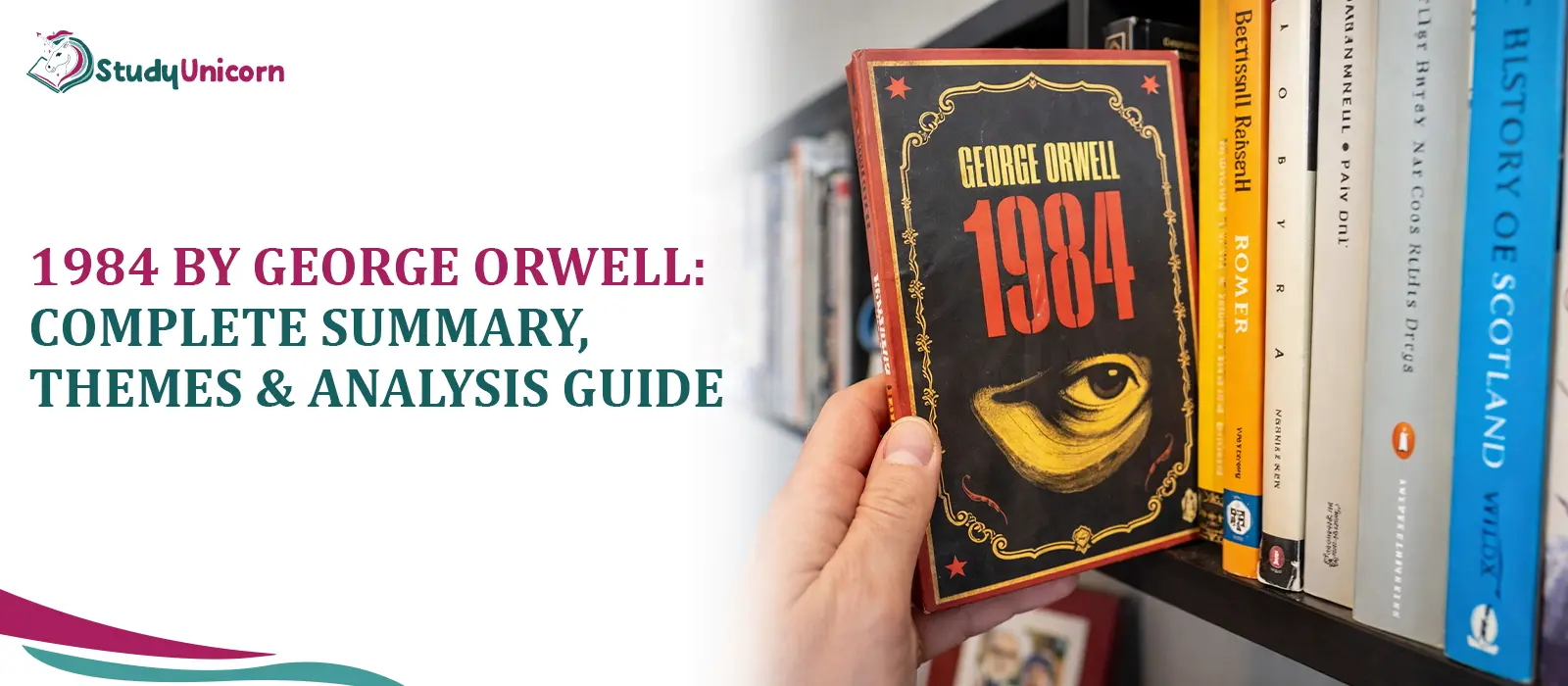
In the masterpiece of dystopianism by George Orwell, 1984 summary, you find yourself in a spooky world where totalitarian power and propaganda not only control all spheres of life but also dictate them. It is a well-written and exciting summary of the novel 1984 that unravels its significant themes, characters, and political cautions. You will find that no matter whether you read it as part of your studies or as a reread of the same story, you will get a better insight into the powerful message and the timelessness of the story.
Quick Overview: 1984 in 60 Seconds
The brief offers an 1984, the author, the genre, the setting, the protagonist, and the conflict. You will see the central idea of the story in a minute, when you will realize that it is a man struggling against the government that governs the truth and even the thoughts of people.
1984 by George Orwell — Quick Reference Overview Table | Attribute | Details |
| Author | George Orwell |
| Published | 1949 |
| Genre | Dystopian fiction, political satire, social science fiction |
| Setting | Airstrip One (formerly Great Britain), a province of Oceania — a totalitarian superstate under constant surveillance |
| Protagonist | Winston Smith |
| Core Conflict | Winston’s quiet rebellion against an oppressive regime that controls truth, language, history, and even personal thought |
| Famous Slogans | “War is Peace” “Freedom is Slavery” “Ignorance is Strength” |
Detailed Plot Summary
An in-depth breakdown 1984 plot summary of the three parts of the novel, which depict the defiance, hope, deceit, and eventual psychological failure of Winston against the totalitarian authority.
Part One: The Seeds of Rebellion
In this part, the world of Winston, his dissatisfaction, and the little yet threatening signs that start his rebellion are presented.
- Life Under Surveillance: You are presented to Winston Smith, a Party member in Oceania, where everyone is spied on by Big Brother. His work is in the Ministry of Truth, where he has to rewrite history to suit the current version of the Party.
- The Secret Diary: Winston is a rebellious person, even though he may seem loyal. His first act of defiance comes when he starts writing in a secret diary whereby he writes against the ideas of the Party.
- Growing Hatred for the Party: The aggravated feelings of Winston occur when he looks back on propaganda, poverty, and the authority of the Party to determine truth and memory. His non-verbal opposition starts to emerge.
Part Two: The Affair and The Brotherhood
Winston feels love, hope, and an illusion of resistance where he feels that he has found freedom and the purpose of politics.
- A Forbidden Relationship: Winston begins a clandestine affair with Julia. The personal act of rebellion in their relationship is against the strict control of the Party over emotions and intimacy.
- The Hidden Room: They lease a room that is in a storehouse because they are sure that they are secure without telescreens and spyware. Winston has never been hopeful.
- The Promise of Rebellion: O’Brien reaches Winston and gives him the concept of the Brotherhood, which is an underground resistance of people. Winston comes into the picture and believes that he is resisting the system.
Part Three: The Ministry of Love
All forms of hope are crushed as Winston gets arrested, tortured, betrayed, and psychologically changed under the merciless regime of the Party.
- Arrest and Betrayal: Suddenly, Winston and Julia are arrested. The secret room was not secure, and they got arrested and punished in the Ministry of Love.
- Torture and Reprogramming: O’Brien manifests his real love for the Party and directs the physical and psychological torture of Winston to destroy his mind to think independently.
- Room 101 and Final Defeat: Winston encounters his worst nightmare in Room 101 and betrays Julia. At the conclusion, he is thoroughly shattered and has resigned to the Party and ends up loving Big Brother.
Three Key Themes
A focused look at the novel’s central ideas, showing how power, truth, and fear shape society and human identity.
Theme 1: Totalitarianism and the Destruction of Individuality
A narrow perspective of the major concepts of the novel, that power, truth and fear influence society and human identity.
Theme 1: Totalitarianism and the Destruction of Individuality
Totalitarianism in 1984 examines the way in which absolute political power deprives people of freedom, identity and independent thought.
- Total Control of the People: In 1984, by George Orwell, the party requires total obedience. There is no freedom of emotions and personal views amongst citizens. The state controls every sphere of life.
- Erasing Personal Identity: Individuality is considered a danger. The danger of the emotions that Winston has for Julia and the private diary is that these reveal the ability to think freely and want something personal.
- Fidelity to Big Brother: The government requires citizens to establish their identity through their loyalty to Big Brother. People must express greater love for the Party than they would for their family members and friends and for their own lives.
Theme 2: The Manipulation of Truth and History
This theme is emphasized by the importance of manipulation of information as the means of controlling reality itself.
- Rewriting the Past: At the Ministry of Truth, historical documents are rewritten continuously to support current assertions to the present by the Party. In case of policy reversal, the history would be changed to reveal that the Party was never wrong.
- The Power of Doublethink: The citizens are indoctrinated to ignore contradictions. They think of two opposite notions simultaneously, as both the Party says they are.
- Control of Reality: The Party controls the present by controlling the past. The impossibility of people to trust facts or memories leaves them absolutely reliant on the government's version of the truth.
Theme 3: Surveillance and Psychological Control
This is a theme that presents continuous surveillance in 1984 in such a way that it may induce dread and make people conscious of their thoughts.
- The Telescreens and Spies: The government uses telescreens and informants to monitor citizens throughout the day. People have no right to privacy because the government trains children to report anything they find suspicious.
- Fear as a Weapon: The fear of being punished has a way of making people obedient. They are very cautious of the things they say and their facial expression to not seem disloyal.
- Breaking the Mind: The final aim of the Party is psychological control. It is not only that it punishes against rebellion, but it also reinvents beliefs until people genuinely accept and love Big Brother.
Two Major Characters Analyzed
A closer look at the novel’s central figures, exploring their roles, motivations, and deeper symbolic meanings.
Winston Smith: The Reluctant Rebel
Winston is a mirror of the silent inner struggle of a common man in the most severe political pressure.
Winston Smith Character Analysis Table — 1984 | Aspect | Details |
| Role | Winston Smith character analysis as the main character in 1984, by George Orwell. |
| Description | Winston is 39 years old. He is physically weak but thinks deeply. He feels confused about his childhood memories, which makes him question the Party’s version of the truth. |
| Symbolism | Winston represents human conscience and the natural desire for freedom, truth, and individuality. |
| Character Arc | At first, he secretly rebels and looks for truth and love. But after torture and fear, he loses hope and finally accepts the Party completely. |
| Name Significance | “Winston” sounds strong, while “Smith” is a very common name. This shows he is both ordinary and capable of resistance. |
| Key Quote Analysis | “Who controls the past controls the future. Who controls the present controls the past.” If they control what people remember, they can control what people think. It shows that the Party has a lot of power. |
Julia: The Practical Rebel
Julia character analysis includes different forms of resistance—personal, emotional, and focused on living freely in the present moment.
Julia Character Analysis Table — 1984 | Aspect | Description |
| Role | Winston’s lover who secretly rebels against the Party through personal actions, not politics. |
| Description | 26 years old, works in the Fiction Department. Confident, energetic, and bold, but hides her rebellion behind loyalty. |
| Symbolism | She represents desire, pleasure, and the human body’s resistance to total control. Her love with Winston is an act of rebellion. |
| Character Contrast | Winston questions truth and politics, while Julia focuses on enjoying small freedoms through secret acts and intimacy. |
| Character Arc | She starts fearless, but after arrest and torture, she is broken and betrays Winston, showing the Party’s power. |
| Key Insight | Julia’s rebellion is personal—she seeks small freedoms, not to overthrow the Party. |
Symbols and Motifs
These are strong symbols that add more significance to the novel as they symbolize control, fragility, fear, and identity loss.
Big Brother
Big Brother is a symbol of unconditional power and the illusion of protection as a means of keeping order.
- Sign of Authority: Big Brother is the image of the Party and he is seen on posters, which say: Big Brother is Watching You. He is an embodiment of unremitting authority and dominance over society.
- Psychological Influence: He may be or may not be there, but he instills fear and loyalty in his image. People are made to love and respect him blindly.
- Greater Significance: Big Brother plays out as a representation of the totalitarian governments that make influential leaders to unify, intimidate, and emotionally manipulate the people.
The Glass Paperweight
The paperweight is an embodiment of delicate beauty, memory, and temporary relief of Winston in the world of reality.
- A Piece of the Past: The coral paperweight Winston purchases is a sign of a link to the past before the Party came to power. It is like a miniature, unexplored world.
- Symbol of His Relationship: The paperweight is a reflection of the covert affair between Winston and Julia: it is beautiful and sensitive, and closed off to the world.
- Shattered Illusion: As the Thought Police arrest Winston, the paperweight is smashed, and it is a symbol of taking away his dreams and inner uprising.
The Telescreens
Constant watch and deprivation of privacy in daily lives are symbolized by the telescreens.
- Monitoring Implemented: Telescreens are used to constantly follow citizens around. It has no secure area to be seen.
- Self-Censorship: Due to the fact that individuals are aware that they are being put under observation, they tend to censor themselves and even their thinking.
- Symbol of Terror: Telescreen is enough to keep one on tight check without using physical restraints and rather by being in a terrified but watched state.
Room 101
Room 101 is a symbol of the supreme fear and the point of human protests.
- Personalized Terror: In Room 101, inmates deal with their greatest fear. Winston experiences his deepest terror through the presence of rats. The penalty is meant to annihilate the individual's strength.
- Psychological Destruction: It is not all about pain; it imposes betrayal. In order to save himself, Winston betrays Julia.
- Final Surrender: Room 101 is the ultimate weapon of the Party's power, the possibility to make people real again with the help of breaking their spirits and making their submission.
Historical and Political Context
The warnings and the deeper meaning of the novel are better understood by just knowing the time and political climate in which it was written.
Orwell’s Influences
The world of the novel was influenced by the experience of the author during the war, propaganda, and authoritarian regimes.
- Totalitarianism Experience: The George Orwell 1984 was able to experience dictators such as Adolf Hitler and Joseph Stalin. The Party in 1984 directly suffered from the way these governments used their propaganda, censorship and fear methods to maintain control.
- Spanish Civil War: The involvement of Orwell in the Spanish Civil War opened his eyes to political disloyalty and use in the revolutionary activities. This experience influenced him to cultivate his mistrust of political extremism.
- Post World War II Anxiety: People who lived after World War II remained fearful about nuclear war, state surveillance, and growing government power. The oppressive dark elements of the novel developed from the combination of multiple international conflicts.
The Novel’s Purpose
The novel is a caution to unstoppable political authority and the harm of the loss of personal liberty.
- A Political Alert: Orwell did not produce 1984 to be fiction. His intention was to alert readers to how an easy sail of a democratic society could be dragged into the control of authoritarian governments in case power is not in control.
- The Danger of Controlling Truth: The narrative stresses the ability of knowledge to harm critical thinking in the case of controlling language, history, and information. Truth was a flexible thing, and thus is freedom weak.
- An Eternal Message: The novel, though published in 1949, is still applicable in modern times. Its wording makes you think critically, respect individual freedom, and challenge systems that would like you to be blind and follow them.
Downloadable Study Guide (PDF Concept)
Conclusion
In 1984, George Orwell sends a chilling message, including the influence of power, truth, as well as language and fear, can overcome even a human mind. The loss of Winston anything to remember is that the freedom starts inside. The timeless impression made by the novel is to question authority, defend truth, and never relinquish independent thinking.