The basis of any successful essay is a powerful thesis statement, and one of the most helpful ones is the 3 point thesis statement. Concise, to the point and clearly laid out in a logical manner, this will not only present your main argument, but also outline the three main points that will back it. You can use the 3-point thesis to write a high school essay, a college research paper, or a persuasive blog post, master it and you are sure to sound coherent and organized.
You will discover in this step-by-step guide by definition what is a 3-point thesis statement, why it is an effective thesis statement, and how to confidently write a thesis statement. We will deconstruct the structure, go through real life examples and it will be accompanied by out-of-the-box templates that you can use on any subject. By the conclusion you will have a basic formula, which you can save on to write better and more focused essays in future.
What is a 3-Point Thesis Statement? (A Clear Definition)
A 3 point thesis statement is a single sentence- most commonly put at the end of the introduction- that states the primary argument of an essay and provides the three major points that shall be used to support it. That is, it informs the readers on what you think and why you think it, in a single structured sentence.
Such a thesis is usually of a straightforward formula:
Main claim + three supporting reasons.
For example:
The modern communication has been revolutionized by social media through enhancing connectivity in the world, development of individual identity and political consciousness.
In this case, global connectivity, personal identity and political awareness are the three supporting arguments to the main argument that social media has revolutionized the process of communication. All these will be made into distinct body paragraphs of the essay.
A 3 point thesis is strong because it is simple to grasp and follow. It provides an easy roadmap to the writer and reader, and it becomes easier to follow and develop the essay.
If you face any problem in writing your thesis then you can contact our thesis writing experts, they are available 24/7 to help you in writing a effective thesis statement.
Why is it So Commonly Taught?
The 3 point thesis statement is a popularly taught model since it fits perfectly in the classic 5-paragraphs essay format. This structure includes:
- Introduction (with thesis statement)
- Body Paragraph 1 (it contains first supporting point)
- Body Paragraph 2 (it has second supporting point)
- Body Paragraph 3 (this paragraph has third supporting point)
- Conclusion (restates thesis and summarizes key ideas)
In this outline, the three points enumerated in the thesis have a direct relationship with the three body paragraphs. This provides a logical flow of the essay and makes it focused and balanced. This structure offers a clear outline to the students, particularly beginners, on how to structure ideas and not write off-topic.
The 3-point thesis statement is one of the most widely taught writing techniques in academic institutions due to its capacity to make the planning process easier and increase its organization.
The Anatomy of a Perfect 3-Point Thesis: The "Claim + Blueprint" Formula
An effective 3 part thesis statement is not just a list of ideas but it is a well-constructed sentence using a clear formula. Imagine it as a mixture of argument + roadmap. The former gives the reader your primary stance, and the latter describes the three main arguments, which are going to justify the former. Combining these two elements will make your thesis narrow, convincing and simple to read.
The formula is commonly referred to as the Claim + Blueprint due to the fact that it does not only make the claim but also outlines the blueprint of the whole essay. We can deconstruct each of the components.
Component 1: The Arguable Claim
Your thesis is the subject of the arguable claim. It puts your position on a subject very clear, what you think, want, or want to demonstrate. Notably is the fact that this assertion should be controversial rather than in itself be a fact.
An example can be the replacement of the statement Exercise is good with a statement: Regular exercise changes mental health by making people resilient. This preconditions persuasion and welcomes evidence.
A good claim will take a stance and it is argued out with evidence. It is also open to argument or disagreement, which attracts interaction and critical thinking by the readers. In the absence of a good claim, your thesis is a summary and not what can be called an argument.
Component 2: The Preview of Points
This is the second section of the formula where you anticipate the three major reasons, categories or arguments that will go in your claim. These are the points that serve as a roadmap to your essay, all of them will be further developed into a body paragraph.
For example:
They should make physical education classes mandatory daily in schools, as it increases the health of students, boosts their academic performance, and positively affects their mental state.
Here:
The claim = Schools ought to compel physical education classes every day.
The three points = enhances the health of the students, increases their academic achievement, and improves their mental well-being.
All those points now lead to the construction of the essay.
The Simple Formula
The following is the simple visual format of the structure:
[Claim] + because/since/through [Point 1], [Point 2], and [Point 3].
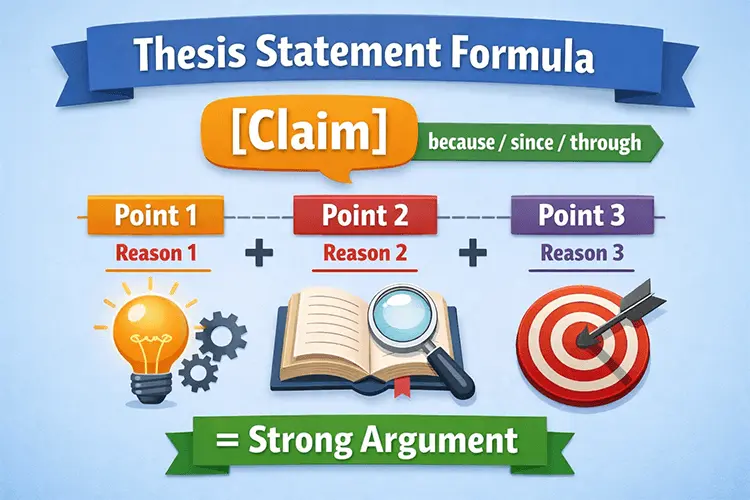
A light, debatable statement with three narrow points of support is going to make a thesis statement that is well countered, coherent, and simple to develop, which is precisely what a solid academic writing entails.
Read our The Ultimate Guide to Writing a Perfect Thesis Statement to know more about how to write a perfect thesis statement.
3-Point Thesis Statement Examples (Across Different Subjects)
It is one thing to learn the format of a 3 point thesis, and it is another to observe one in action. The following are 3 point thesis statement examples in various academic topics to demonstrate how the formula of Claim + 3 Points is applicable in different fields.
Example 1: Literature / Literary Analysis
3-Point Thesis Statement Examples: Literature Analysis (Macbeth Case Study) | Prompt: Discuss the way in which Shakespeare uses ambition in Macbeth. Bad Thesis: Macbeth has a significant theme of ambition. (Too vague, not arguable, no roadmap. Good 3-Point Thesis: In Macbeth, Shakespeare depicts that ambition is a destructive element through the downfall of the morals of Macbeth, the manipulation of Lady Macbeth and the violent implications of the play. Breakdown: - Claim: Shakespeare describes ambition as a destructive power.
- Point 1: Death of morality in Macbeth.
- Point 2: Manipulation by Lady Macbeth.
- Point 3: The bloody consequences of the play.
Every point may now be made a specific body paragraph. |
Example 2: History / Argumentative Essay
3-Point Thesis Statement Example: Industrial Revolution Argument Essay | Prompt: Was the industrial revolution an advantage to the society? Bad Thesis: The industrial revolution transformed the society in numerous aspects. (Too general and not very argumentative) Good 3-Point Thesis: Despite the challenges produced by the Industrial Revolution, the same proved to be positive since it opened up more economic opportunities, boosted technology and enhanced the economic standards of living in the long run. Breakdown: - Claim: The Industrial Revolution was positive in the end.
- Point 1: An increased economic opportunity.
- Point 2: Advanced technology
- Point 3: Higher living standards in the long-term.
You will see that the statement makes a definite part. |
Example 3: Social Sciences / Expository Essay
3-Point Thesis Statement Example: College Stress Expository Essay | Prompt: Expound on the primary causes of stress among college students. Bad Thesis: Students in colleges are under a lot of stress. (Gives a statement but does not preview any important points). Good 3-Point Thesis: Academic pressures, financial demands, and social pressures are some of the factors that put stress on college students. Breakdown: - Claim: Stress among college students is a common occurrence.
- Point 1: Academic pressure
- Point 2: Financial responsibilities
- Point 3: Social expectations
The assertion in expository writing does not necessarily have to be argumentative, but it nevertheless has a distinct roadmap. |
Example 4: Science / Persuasive Essay
3-Point Thesis Statement Example: Renewable Energy Persuasive Essay | Prompt: Is more investment in renewable energy by governments needed? Bad Thesis: Renewable energy holds the key to the future. (Too broad and lacks structure.) Good 3-Point Thesis: Governments ought to invest further on renewable energy since it will ensure that they minimize environmental degradation, enhance energy autonomy, and enhance economic development. Breakdown: - Claim: Governments ought to increase their investment on renewable energy.
- Point 1: minimizes environmental degradation.
- Point 2: Enhances energy autonomy.
- Point 3: Fosters the growth of economy.
This case gives a clear picture of how a convincing argument can be justified using three justifiable reasons. |
These illustrations indicate that the 3-point thesis statement is applicable in any subject, be it literature, history, social science and science, since it is clear, well-organized and focused.
How to Write a 3-Point Thesis Statement: A 5-Step Process
Having learned the structure and having observed some examples, it is time to learn how to write a 3 point thesis. It does not take guesses to make a good 3-point thesis but only makes sense and has a logical flow of thoughts. With the following five steps you can transform what is a simple answer to a well-structured thesis which is clear and guides your whole essay in a well-structured manner.
Step 1: Answer the Prompt with a Simple Statement
Begin by just giving a straight forward answer to the essay question in one sentence. At this point, there is no need to concern yourself with structure, simply focus on your central idea or main position. As an illustration If a prompt presents the following question: Should schools have a four-day school week, your uncomplicated response may be: Schools should have a four-day school week. It is this which forms the basis of your thesis the basic argument.
Step 2: Brainstorm Three Strong Reasons for Your Answer
As a way of convincing a point, start by questioning yourself on the reason why your assertion is correct. Find three of your strongest and most individual reasons to support your argument and make sure the reasons are as clear and substantial as to justify a whole paragraph of your essay.
As an example, you can think of the points like decreasing the student burnout, decreasing the costs in the operations, and enhancing the retention of teachers. These are important reasons but it is important that they relate directly to your overall argument that will form the basis of your body paragraphs to come.
Step 3: Connect Your Answer and Reasons with a "Because" or "By" clause
Next, mix your main answer (claim) and your three reasons in a single sentence with the help of such connecting words as because, since, or by.
Example:
The schools need to embrace the four-day school week since it will limit the burnout of students, lower the operating expenses, and enhance the retention of teachers.
You now have a complete 3 point thesis statement with the Claim + Blueprint formula.
Step 4: Refine for Parallelism and Specificity
In this stage, you need to narrow down on a thesis to make it clear by making sure that your three main points are described in a coherent manner and they are specific. This is one of the parts that many students have trouble with and therefore always remember to have your points arranged in the same way grammatically. Rather than generalizing such as saying there are numerous benefits or there are numerous problems that need to be addressed, be clear on the particular areas that you will be addressing. Specificity and parallel structure will help to make your thesis more admirable and transparent.
Step 5: The Final Check: Does It Map to Your Essay's Structure?
Last but not least is to compare your thesis with your intended essay. Ask yourself:
- Is it possible to make each of the three points a body paragraph on its own?
- Are the same points discussed in the essay as they are discussed in the thesis?
- Is it the same fundamental assertion that you have concluded?
When the response to this question is yes then your thesis is successful in mapping your essay structure.
A thesis statement with three points when done properly does not merely present your thesis, it serves as a road map that will help keep your entire paper in line, point and make sense throughout its introduction to conclusion.
Ready-to-Use 3-Point Thesis Statement Templates (A Cheat Sheet)
A good 3-point thesis statements puts your argument or purpose in a clear way and it gives you a preview of the three main points you are going to discuss in your essay. This structure helps:
- Keep your writing organized
- Take your reader through your argument.
- Each body paragraph should be in support of what you are trying to say.
The templates of the various types of essays can be found below:
?? Click here to download : Argumentative Thesis Template
??Click here to download : Analytical Thesis Template
??Click here to download : Expository/Report Thesis Template
Common Pitfalls & How to Avoid Them
Although this 3-point thesis statement may be simple to make up, it is a formula that most writers are not good at applying. It is easy to make small mistakes, such as forgetting to write a definite claim or being too vague, and this will undermine the whole essay even at its inception. The good news? These issues can be dealt with after learning what to look up.
These are the most pitfalls that students usually encounter when writing a 3-point thesis, and how they can be avoided.
The "List" Thesis (No arguable claim)
The greatest trap of most writers is to end up producing a thesis statement that merely appears as a list of things instead of a definite statement that can be argued out and agreed upon. An abstract thesis may make readers believe that they are reading a series of facts, but not a sophisticated argument.
How to Avoid It: To avoid this problem, write a clear thesis statement that will summarize the subject of your discussion. Ensure that it is a specific, debatable position that can be discussed during your essay. Instead of saying, there are a lot of positive things about exercise, such as losing weight, feeling better, and getting a better sleep, say something more complex, i.e., regular exercise does not only help in losing weight but also improving mental health and sleeping patterns by getting out of anxiety.
Vague or Overly Broad Points
The other trap is preparing too general or abstract thesis points and this may confuse a reader and weaken the power of the argument that you make. When you are not specific in your points, there is a possibility that your audience will not know the crux of your argument.
How to Avoid It: Be precise and straight forward when making your points. Rather than explaining that social media has numerous effects, indicate what those effects consist of and how they pertain to your argument. An example of this would be to say, Social media plays a major role in the political participation of young voters through the availability of information, making it easier to have discussions in communities, and by encouraging grassroots movements. This style makes every point make a distinct contribution to the general assertion of your thesis.
Points That Are Not Parallel in Structure
A disjointed and confusing argument may be caused by the creation of thesis points, which are not parallel in form. It is also more difficult when your points are not consistently formatted making it harder to follow your reasoning and see the connection between your ideas.
How to Avoid It: It is important to make sure that your thesis points are organized in a logical grammatical order. When one point starts with verb, then all the points should start with verbs. You can use the following example: rather than a combination of constructions such as Advocating for renewable energy and The need for governmental policy change, you can write Advocating for renewable energy, enforcing stricter emissions regulations, and promoting public awareness campaigns. When you have parallelism you have a more cohesive and professional thesis.
Points That Do Not Logically Support the Main Claim
Finally, the worst error one can make is adding, in your thesis, things that do not make sense in relation to your central argument. When every point deviates too much off the main idea, then it may make your thesis weak thus, resulting in a disjointed essay.
How to Avoid It: To prevent it, you should always weigh each point before you finalize your thesis statement and make sure that it will directly add to and support your thesis statement. Wonder whether every point makes sense to your argument. In case it appears that a point is tangential, it is worth rethinking whether the point should be included or not. Editing your arguments in such a way that you find that you can support your thesis will strengthen your argument in general and create more clarity in your writing.
When you know these pitfalls and apply the tactics stated, you will be able to create a solid three prong thesis statement that will argue your point well, and will be interesting to your audience.
Advanced Considerations: When a 3-Point Thesis Isn't Enough
The 3 point thesis statement is a great device to create clarity and structure in particular short essays or academic assignment constructed on the 5 paragraph model. But as you get more sophisticated in your writing, you will find this format suffocating. Longer argumentative essays and college-level research papers, as well as analytical essays, frequently need more freedom and flexibility than a three-point framework would permit.
It is also as significant to know when to go beyond the 3-point thesis as it is to learn how to apply it.
Limitations of the 3-Point Structure
Although the 3-point thesis is effective in clarity and organization, it is limited in a number of ways:
- It Can Oversimplify Complex Topics: There are things that cannot be just discussed within three categories or reasons. As an illustration, a 15-page research paper on climate policy might be in need of a number of dimensions, counterarguments, and layers of analysis.
- It Can Be Formulaic: In high academic writing, an instructor might require a more sophisticated argument, as opposed to a distinctly divided Point 1, Point 2, Point 3.
- It Shuts the Door to Change: When your study takes you slightly off track, a strict three point road map may complicate the process of revision.
Form is useful in short essays. Far too much structure may be stifling in the case of longer or more analytical writing.
Transitioning to a Complex Thesis
When you start writing on a higher level, your thesis can change to a more complex and sophisticated argument out of a 3-point formula. Rather than enumerating three points in a thesis, a complicated thesis may:
- Make a main point with several points connected to each other.
- Acknowledge counterarguments
- Focus on cause and effect, thematic relationships.
- Dwelling on the importance and not a numbered system.
For example, instead of writing:
The government has to be regulated since it will safeguard the consumers, lessen the ecological harm and uphold healthy competition.
A more advanced thesis might say:
Government regulation stands out as a key way of balancing economic growth and consumer protection and environmental sustainability in contemporary market economies.
Observation that the latter is not a strict listing of three. Rather, it is a more generalized, more conceptual argument which can be explored further.
The 3-point thesis is a great base towards learning structure and clarity, yet as your writing increases in complexity, then you should also increase your thesis.
Conclusion
The art of the 3-point thesis statement is a revolution to any author. It makes it understandable, structured, and has a road map to your essay because every point is clearly backed up by your argument. It may be basic, but it will be a foundation on which your strong academic writing is built and you can modify the same to suit the more involved essays as your competency expands. Through knowing the structure, how to avoid traps of the thesis and practicing using your examples in any topic, you will be able to write thesis statements every time that not only help direct your writing but also get your readers to listen to you and make your arguments sound and clear. The 3-point thesis is not merely a tool, but the platform on the way to the assured, structured writing.