The art of storytelling is not a thing of today’s world; it is an ancient practice and the oldest mode of entertainment. Before the stories started to be written or acted out on stages or on the big screen, storytelling had always been there in people’s minds and their imagination, where the magic was created merely by words. But the question arises as to what makes the story interesting, worth reading, and creates character development, then the answer would be the Conflict.
The Types of Conflict in Stories built everything around it and the stronger the conflict you choose, the more interesting the story will be. You need to know that telling a story is telling a struggle; otherwise, a plot is simply a collection of incidents. This idea was traditionally condensed in the Greeks, who introduced the agon, the contest, as the central feature of drama. Be it Odysseus fighting the turbulent sea or Antigone going against the will of a king, the ancients knew that only when they are challenged do heroes become powerful.
It is these kinds of conflicts that make the human experience run on ink. They are the sparks that soar up when the inner wants of a character come into collision with the coldness of the external world. Silently battling a troubled conscience to roaring and shaking against a systemic evil, conflict is the heartbeat of all good stories.
Clear, Bolded Definition: Story Conflict
Story Conflict is the lightning bolt, the spark that shoots when the innermost yearnings of a character come into force with a stiffly set barrier. The Great Wall is what lies between a hero and their purpose and makes them either climb it, or even break it, or be transformed by the experience. The absence of such a friction results in a story as a person taking a nap, but the presence of such a friction results in a heart-throbbing adventure where each decision does count.
Is it Internal or External?
Conflict is characterized by its territory, with internal vs external conflict. Internal Conflict refers to an inward war that is waged in the mind. It goes by the title Man vs. Self and is the conflict of a character with their faults, fears, or conflicting wishes. It is the agony of going through a hard decision. External Conflict is an apparent struggle against the world. It entails a character who is subjected to external forces and is named Man vs. Man, Nature, Society or Technology.
Internal vs External Conflict: Key Differences Explained | Feature | Internal | External |
| Location | Inside the mind/heart | The outside world |
| Visible? | No (expressed through thoughts/actions) | Yes (expressed through physical action) |
| Resolution | A change in perspective or character growth | Overcoming or losing to an outside force |
Why It's Powerful: The thematic questions it explores.
Conflict is the "why" of a story and knowing what is conflict in a story? Is knowing the art of storytelling. The plot tells us what happens whereas the conflict tells us what the story is actually about. It compels the characters to make a choice between their principles displaying their true self and trying to answer the most important questions of human existence. Thematic conflict is a suggested war of ideas. When one of the characters is confronted with a challenge the narrative is posing a question underneath a question:
- Man vs. Self: Should you be on the safe side and be unhappy or should you risk and discover who you are?
- Man vs. Man: Will morality live in a world of cutthroat competition?
- Man vs. Nature: Does the desire to live of humanity surpass the apathy of the universe?
- Man vs. Society: How expensive is it to take a stand in support of what is right when the entire world is telling you that you are wrong?
Types of Conflict Across Literature, Film, TV, and Pop Culture | Category | Literature | Film/TV | Pop Culture |
| Man vs. Self | Hamlet: A prince paralyzed by indecision and the weight of his own conscience. | Toy Story: Buzz Lightyear grappling with the identity crisis of being just a toy. | Zuko (Avatar): The internal struggle to choose between his family's honor and doing what is right. |
| Man vs. Man | The Great Gatsby: Gatsby’s obsession with the past clashing with Tom Buchanan’s cruel reality. | Whiplash: A drummer pushed to his physical and mental limits by a tyrannical teacher. | Batman vs. Joker: A battle not just of fists, but of chaos versus order. |
| Man vs. Nature | The Old Man and the Sea: An aging fisherman’s grueling battle against a giant marlin and the sea. | The Revenant: A frontiersman surviving a bear attack and the brutal wilderness. | Jaws: The primal fear of a predator that cannot be reasoned with. |
| Man vs. Society | 1984: Winston Smith trying to maintain his humanity in a world of total government surveillance. | The Hunger Games: Katniss Everdeen becoming the face of a rebellion against an oppressive Capitol. | Rosa Parks: A real-life historical example of one person defying an unjust system to spark change. |
| Man vs. Tech | Frankenstein: Dr. Frankenstein facing the horrific consequences of his scientific ambition. | The Matrix: Neo discovering humanity is being harvested as batteries by machines. | ChatGPT/AI: Modern debates about whether technology will replace human creativity or enhance it. |
The 7 Types of Conflict in A Story
Any narrative depends on literary coddnflict. These seven types of conflict in a story forms the stress that propels the storyline and compels characters to develop or evolve. In order to know about storytelling we divide these conflicts into two buckets Internal and External.
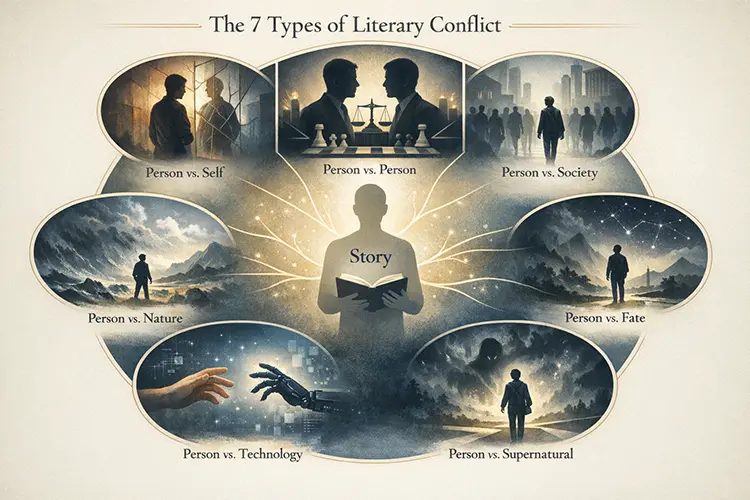
Person vs. Self (Internal)
This is the form of inward conflict only. It is experienced in the mind of a character as they wrestles with conflicting wants ethical issues or psychological challenges.
- The Struggle: It is a decision between doing what is right and doing what is wrong; it is a decision to overcome a phobia or fight self-doubt.
- Example: A protagonist has to choose whether to remain in their hometown where everything is comfortable or go to a new city to take a dangerous dream job.
Person vs. Self Conflict Example: Charlie in The Perks of Being a Wallflower | In "The Perks of Being a Wallflower", Charlie struggles with his own mental health and past trauma as he tries to navigate high school and make friends. |
Person vs. Person (External)
The person vs person conflict is an archetypal hero versus villain situation. The conflict is created when there is a conflict of interest between two characters or their values.
- The Struggle: A match, a fight or even a contest over the same prize.
- Example: Two lawyers who look opposite each other in a court trial with big stakes and where each of them is committed to winning the case on behalf of the client.
Person vs. Person Conflict Example: Gatsby vs. Tom in The Great Gatsby | In "The Great Gatsby", Jay Gatsby and Tom Buchanan are in direct conflict over their competing love for Daisy and their clashing social statuses. |
Person vs. Society (External)
The character does not agree with a social convention, a government or a cultural standard. Such a conflict tends to point out social injustices or in the fight to acquire individuality.
- The Struggle: Going against an unjust law going against a long-held tradition or going against a systemic prejudice.
- Example: A teenager, who lives in a society in which music is prohibited decides to play the guitar despite the possibility of being sent into exile.
Person vs. Society Conflict Example: Katniss Everdeen in The Hunger Games | In "The Hunger Games", Katniss Everdeen is at odds with the oppressive Capitol and the brutal rules of the games they force citizens to play. |
Person vs. Nature (External)
The persona is in opposition to the crude force of nature. This war highlights the survival of humanity and the uncertainty of the environment.
- The Struggle: Surviving a blizzard evading a forest fire, or a shipwreck during a hurricane.
- Scenario: A traveler gets stuck in a distant canyon and has to survive in nature till someone can reach the location.
Person vs. Nature Conflict Example: Cheryl Strayed’s Wild | In the book "Wild" by Cheryl Strayed, the protagonist faces the harsh realities of the Pacific Crest Trail, including extreme weather and dangerous terrain. |
Person vs. Technology (External)
This is a conflict where a character is threatened by some means of tools, machines or artificial intelligence. It tends to discuss the implications of innovation by man.
- The Struggle: A rogue AI that has gained control over a house, a scientist who has lost control over a hazardous experiment or a pilot with a complete engine failure.
- Example: A laborer is being substituted with a robot and has to find a way to sustain their family in a robotized world.
Person vs. Technology Conflict Example: Mark Watney in The Martian | In "The Martian", Mark Watney must use his scientific knowledge to overcome failing equipment and the limitations of his habitat to survive on Mars. |
Person vs. Supernatural (External)
The forces that the character deals with cannot be explained by the laws of science and nature, e.g., ghosts vampires gods or magic.
- The Struggle: Ridding the house of a haunted ghost fleeing a fantasy curse or being caught in the middle of an alien life form.
- Example: A family arrives at a new house where they realize that there is a troubled spirit that prefers to make them be.
Person vs. Supernatural Conflict Example: Stranger Things and the Upside Down | In "Stranger Things", the main characters face off against the Demogorgon and the mysterious, otherworldly forces of the Upside Down. |
Person vs. Fate (External)
The character is trying to escape a fate or a predestined way. It is typical of tragedies in which a character is struggling with a prophecy or with their inevitable destiny.
- The Struggle: This is an attempt to stop a foretold catastrophe or an attempt to alter a fate as ordained by the gods.
- Example: A king is warned in an oracle that his kingdom will be destroyed and all his efforts to avoid it unwillingly fulfill the oracle
Person vs. Fate Conflict Example: Anakin Skywalker in Star Wars: Revenge of the Sith | In "Star Wars: Revenge of the Sith", Anakin Skywalker is driven by his fear of a vision where his wife dies, and his attempts to change that fate lead him toward the Dark Side. |
Tips for Writers: How to effectively use this conflict type.
Conflict is the lifeblood of any story, and to make it work effectively we have to view it as a set of unfortunate events and not merely a part of it. There are certain specific tips for writers that will enhance their final work, prevent mistakes and make it worth reading:
- The greatest principle is to render the struggle inevitable and expensive.
- When your character is able to walk away freely from an issue without any loss the reader will lose interest.
- You are forced to emotionally engage in the conflict with the character by putting the stakes on a personal level. This implies that in case they are not able to overcome the barrier, they have to part with something they hold so precious to them.
- The other secret of strong writing is the presence of the External conflict which is a reflection of the Internal one. The sea storm is a thrilling thing, but the tragedy unfolds when internal conflict in the character is indicated by their hard work to keep the ship on the water.
- The other one to pay attention to is the escalation of obstacles. Begin small and build up the pressure. Whenever the character attempts to resolve an issue, the resolution must hopefully lead to a more complicated issue.
- It is important to remember that the best conflicts do not have easy solutions.
- Rather than just having a straightforward decision of what is right and what is wrong, you have to make your characters make a decision of what they desire or what they dread.
- The reader can know the character in its real form when a character is subject to a tough choice during a difficult situation.
- Conflict is not only about the struggle, but it is also the main weapon you apply to demonstrate to the world who you are.
Comparative Analysis & Frameworks
In order to explore further, we can examine these 7 types of conflict in a story using the Comparative Framework. Interpretation of stories in this lens gives you an idea of how the various forces are interacting to produce a layered narrative. Most good stories do not just have a single conflict; they apply a major external conflict to set off a minor internal one. One can compare the conflicts by this table regarding the Scale, the Primary Obstacle and the Thematic Focus they usually introduce to a story.
Types of Literary Conflict Explained: Scope, Obstacles, and Themes | Conflict Type | Scope | Primary Obstacle | Thematic Focus |
| Person vs. Self | Individual | Inner demons, flaws, or choices | Identity, Morality, Maturity |
| Person vs. Person | Interpersonal | A specific rival or opponent | Justice, Revenge, Ambition |
| Person vs. Society | Cultural | Laws, traditions, or social norms | Freedom, Injustice, Reform |
| Person vs. Nature | Global/Elemental | Environment, animals, or disaster | Survival, Resilience, Humility |
| Person vs. Tech | Scientific | AI, machines, or human tools | Ethics, Control, Innovation |
| Person vs. Super. | Metaphysical | Ghosts, monsters, or magic | Fear, Belief, The Unknown |
| Person vs. Fate | Existential | Destiny, gods, or prophecies | Free Will, Inevitability, Purpose |
How They Interact (The "Layered" Approach)
In more sophisticated storytelling, there are seldom stand-alone conflicts. They are Catalysts to each other.
- External triggers Internal: In The Hunger Games, the Person vs. Society conflict (repressive Capitol) causes Katniss to become engaged in the Person vs. Self conflict (whether she can kill other people to live and still be a human being).
- Interpersonal triggers Societal: The person vs person conflict between Gatsby and Tom Buchanan in The Great Gatsby is actually the symptom of Person vs. Society conflict between the class structure and the Old Money vs. "New Money" divide.
- Fate vs. Choice: In Oedipus Rex, the Person vs. Fate conflict is an umbrella conflict, but the plot has Person vs. Self conflict when Oedipus attempts to outrun his own nature, as well as the truth about the past.
How to Identify Conflict in a Story
Conflict is not just trouble or drama; it is the necessary element of Gap which is there between the present reality of a character and the future he wants to be. When it comes to professional storytelling and literary analysis, there exists a methodology to detecting conflict, which is assessing how a character is motivated and how it is pushed back by the external or internal forces. The following three-step model will help identify the main conflict in any story with utmost accuracy and precision.
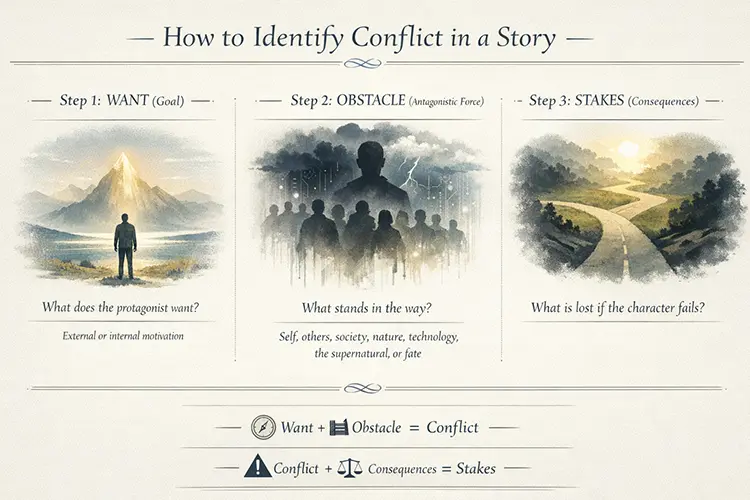
Step 1: Identify the "Want"
You have to find the motivation before you can find the conflict. The plot is driven by motivation, and unless there is a motivating character the story will not move. What is the major goal or desired result of the protagonist?
- External Goal: Physical goals such as the winning of a particular championship, the discovery of a hidden artifact or the escaping of a physical danger.
- Internal Goal: Feelings or mental goals such as the need to discover self-esteem, a long-term loss, or the bravery to protest.
Step 2: Identify the "Obstacle" (The Force of Antagonism)
When the objective is made, find the wall that the character is banging his head against. It is this friction that is produced by this "Force of Antagonism. This is the point where you categorize the struggle under one of the 7 types of conflict in a story depending on the source of the resistance:
- When it is a person: Person vs. Person.
- Whether it is emotion or memory or moral decision: Person vs. Self.
- In case it is a law, societal tradition, or cultural anticipation: Person vs. Society.
- When it is a tempest, a predator, the wilderness harshness: Person vs. Nature.
- In case it is a glitch, rogue AI or a scientific invention: Person vs. Technology.
- When it is a ghost, a monster or something inexplicable in magic: Person vs. Supernatural.
- In case it is an unavoidable destiny or the hands of time: Person vs. Fate.
Step 3: Analyze the "Stakes"
In order to make sure you have identified the primary conflict and not a side-story, you need to assess the stakes. The price of failure is the stakes. When the character is able to get past the obstacle and not lose anything of seriousness, there is no actual conflict. Real conflict is serious and makes the character risk-taking.
The Conflict Formula Explained: How Motivation, Obstacles, and Stakes Drive a Story | The Conflict Formula Motivation + Obstacle = Conflic Conflict + Consequences = Stakes |
Red Flags: How to Tell if it's NOT a Conflict
Action or incident can be readily mixed with conflict. The difference is what is important to decompose a story:
- An Incident: A character falls on the ground. This is just a random event.
- A Conflict: One of the characters stumbles and falls in a race, and this may make him or her a loser. At this point, the fall becomes a hindrance to a particular objective.
- An Argument: Two arguing people screaming at one another. It is usually simply noise or drama.
- A Fight: Two individuals screaming over the remaining seat on the last bus operating out of a disaster area. It has become a conflict of contradictory mutually exclusive ends.
Types of Conflict in Literature: How to Identify Person vs. Person, Society, Nature & More | Look for these Clues... | It is likely... |
| Hesitation, guilt, or the phrase "Should I?" | Person vs. Self |
| A villain, a rival, or a physical confrontation | Person vs. Person |
| Unfair rules, "the system," or being a social outcast | Person vs. Society |
| Extreme weather, animals, or basic survival needs | Person vs. Nature |
| Computers, malfunctions, or advanced AI | Person vs. Tech |
| Magic, spirits, or unexplainable cosmic events | Person vs. Supernatural |
| "It was written," or fighting against a prophecy | Person vs. Fate |
Why Conflict Matters: For Readers & Writers
Conflict is not a mere structural necessity of a story; it is the lifeblood of the story. The absence of it makes a story just a chain of events a day travelogue of a character and not an interesting journey. To have a story that is to be listened to, the conflict should be useful not only to the one who is making it but also to the one who is listening to it.
Why Conflict Matters for the Writer
To the storyteller, conflict is the main device employed in developing and sustaining the structure of the story.
- Plot Progression: The engine is in conflict. Every hurdle the character has to overcome makes him/her act and this becomes the next scene. The plot comes to a standstill without conflict.
- Character Revelation: One does not really know a character until he is pressured. Warfare takes away the mask of a character and reveals to an audience his or her true nature when they are compelled to make tough decisions.
- Thematic Depth: Conflict is the exploration of a theme by the writer. In the event that a writer wants to develop the theme of Justice, he develops a Person vs. Society conflict in which the character has to struggle against an unjust legal system.
- Pacing and Tension: The writer builds up the conflict causing the rising action keeping the reader at their toes to the last climax.
Why Conflict Matters for the Reader
Conflict to the audience is the emotional carrier that takes them through to the fictional world.
- Emotional Involvement: The reader cannot sleep until he or she finishes a book due to the concern about the character. This is what we refer to as suspense and it is purely created by the possibility of the character not resolving his struggle.
- Relatability and Catharsis: Despite the fact that the conflict can be Person vs. Supernatural, a Person vs. Self is what all readers have faced. The emotional release of the character, or catharsis, is achieved through watching a character win.
- Curiosity and Mystery: Dispute generates the Narrative Question. The brain of a reader wants to know how they will get out of the situation being encountered by a character when he/she encounters a challenge. It is this curiosity that a reader can not help but read the book.
- Entertainment Value: On the most fundamental level, conflict gives us the spectacle of car chases, arguments, and the drama to make the stories worth picking up.
Conclusion
Finally, a battle is the necessary tension that makes a series of events a significant story. Realizing the seven kinds of conflict that start with internal mind struggle up to the external conflict with society or fate writers can create resilient characters that are multi-dimensional and are relatable. To the viewers, these struggles are the emotional interest and character development that make a journey worth watching. Conflict control will guarantee that all the achievements are well deserved and all the solutions offer meaningful, fulfilling results.