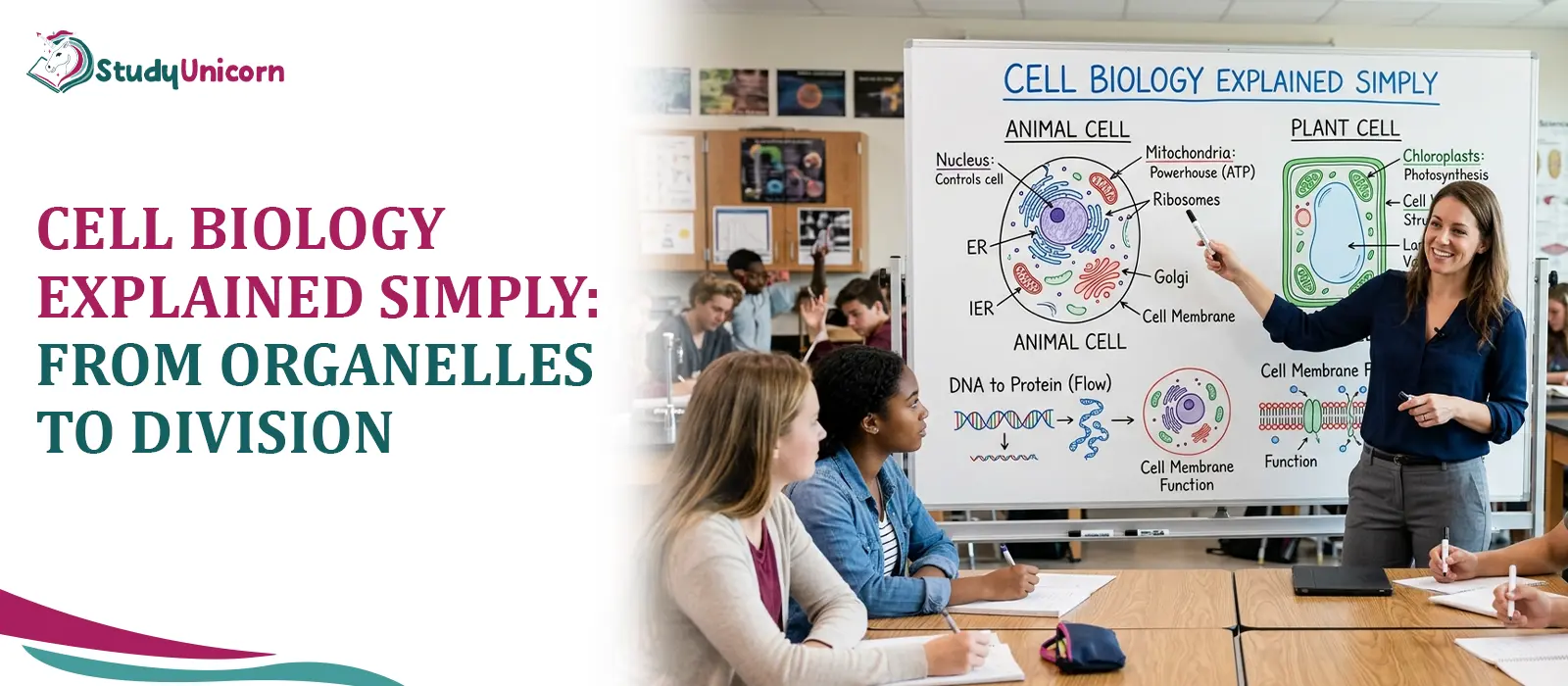
What if the real magic of life was happening somewhere too small to see? Inside each little creature, trillions of itsy-bitsy units called cells work in silence to keep life running smoothly. Here is a sort of road map to the world of cell biology explained, starting with the minute, specialized structures known as organelles that make each cell work, and concluding with an amazing process known as cell division that enables life to grow and regenerate. You will learn about cells as complete entities in details which will allow you to understand their exceptional nature.
The Two Main Cell Types
It is necessary to know that not every cell is created in the same manner before getting into how the cells work. Actually, every life on earth consists of either one of the two basic types of cells, prokaryotic or eukaryotic cells. These two forms vary significantly in design, complexity and functions within the living world.
Prokaryotic vs. Eukaryotic Cells
Suppose two architects were assigned the same task which was to build a living unit, only to have entirely different blueprints. The distinction between prokaryotic cells and eukaryotic cells exists. One system operates with minimal requirements while the other system creates an entire elaborate operational system. A comparison of their side by side in terms of exploration of their cell structure and function will help one realize the extent to which life is so beautifully adapted at the smallest scale.
Prokaryotic vs. Eukaryotic Cells: Structure and Function Comparison | Feature | Prokaryotic Cell | Eukaryotic Cell |
| Nucleus | Absent | Present |
| Cell Size | Small (1–10 micrometers) | Larger (10–100 micrometers) |
| Complexity | Simple | Complex |
| Organelles | No membrane-bound organelles | Contains membrane-bound organelles |
| DNA Arrangement | Circular, floating in cytoplasm | Linear, enclosed in the nucleus |
| Cell Division | Binary fission | Mitosis or Meiosis |
| Examples | Bacteria, Archaea | Plants, Animals, Fungi, Humans |
Want to improve your practical writing skills? Check out our detailed guide on how to write a biology lab report with examples .
Cell Organelles and Their Functions
A cell is not a shapeless mass of life, and there is no more vital of the cell biology basics a beginner should understand than that a cell is not a shapeless mass of life. Instead, it is an extremely well-coordinated system where every minute structure performs a certain task. Take away a single part, and the whole business is affected. Sound familiar? The reason is that cells are like a factory that runs efficiently.
The Cell Factory Analogy
Imagine a big and busy factory. The management office issues commands, workers assemble products, a power room, creating energy, a delivery system, moving goods, a security gate, who enters and who leaves. Now reduce all that to a size less than the eye of the naked eye, and you have a cell.
Each organelle within a cell operates with the same degree of necessity as every department functions inside a factory. The analogy shows its value because it transforms complex biological systems into understandable elements that people can easily understand. The entire system operates according to its design because every element exists for a specific reason. The combination of these elements sustains both the cell and all living things in continuous movement.
Cell Organelles Explained Through a Factory Analogy | Organelle | Function in the Cell | Factory Analogy Role |
| Nucleus | Controls cell activities and stores DNA | The Management Office that issues all orders and holds the master plan, ensuring every department operates with purpose and direction. |
| Mitochondria | Produces energy (ATP) for the cell | The Power Plant that generates the energy needed to keep every corner of the factory running without interruption. |
| Ribosomes | Builds proteins essential for cell function | The Assembly Line Workers who manufacture the factory's core products, tirelessly building proteins that the entire operation depends on. |
| Endoplasmic Reticulum | Transports proteins and lipids within the cell | The Internal Highway that moves essential materials smoothly between departments, ensuring nothing gets delayed or misdirected. |
| Golgi Apparatus | Packages and ships proteins to their destination | The Shipping and Packaging Department that carefully prepares finished products and sends them out precisely where they need to go. |
| Cell Membrane | Controls what enters and exits the cell | The Security Gate that monitors and manages all incoming and outgoing traffic, protecting the factory from anything that does not belong. |
Part 3 – Cell Membrane and Transport
All cells require a boundary, something that starts, ends and most importantly what is to be brought indoors. The cell membrane transport does just that. However, instead of being a dull and inanimate wall, this is one of the most active and intelligent constructions in the whole of biology.
The Fluid Mosaic Model
The cell membrane is a complex concept that requires scientists to adopt an idea, the Fluid Mosaic Model, and the name is the answer to the question. The membrane consists of a layer of two membranes of molecules known as phospholipids, which are constructed in the shape of a small lollipop with a water-loving head and two water-fearing tails. These molecules form a sheet of molecules back to back in opposite directions forming what is called the phospholipid bilayer. This bilayer forms a self-sealing, flexible barrier about the cell.
Now, why "fluid"? The membrane is not fixed or rigid. The phospholipids are in constant movement, change and flow with each other- just like people slowly floating in a slow flowing crowd. This flexibility enables the cell to adapt its shape, develop and react to the surroundings.
And why "mosaic"? Since this fluid layer is scattered with a rich assortment of proteins, cholesterol molecules and carbohydrate chains - all embedded or attached in various positions, similar to the tiles of a mosaic piece of artwork. There are proteins that are doorways, proteins that are identity tags and proteins that are messengers that get external signals to the cell. This protein-covered, mosaic-like structure combined with this fluid makes one of the most advanced gatekeeping systems in nature - allowing certain substances to enter and not letting others in.
Concepts like diffusion, osmosis, and active transport often require deeper understanding and practice. If you need extra support, this biology homework help resource can help simplify these topics.
How Substances Cross the Membrane
Not everything passes through the cell membrane. The materials are moved in and out in a number of processes that are carefully controlled some of which do require energy, others do not require any energy at all. The importance of knowing these modes of transport is to realize the exact way a cell can control its internal environment.
Cell Membrane Transport Mechanisms: Diffusion, Osmosis, and Active Transport | Transport Type | Energy Required | Direction of Movement | Description | Example |
| Diffusion | No | High → Low concentration | Molecules spread naturally from an area of higher concentration to lower concentration until balanced. | Oxygen entering a cell during respiration |
| Facilitated Diffusion | No | High → Low concentration | Molecules that cannot cross freely use special protein channels as doorways to move across the membrane. | Glucose entering cells through carrier proteins |
| Active Transport | Yes | Low → High concentration | The cell uses energy (ATP) to push molecules against their natural flow — from low to high concentration. | Sodium-potassium pump in nerve cells |
| Osmosis | No | High → Low concentration (water) | The movement of water molecules specifically across a semi-permeable membrane from an area of high water concentration to low. | Water moving into plant root cells from the soil |
Key Analogy: The cell membrane functions as a security system which permits certain substances to enter while requiring specific protein keys for other substances to pass through and it uses active transport to move substances into the cell against their natural flow while water enters through specialized channels. The guard never leaves and neither does the membrane.
Part 4 – Cell Division: Mitosis and Meiosis
Cell division enables living organisms to grow through its role in tissue repair and their ability to reproduce. In this section, mitosis explained simply demonstrates how the same body cells are produced to grow and repair, and meiosis produces sex cells that are genetically varied. Both are crucial processes, guaranteeing the continuation of life and the effective operation of all the living beings.
Mitosis – Making Body Cells
Mitosis is the process which is used by your body in order to create new body (somatic) cells, which are exactly the same as the original cell.
Purpose: To grow, repair, and replace body cells - to keep your tissues healthy and functioning.
Outcome: 2 daughter cells that are equal in number and each containing the same number of chromosomes as the parent cell.
How Mitosis Happens (A Simple Flow)
Mitosis is a process that involves a step by step transformation of one cell into two identical cells.
Interphase — The Preparation Stage
The cell becomes larger and replicates all its DNA before it divides. Imagine it as a case of completing all homework before the real test. The cell is occupied, though that may not seem the case.
Prophase — Chromosomes Appear
The replicated DNA strands become taut and twist into apparent X-shaped things known as chromosomes. The cellular control center which is called the nucleus begins to break down while the cell division machinery starts to form.
Metaphase — Lining Up In The Middle
The chromosomes are all arranged in a perfect row along the middle of the cell -soldiers in a line. This will make sure that all the chromosomes will be drawn to position in the subsequent step.
Anaphase — Pulling Apart
The chromosomes are dragged away at opposite ends half to one end of the cell and half to the other end. Each side now has a complete set of genetic instructions. The cell begins to stretch and become elongated.
Telophase — Two New Nuclei Form
Each set of chromosomes forms a new nuclear membrane. The chromosomes unwind and unfurl. The cell now contains two distinct nuclei -one to each prospective daughter cell. Separatism is almost total.
Meiosis – Making Gametes (Sex Cells)
Meiosis is a special kind of cell division which is used to produce sex cells such as sperms and ova. In contrast to the normal division of cells, it gives rise to cells that are distinct and have half of the normal quantity of genetic material.
Purpose: Sex cells that are required in sexual reproduction are produced during meiosis: sperm and eggs. It guarantees that the offspring have a combination of genetic information of both parents and this facilitates diversity.
Outcome: The process of meiosis produces 4 daughter cells which contain half the chromosomes of their parent cell. The cells function as gametes which include both sperm and egg cells that await the process of fertilization.
Key Event (What Makes Meiosis Unique):
Crossing Over: DNA pieces are exchanged among chromosomes.
This brings about genetic variation, and therefore every cell is different.
How Meiosis is Different from Mitosis:
- Meiosis yields 4 different cells whereas mitosis yields 2 similar cells
- Meiosis cuts the number of chromosomes in half; mitosis maintains it unchanged
- Meiosis creates variation; mitosis produces exact copies
This is significant as it brings variety to the living organisms and aids in ensuring the proper number of chromosomes per generation.
Part 5 – Cellular Respiration (Energy)
Your cell phone should be charged. So does your body in some other way. Each movement that you make, each thought that you have, each beat of your heart needs some energy. The process that your cells go through to produce energy is known as cellular respiration and it breaks down the food you consume. In its absence, life just ceases.
What is Cellular Respiration?
Cellular respiration refers to the reaction whereby cells generate energy required to perform their activities. In this process, the cells absorb glucose (form of sugar) and oxygen and break them down in a series of reactions. The process results in energy release which gets stored within a molecule called ATP because this molecule serves as the cellular energy currency that powers all cellular functions.
Cellular Respiration Equation (Simple Form)
Glucose + Oxygen → Carbon Dioxide + Water + Energy (ATP)
Stages of Cellular Respiration (Step-by-Step)
There are three major stages of cellular respiration, each having a definite purpose:
- Glycolysis (Cytoplasm – outside the mitochondria)
The process of splitting sugar is called glycolysis. A single molecule of glucose is divided into half within the fluid of the cell (the cytoplasm). Oxygen not required here.
Glycolysis Overview: Inputs and Outputs in Cellular Respiration | Input | Output |
| 1 glucose molecule | 2 ATP + 2 pyruvate molecules |
- Krebs Cycle (Mitochondria – inside the cell’s “powerhouse”)
Pyruvate produced in glycolysis gets into the mitochondria - the powerhouse of the cell. Here, it is further subdivided in a cyclic manner (a loop). The release of energy carriers is triggered by each cycle in the process of powering the next step.
Krebs Cycle Explained: Inputs, Outputs, and Energy Production | Input | Output |
| 2 pyruvate (from glycolysis) | 2 ATP + CO? + energy carriers (NADH) |
- Electron Transport Chain (Mitochondria)
Here the bulk of the energy is generated. The Krebs Cycle energy carriers transfer their electrons down a series of proteins, as in a relay race. This process causes the movement of hydrogen ions across a membrane and this stimulates the generation of large volumes of ATP. Oxygen is the last electron acceptor - this is why we need oxygen to breathe.
Electron Transport Chain: Final Stage of ATP Production | Input | Output |
| NADH carriers + oxygen | ~34 ATP + water |
Quick Flow to Remember:
Glucose → Glycolysis → Krebs Cycle → Electron Transport Chain → ATP (Energy)
Anaerobic Alternative (Without Oxygen)
There are times when oxygen is insufficient - such as when you are running very fast or in a piece of yeast forming bread. When that occurs, the cells revert to a backup strategy referred to as fermentation. It is less effective (just 2 ATP are generated), yet it maintains the functioning of the cell.
Anaerobic Respiration: Fermentation in Muscles and Yeast | In your muscles | In yeast cells |
| Glucose → lactic acid + 2 ATP. That burning feeling during a hard workout? That's lactic acid building up. | Glucose → ethanol + CO? + 2 ATP. This is how bread rises and how beer and wine are made. |
Examples:
- Muscle cells: When a person is working vigorously, the energy is produced without sufficient oxygen, which causes fatigue.
- Yeast cells: They are utilized in brewing and baking, and they ferment sugar in the absence of oxygen.
This option assists cells to continue their functioning within brief durations, however it is far less effective compared to the usual cellular respiration.
Quick Study Guide – Cell Biology at a Glance
This is a fast revision guide that will remind you of the most significant aspects of cell biology in a simple easy-to-scan format. Just in Time revision: good before exams.
Cell Biology Quick Revision Table: Organelles, Functions, and Analogies | Organelle | Function (Simple Explanation) | Analogy (Real-Life Comparison) |
| Nucleus | Controls the cell and stores DNA (instructions) | The control room or brain of a factory |
| Mitochondria | Produces energy (ATP) for the cell | The power station of the factory |
| Ribosomes | Make proteins needed for cell functions | The factory workers building products |
| Endoplasmic Reticulum (ER) | Transports materials inside the cell | The transport network or conveyor belts |
| Golgi Apparatus | Packages and sends proteins to the right place | The post office or shipping center |
| Cell Membrane | Controls what enters and leaves the cell | The security gate of the factory |
Conclsuion
The protective cell membrane and the energy-making mitochondria and all other cell components serve specific purposes. The cell functions through organelle collaboration and material movement by transport systems and cell division for body growth and repair and through cellular respiration which provides energy to the cell. The complete set of processes enables life to exist through the operation of individual cells.v