First impressions in the written works are similar to those in the real world because they influence the reader to remain or leave. The lines of the first paragraph predetermine the rest, regardless of whether it is an essay, a blog post, or a story. It is not only a good introduction to a topic, but it also builds curiosity and emotion, which attracts the reader into the topic. Hook sentences come in at that. A proper hook is the handshake between the writer and the reader and it will tell that the following is worth reading.
This manual is created to demonstrate how to perfect that first moment. Rather than abstract theory, you will be confronted with actual hook sentence examples based in the real-world context of writing, whether it is an academic essay or a creative retelling or digital-based content. You will get to know how to use hooks to suit your purpose, audience, and tone without falling into the traps of most pitfalls that undermine first impressions. You will have a collection of sure-footed, no-brainers to make any composition you are doing immediately more interesting.
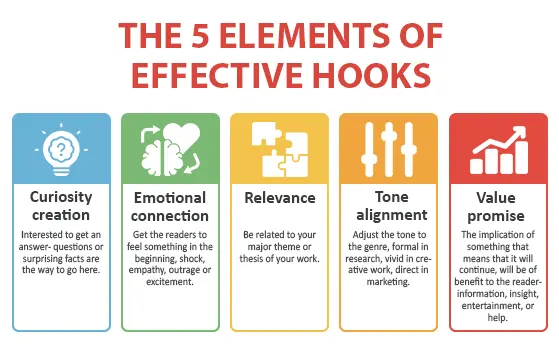
What Makes a Great Hook Sentence?
A fantastic hook sentence catches the interest of the reader at once and it acts as a pointer to the content that is to come. It is more about the intentional, but not the accidental, matching of interest, relevance, and value, rather than merely what you say. Blogs like First Week of School Memes, Cool Poem Titles and Good Luck Wishes can be a helping hand. Learn with hook sentence examples and give a perfect start.
Common Hook Mistakes to Avoid
- Overused classics: The expressions such as since the dawn of time are hackneyed and devoid of originality and therefore the text appears a lot more predictable and therefore a lot less exciting. A new language is more appropriate to draw the attention of the readers and create a better connection with the subject.
- Misleading or irrelevant openers: When someone begins with a piece of information that is not related to the main point or argument, the readers get lost. A good introduction must state explicitly what the article is going to be about, and this will make the readers interested in the article and this will give them a guide of what will be discussed.
- Tone mismatch: When writing on a casual level, it is not credible or professional. It is also important to use a proper degree of formality in order to demonstrate respect for the topic of discussion and to the expectations of the audience.
- Weak generalization: Statements such as technology is changing the world are too broad and do not have any depth and inhibit the process of persuasive writing. Good arguments must have concrete illustrations and subtle details to support arguments and appeal to readers in a more significant way.
Comparison
- Weak: The pollution is bad for the environment.
- Better: "With every inhalation of air in a large city, you inhale 20 times the number of toxins your grandparents inhaled in their lifetime.
The second hook sentence examples is shocking and brings down the issue in specifics.
The 8 Major Hook Types with Annotated Examples
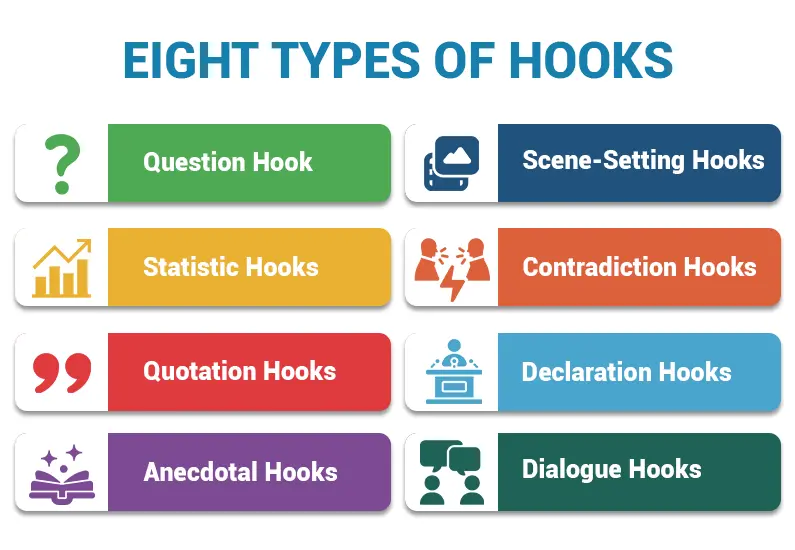
1. Question Hooks
- The invitation of the readers to an investigation arouses interest and involvement.
- Why it works: The questions prompt the reader to respond mentally to the question, and this is an instant way to engage the reader in the conversation.
- Annotation Key: Determine the framing of the question, personal connection, and connection to the topic.
Examples:
- What would happen to your biggest fear? -to save your life? (Introduces a paradox and emotional conflict.)
- Why would there be a success and failure gap between people of the same talent? (Provokes self-reflection.)
- In the question "Can honesty live in a world of filters?" (Social commentary spark.)
- Would you dare to tell the truth to get fired? (The hook sentence examples show the Ethical tension.)
- How much would you give to secure your privacy on the Internet? They must be relevant to digital conversations. They have to be applicable to digital conversations.
2. Statistic Hooks
- Uses unexpected information to bring out authority and shock readers into attention.
- Why it works: Numbers establish gravity and urgency, and demonstrate that your assertion has some backing by reality.
- Annotation Key: Assess the credibility of the data source, the level of impact, and its relationship with the content.
Examples:
- According to the statistics, more than 60 percent of adolescents claim they are more stressed than adults were twenty years ago. (Shows a generational shift.)
- About 8 million tons of plastic find their way to our oceans every year- it is the size of adding one garbage truck every minute. (Visual impact.)
- One of the studies has discovered that 3 of 4 individuals drop online courses in the middle. (Reaches learning audiences via the Internet).
- People in America devote 7 hours a day in front of the screen. (Relatable lifestyle data.)
- Only 2 percent of authors complete the books they write. (Context of motivational writing).
3. Quotation Hooks
- The introduction of strong voices gives authority or thematic echo.
- Why it works: The familiar voices relate immediately to communal meaning or trustworthiness.
- Annotation Key: Evaluate the relevance of the quotation, the authority of the author, and the enrichment of the theme.
Examples:
- It has been said by Albert Einstein once, that imagination is more important than knowledge. That is the basis of any great story.
- As a threat to justice everywhere, injustice anywhere. The warning issued by Dr. King reverberates in the contemporary world demonstrations.
- Here is the quote that Mandela wrote in his life: "The greatest glory in living is not never to fall, it is to rise whenever we fall, and it is the meaning of resilience.
- "Should art comfort the afflicted and afflict the comfortable. That is what the contemporary film has the guts to do.
- '"You are what you do over and over again.' The maxim of Aristotle summarizes the fact that success is characterized by habits.
4. Anecdotal Hooks
- Micro-stories or intimate experiences appeal to compassion and sympathy.
- Why it works: Folks connect with stories- they visualize and commit to them emotionally.
- Annotation Key: Evaluate the tone of the story, emotion, and focus on the topic.
Examples:
- It was when I lost my first job that I felt that I had been characterized by failure only to find out that it was the start of everything great I had created.
- In the bookstore the old man stared at me and declared, You are not picking the books, the books are picking you. That is the sentence that altered my career.
- It started with some money, no friends, and a dream that scared me and it was my first day abroad.
- When I was a child, I wondered why the sky changes its colors. The issue inspired me to join environmental science.
- Last year, I saw a stranger giving his winter coat to a person who was freezing. The 10-second experience changed the definition of generosity to me.
5. Scene-Setting Hooks
- Creates a very graphic, descriptive impression that would drag readers into a moment.
- Why it works: Sharp imagery invokes imagination and emotional tone at the very beginning.
- Annotation Key: Sensory use (sight, smell, sound) analysis, mood effect, and emotional involvement.
Examples:
- Snowflakes were snow jewels on the park bench under gray clouds that were dwindling.
- There was the scent of smouldering coffee as the doors of the courtroom opened.
- Thunder rang over the mountains, and men stood silently together.
- The lights flashed neon lights over puddles and the city was singing its insomniac ditty.
- Dust went in gold lines in the morning sun when the farmer took his first basket of the crop.
6. Contradiction Hooks
- Shock your readers by acting contrary to expectation or by defying conventions.
- Why it works: Tension between things that are familiar and appear to be contradictory is what makes humans attracted.
- Annotation Key: Observe the questioning of assumptions, evidence preparation, and the following curiosity.
Examples:
- The worst thing that can happen to you is donning success.
- It has been said that silence is sometimes louder than words.
- It was supposed to make us closer together but the internet just made us feel alone.
- Happiness does not lie in seeking happiness but in standing still.
- School was supposed to get me ready to live. It didn't."
7. Declaration Hooks
- Begins with a powerful quote that states a definite opinion or fact.
- Why it works: Concrete conviction is an indication of power and leadership.
- Annotation Key: Test the strength of the statement, the clarity of the position, and the interesting tone.
Examples:
- Climate change is not something that will happen in the future, but it is an ongoing crisis.
- Creativity is not an option anymore in remaining in business; it is a survival requirement.
- Standardized testing is murder to intelligence.
- Technology is not the future of education: empathy is.
- Your comfort zone is your greatest enemy.
8. Dialogue Hooks
- Begin with dialogue to be more immediate and realistic.
- Why it works: The readers get a sense that they are already present in a scene that is already in action.
- Annotation Key: Recognize character dynamic, conflict hint, and tone immediacy using speech.
Examples:
- Handing that to you, you see, you can't possibly be serious. But I was."
- And the archaeologist said, "We were not expected to find anything here, and brushed the dust off.
- "My father said, Go out that door, and not to come back.
- How do you write about something you do not understand, asked the student.
- "Give me one thing, never forget why we came to start. It was the final message she sent.
Context-Specific Hook Examples
The strategies employed by Hooks are needed in various situations of writing. Academic writing is concerned with being clear and bossy, whereas creative writing is concerned with getting submerged and touching the heart. Through such nuances, you are bound to get a hook that fits perfectly well into purpose, audience, and genre.
Academic Writing Hooks
An academic writing hook is an interesting introduction statement or a question that catches the eyes of readers to the topic and makes them curious of the subject matter and therefore, compels them to read more into the text. Go through the examples of hook sentences given below.
Argumentative Essays:
- Is Privacy a right or a privilege in the digital society today?
- Every year, the misinformation propagated by social media is catching up with the truth at a faster rate than the truth.
- School uniforms can be said to foster discipline, though at the expense of individuality.
- The question of whether justice can justify killing is not a question that can have an answer because of the death penalty.
- Why should millions of people be excluded from education being the key to opportunity?
Research Papers:
- Urban air pollution causes the death of 7 million people annually, according to WHO data.
- Quantum computing can soon outperform all the existing encryption techniques.
- Agriculture uses over 80 percent of the freshwater.
- The article is of artificial intelligence systems which now are more capable of detecting the signs of early cancer than the doctors.
- The amount of renewable energy available in the world has been increasing by 45% in the last three years.
Literary Analysis:
- Whether to be or not to be is not the death issue, but the issue of indecisiveness.
- Shakespeare tragedies are not primarily about the destiny; it is all about human imperfections.
- The language in the world of Orwell is not a means of communication: it is control.
- The green color in the Great Gatsby does not represent green envy only; it is a desire that cannot be obtained.
- According to this, Bronte storms are reflections of emotions; nature turns out to be a painful language.
Hook Effectiveness by Essay Type
Best Hook Types by Essay Type: Improve Introductions & Reader Engagement | Essay Type | Best Hook Type | Secondary Type | Tone |
| Argumentative | Question, Contradiction | Statistic | Assertive |
| Expository | Statistic, Declaration | Quotation | Informative |
| Descriptive | Scene-Setting | Anecdote | Imaginative |
| Narrative | Dialogue, Anecdote | Scene-Setting | Reflective |
| Analytical | Quotation, Question | Statistic | Formal |
Creative Writing Hooks
Creative writing hooks are strong first lines or sentences that are used to draw the attention of the readers and attract them to continue reading a story or a narrative. Here are some hook sentence examples for better understanding.
Fiction Openings:
- It was on a day when the sun would not come up.
- Well, it was a secret with the river, so everybody in town knew.
- She smiled at the things she lied about; it was her maddest habit.
- The clocks ceased to tick at the very moment of midnight.
- He did not find that the world remembered him.
Memoir Beginnings:
- I had no intentions of leaving, yet sometimes, it is much more dangerous to stay.
- Growing up was as ashes and violet.
- I found my voice on the day when my mother stopped speaking.
- We invited Grief to our supper table, as a sort of undesired guest.
- I had been dragging silence as my survival.
Poetry Starters:
- Rain will recollect the footsteps that we attempt to forget.
- The city sings a lullaby which the hearts can hear.
- Time is a river; it never seeks permission.
- Names lose their names, but the echo lingers on.
- The night draws up his whispers.
Annotation Focus
- Genre Adequacy: The genres in creative writing must and ought to be categorized in line with the mood and form wanted like thriller, romance, memoir, or poem.
- Reader Engagement: Each instance either creates the feeling of curiosity, feeling, or sensorial involvement, and that is, the reader instantly associates themselves with the image of the author.
Content Marketing Hooks
The content marketing is best in cases where the hooks can serve a need at the moment, evoke emotion, or promise of a direct value. The optimal hooks are based on the platform and the audience; nevertheless, they are linked by one particular feature being clear, compelling, and authentic. Take a look at hook sentence examples given below
Blog Post Openers:
- Your readers make a decision to read your article or not in 3 seconds; make it count.
- This is a simple adjustment which saw our traffic rise by 72% overnight.
- Would you like to work more leads with spending less on advertising?
- The most obvious growth strategy, which is right in the front of most marketers, is ignored.
- When your emails are not converting, it is your hook to blame.
Social Media Hooks:
- Stop scrolling - this one sentence can alter the way you view your career.
- What is the secret of productivity doing less?
- Before you post the next photo, read this.
- You are too comfortable in your comfort zone and it is killing your engagement.
- My content went viral as a result of this 10-second hack.
Email Subject Line Hooks:
- You have left something in your cart (and it is out of date).
- One little thing that will save you 10 hours per week.
- "Want to write like a pro? Start here."
- The next innovative idea of yours is only a single click away.
- You are losing readers, and here is why.
Performance Metrics: What makes these hooks effective
- Personalization: Hooks sound when they appeal to a particular issue or want of the reader.
- Value Promise: They are supposed to provide viable deliverables such as tips, special deals or changes.
- Relevance & Urgency: Timely facts and thought-provoking questions attract users who are in need of fast answers.
- Emotional Trigger: Receiving emotional responses such as curiosity or relief enhances interaction.
The Hook Creation Framework
Hook Creation Framework is a strategic mode of developing interesting information which is able to capture attention. Using emotional appeal, distinctive understanding, and convincing narration, creators could come up with hooks that will be appealing to their audience, stirring curiosity and motivating them to learn more.

Formulas and Templates
Question Formula:
- [Provocative question] + [Hint of relevance]
- Sample: What will happen should technology progress quickly in comparison with our ethics?
Statistic Formula:
- [Surprising data point] + [Implication]
- Sample: "One-third of food worldwide ends up as garbage, even as millions of people are starving. How did plenty become too much of a good thing?
Story Formula:
- [Characters/Situation] + [Conflict hint].
- Sample: Maya left her corporate job without a plan when she was 23, with the assumption that freedom was a risk worth taking.
Interactive Template Exercise:
- Enter in the blanks with your topic keywords:
- What happens to [unforeseen thought] could [good thing]?
- This is because in a world that is [situation], there is one truth: [insight]..
- "Last year, [startling fact]. This year, it got worse."
- Everyone says so, [but contradiction]
Advanced Hook Techniques
Multi-Sentence Hook Combinations
Combine multiple devices for richness. The sentence hooks examples below will show you.
Examples:
- Question + Statistic: How safe are you online? The number of people who share personal data every day is over 80 percent, and they do not even realize it.
- Anecdote + Statement: When my startup failed, I believed that it was over. It did instructed me in all.
- Thought + Response: The unquestioning life is not worth living. But how can we look at it with all this noise?
- Scene + Contradiction: "The people sang in fireworks. But to her, victory was as nothing.
- Dialogue + Declaration: "'You will repent it, she had said. I did not, and nothing like that mattered.
Tone-Matching Hooks
Formal vs Informal:
- Formal: "It has been indicated through research that emotional intelligence is the foundation of good leadership.
- Informal: "Dumbing it down: Leaders that do not read emotions do not outlive their welcome.
Humorous vs Serious:
- Funny: "Silver medal: If procrastination were a sport in the Olympics, I would have won the gold medal, at some point.
- Serious: "Procrastination robs away potential better than failure itself.
Professional vs Conversational:
- Professional: Market churn highlights the importance of diversified portfolios.
- Conversational: The rollercoaster of the stock market once more? Here is the way to avoid getting sick.
Testing and Refining Your Hooks
The Hook Effectiveness Checklist
- Does it instantly grab attention?
- Is it directly relevant to your topic?
- Does it match tone and audience level?
- Is it specific rather than vague?
- Does it spark curiosity or emotion?
- Does it transition logically to your main idea?
- Is it free of clichés or filler phrases?
- Could you make it more concise?
- Does it highlight value or benefit?
- Would you want to keep reading?
Peer Review Guidelines: These guidelines involve specifications and traditions of carrying out effective peer reviews. They also assist in ensuring that the reviewers are helpful in terms of ensuring that their feedback is constructive, they are objective and promote ethics in the review process.
Self-Assessment Questions: These questions will prompt the reviewers to be critical of their assessments. Through evaluation of their answers, they can enhance the quality of reviews and help guarantee that most of their responses are exhaustive and reasonable.
Common Hook Problems and Solutions
Common Hook Problems and Effective Solutions for Strong Essay Introductions | Problem | Why It Fails | Fix |
| Too Generic | No curiosity or value | Add specificity or data |
| Off-Tone | Audience disconnect | Match tone to context |
| Weak Transition | Feels disjointed | Link directly to thesis |
| Overused Cliche | Predictable | Reframe with your voice |
| Overlong Intro | Loses impact | Compress to one or two lines |
Before/After Fix Example
- Before: “Since ancient times, people have dreamed of flying.”
- After: “Two brothers watching birds changed the fate of transportation forever.”
Practice Exercises and Resources
Prompt Exercises:
- Write a question hook for a debate about climate policy.
- Turn your morning routine into a one-line anecdotal hook.
- Write a statistic hook about digital learning.
- Create a declaration hook about creativity.
- Combine a quote and contradiction for one topic.
Hook Inspiration Sources and Databases
- Writing blogs and style guides: The educational YouTube channels provide curated hooks examples and writing tips.
- Academic writing centers: University writing labs often share hook sentence examples for essays and research papers.
- Social media and marketing campaigns: Scroll-stopping headlines and subject lines demonstrate hooks in commercial contexts.
Further Reading and Advanced Techniques
- Read On Writing by Stephen Hawking as a source with techniques of narrative hook and They Say / I Say about the openings of an academic argument.
- Study of the interaction with readers and cognitive psychology: study what are the best kinds of hooks to use to get attention.
- Discover the way to use multi-sentence and hybrid hooks to appeal to the hearts and minds more strongly.
- Adapt tone to suit hooks to a certain audience and type of content.
- Examine case studies of the viral blog posts and speeches when implementing the hook practically.
Further learning will help you perfect your skills in crafting hooks that cut across audiences and mediums.
Conclusion
It takes art and strategy, a combination of empathy, timing and precision to make great hooks. When you know how to strike the right balance between curiosity and clarity and tension and truth, then you will never have a problem capturing attention once again. It does not matter what you are writing, whether it is essays, stories, or business writing, these sentence hooks examples and outlines can make you captivate the reader from the first line itself.