To be able to juggle school and work in 2026 is not simply about managing the busy schedules anymore; it is about creating a system that highly favors your needs. The skill of knowing how to balance work and school has transformed from simply a time-management trick to a life skill because of the digital interruptions and the technological conveniences like flexible classes and remote work that are in place.
This guide reveals an even more clever and practical way that makes it possible for you to keep being productive without exhausting your energy and, consequently, be both a good student and a good employee at the same time.
The Foundation: Mindset Shifts for Sustainable Balance
Before the arrival of tools, schedules, or productivity hacks, the real balance comes from your thoughts. In 2026, the balancing of schooling and working has to do with doing the necessary with purpose rather than doing more. A firmly established and proper mindset enables one to escape the trap of fatigue, keep being adaptable, and exercise better judgment even when things go wrong.
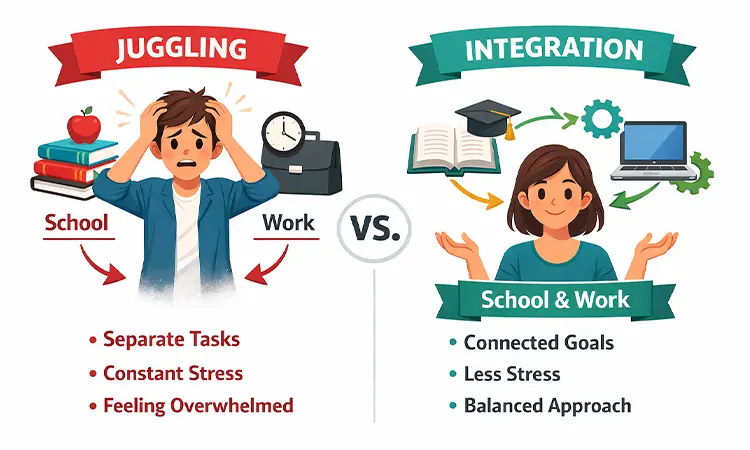
From “Juggling” to “Integrating”
Try to see how to balance school and work in college as two facets of your personal development rather than as two rival roles. The skills you obtain at your employment can be of assistance to your studying, and vice versa, what you learn in school can be a factor in your being better on the job. The merging of the two roles leads to less tension and makes the days feel more in harmony, not disordered.
Key pointers:
- Find the common ground between skills required in a job and academic aspirations.
- Create a joint task schedule instead of separate “mental boxes”.
- Recognize that some days will be more inclined to one side - and this is fine.
Setting Realistic Expectations
There is a risk of burning out rapidly if you set perfection as your goal in both school and work. The key to a green living is setting realistic targets and being aware of your limitations. The primary concern must be with the gradual improvement instead of the final outcome.
Key pointers:
- Be sincere regarding your available time and energy.
- Give priority to tasks that have to be done over those that are nice to do.
- Lower the expectations during exams, deadlines or periods with heavy workload.
Phase 1: The Strategic Planning System (Before the Semester)
You will get a clear road map to follow and will not be caught later by the pressure of the situation during this phase before the semester starts. Knowing in advance how to balance graduate school and work, you set up a balance that turns out to be realistic and sustainable once school and work are taking place in full.
The Master Integration Audit
At this point, you must uncover the actual state of your life—be it the one with a fancy updo or the one that you are already living and closely examining the energy levels to do smart and stress-free planning instead of exhausting yourself with gatherings and meetings.
- Step 1: Quantifying all commitments
Write down all you spend your time on: classes, study, job, commute, and personal commitments. With such knowledge, you may plan your time according to needs. - Step 2: Identifying non-negotiable vs. flexible time blocks
Your schedule change will be made easier if you separate fixed commitments like university classes or work shifts from those that are more flexible, like studying or personal time. - Step 3: Mapping energy patterns to task types
Be conscious about the times when your vitality is at its maximum and also at its minimum. Do the hardest tasks during your energetic period, and plan the easier ones for when you are less energetic.
Download PDF Tool Worksheet: Energy Audit Worksheet
The Semester Negotiation Strategy
When you know what you want, you need to establish early expectations. It does not mean negotiating special treatment, it simply means establishing a clear situation where school and work can easily be a part of your life.
With Employers
Be honest with your school time and schedule. Talk about such possibilities as flexible schedules, modified hours when examinations are being held, or work distance in case possible. Early communication develops a sense of trust and minimises conflicts in the future.
With Academic Institutions
Contact with schedule issues as necessary. This may be choosing the areas that are within your working schedule or seeking small adjustments in case of work pressures.
With Yourself
Make realistic expectations of your capacity. Select a course load that is appropriate to your work hours and energy levels. Incidents of overcommitting at the beginning of the semester usually result in burnout at the end.
Phase 2: The Weekly Management System
If anything falls down, managing school, work, and personal life could become a total disaster. It involves introducing a basic system of management in a week to help you stay in order, eliminate stress, and make time that actually matters.
The Integrated Time-Blocking Method
College students who are working and attending school are transforming time-blocking. It will assist you in making weekly plans visually so that nothing will fall through the cracks.
- Fixed Layer: The fixed layer entails those commitments that cannot be transferred. These are the tasks that are time-bound and should be performed at the appropriate time.
- Flexible Layer: The flexible layer comprises of tasks that are significant and can be altered. These can be rearranged according to other priorities.
- Recovery Layer: The recovery layer is a layer of self-care and rest. It makes you have time to rejuvenate and create balance during the week.
Color-Coding Strategy
Color-coding is a system where various colors are used to denote various kinds of work or spheres of your life. It can assist you in seeing your timetable clearly and at a glance how your time is allocated.
Tool Recommendation
- Google Calendar
- Notion
- Trello
The Priority Quadrant for Working Students
The urgency or importance of everything is not the same. The Priority Quadrant makes you prioritize what is important.
Time Priority Framework for Working Students | Priority Level | Examples | How to Approach |
| Urgent & Important | Exams, work deadlines | Do these first—high focus, no delays. |
| Important but Not Urgent | Long-term projects, career networking | Schedule regular blocks—these improve your future. |
| Urgent but Not Important | Some meetings, emails | Try to delegate or limit these. |
| Neither Urgent nor Important | Social media, unnecessary perfectionism | Minimize or avoid—these waste energy. |
Communication Frameworks for Both Worlds
The connection that joins the different areas is communication, which leads to success not only in a professional setting but also in an educational one. Communication being the connecting thread, the outcome is common in both environments to build up communication that is effective, respectful, and strong. Know more below:
Managing Up at Work
Your communication with your boss or supervisor is more than just refreshing their memory; it also includes building trust and being forward-looking.
- Know What Matters to Them: Be aware of your manager's priorities and tailor your manager's shares according to what they deem important.
- Communicate Updates: Be open and to the point. Give updates on advances, successes, and possible issues so that they are informed.
- Give Solutions, Not Problems: If you happen to get stuck in a tight spot, suggest some possible solutions. This is responsible and proactive thinking.
Professional Communication Scripts for Working Students | Scenario | Script Template |
| Employer Schedule Share | Hi Sir/Ma'am, Here's my class schedule for the semester. I'm available [times] and happy to swap shifts. Let me know how I can help the team. |
| Shift Handoff | Hey [Colleague], Quick handoff: [tasks completed], [pending items checklist]. Confirming [details]. Smooth shift! |
| Feedback Request | "Thanks for the opportunity here. With my studies, I'd value quarterly feedback on my performance to improve." |
Managing Academic Relationships
Developing effective academic relationships is not as simple as just making it into classes, but is all about interacting with professors, advisors, and high school students in a meaningful way.
- Communicate in a Respectful manner: One should always be polite and professional in communication, whether in emails, discussions, or even presentations.
- Request Feedback Proactively: Ask exact questions to get a better understanding of performance and demonstrate that you appreciate advice.
- Collaborate and Contribute: During group work or study sessions, it is important to clarify your part in the work and contribute so that there is further enhancement of trust and cooperation.
Academic Communication Scripts for Working Students | Scenario | Script Template |
| Teacher Check-in | Hi Professor, I'm balancing classes with a part-time job. Let's discuss my progress on [assignment] and any flexible options for deadlines. Thanks for your support. |
| Group Project Update | Team, here's my contribution on [task]. Due to my work shift, I'll review feedback by [date]. Thoughts? |
| Advisor Flexibility Request | Dear Advisor, My work schedule conflicts with [exam/class]. Can we explore options like makeup sessions? Attached is my calendar. |
Efficiency Systems for Each Domain
It is difficult to manage both studies and a job at the same time, but with the proper systems for being efficient, time and energy can be utilized to the maximum. By imitating the approaches in every area, you can remain efficient without experiencing the pressure of work.
Academic Efficiency Tactics
- 90-Minute Study Sprint: Divide your studying into 90-minute focused intervals to keep yourself totally involved and to memorize more.
- Active vs. Passive Learning: If time isn't a constraint, then go for active methods like solving practice questions or teaching for total comprehension and passive methods like going over one's notes when time is limited.
- Assignment Stacking: Merge related activities to maintain mental state and prevent losing energy due to constant changes in types of work.
Download PDF Checklist: Maximize Your Study Efficiency: Self-Assessment
Workplace Efficiency Adaptations
- Commute Utilization: You could listen to audio lectures or do quick reviews of the materials you studied to utilize your commuting time the best way possible.
- Lunch Break Micro-Learning: Utilizing the time during breaks for 10-15 minutes to skim through the main concepts or to take notes is a possibility.
- Work-School Synergy: The skills learned in school can be transferred to work activities, which not only makes the work faster but also creates a stronger understanding of the knowledge.
Example:
A student uses their commute to listen to podcasts made by the instructor, goes through the notes during a very brief lunch break, and creates a linkage between the concepts taught at the school and the reality of their work to both cut down the time taken and make the learning process more durable.
Scenario-Specific Strategies
The universal principles of balance are trusty helpers in any energy-challenging situation; nevertheless, it is still a unique tactical plan that is required for your particular combination of work and school. Choosing your main situation enables you to make the most of your energy and to set the right expectations.
Full-Time Work + Part-Time School
In this situation of how to balance full time work and school, the profession you are in becomes the anchor. “Extreme Batching” is the way to success. Reserve your weekends or two specific weeknights just for studies to eliminate the fatigue caused by daily context-switching.
Tell your boss about your plans for education; often, companies support internal development and may even provide tuition reimbursement or flexible hours for tests. Select a “slow and steady” academic pace to ensure that your professional performance does not suffer while preventing the burnout that comes from overextension.
Part-Time Work + Full-Time School
In this scenario, you consider school your primary occupation. The ideal work for you would be "low-cognitive load" or flexible positions like campus or freelance jobs. Utilize your work time as a short break from the demanding academic rigour.
The risk involved is "academic drift," which means that working long hours takes away time for studying. Keep your most productive morning hours for hard subjects and plan your work shifts at a time when you have the least energy in the afternoon or evening to increase the total daily productivity.
The Adult Learner Scenario
How to balance school and work as an adult? Usually, adult learners juggle work, school, and family duties. Your ace up the sleeve is "Integrated Learning." Seek overlaps, where work-related skills would meet course stipulations, or where school projects could help your company's problems.
Efficiency is the watchword; make use of "dead time" (journeys, lunch breaks) for tiny amounts of learning. Create a "Community Support Contract" with your relatives or roommates to share housework during high-pressure times like finals week or major work audits.
Wellness and Burnout Prevention
By 2026, the highest performers are to use the term "energy management" instead of "time management." Your focus on studying or doing work is sometimes in sync with your biological clock and cognitive load, while at other times it is not.
- Ultradian Rhythms: Do one and a half hours of work followed by a fifteen-minute break. This method is in harmony with your brain's natural concentrations and helps to avoid the condition of "brain fog" that is usually experienced after four hours of uninterrupted studying.
- Strategic Nutrition: Avoid heavy and high-carb meals during your study or work hours as they will first raise and then lower your energy levels via insulin spikes. Rather, opt for "brain foods" like walnuts, berries, and complex grains which will provide a steady supply of glucose to the prefrontal cortex.
- The Sleep Non-Negotiable: During sleep, the brain stores new information from your classes. It is futile to sacrifice sleep for a late-night cram session; you basically "erase" the learning of the day because you do not allow it to be consolidated during REM cycles.
Boundary Protection Strategies
Burnout usually happens when the lines between work and school are not clearly defined, or the stress of schooling affects your leisure time. It is very important to set and keep your limits for the sake of a long-lasting career.
- The "Digital Sunset": At least one hour before going to bed, stop working with emails and school online systems. The blue light and the rise in cortisol levels due to a stressful message can completely ruin your recovery time.
- Physical Transitions: Even if you work or learn at home, create a "commute ritual." Changing your clothes, going for a 10-minute walk, or putting on a specific "study playlist" tell your mind that the first role is over and the next one has started.
- Rejecting the Non-Essential: During the semester, your "social battery" is a limited resource. This is why you should apply the "Essentialist No"—politely declining social invites or extra work projects that do not fit into your main goal for that month.
Technology and Tool Stack
With the right tools, it is considerably easier to manage both the study and the wok. Naturally, you do not need a surplus of tools—just a handful of them to keep you organized, focused, and less worried.
Essential Digital Tools
- Calendar Systems: Google Calendar or Outlook, by the way, are examples of such tools that would show everything classes, shifts, and personal time on one screen. It is easier to plan and prevent conflicts when everything is on one calendar.
- Task Management: You may use applications like Todoist, Trello or Notion to help you capture everything that needs to be done and divide the major undertakings into smaller stages. This way, work and studies will not be so overwhelming.
- Focus Tools: Social media is among the distractions that focus apps like Forest, Freedom, and Cold Turkey help you avoid. They come in handy at times when the clock is ticking, and you have to be fully concentrated.
- Integration Tools: One can use Zapier or IFTTT to connect their apps with each other. Consequently, your tasks and reminders will be updated automatically; thus, you will not only save time but also remain informed about the significant things.
Low-Tech/High-Impact Tools
- Bullet Journal for Working Students: A simple bullet journal facilitates paper planning of your daily activities. You can swiftly list tasks, deadlines, and notes, making it easy to change things when plans change.
- Physical Planning Systems: A notebook, planner, or wall calendar will empower you to visualize your plans. Writing down things might seem more real and, therefore, easier to remember.
- Family Command Centers: A unified calendar or a board at your residence would aid in keeping everyone informed about each other’s activities. It becomes particularly helpful when you have to juggle studies, work, and family duties.
Download PDF Template: Weekly Planning Dashboard
When Systems Fail: Contingency Planning
In the event that your school–work balance system ceases to function, this section outlines the procedures to follow. You will learn how to identify the issue promptly and systematically reset it, instead of feeling guilty or making extra efforts.
Warning Signals of Imbalance
Here are the signs that warn you to take action, and they should be:
- Declining Academic Performance: This is seen when your grades start to drop, you miss deadlines, and it feels really hard to focus on studying.
- Work Performance Signs of Stress: These are the symptoms that you are beginning to err, working at a pace slower than usual, or having a remarkably low level of motivation for your work.
- Physical & Psychological Exhaustion Indicators: These are characterized by the constant feeling of being tired, stress, being easily annoyed, having headaches, and the awareness of being mentally or emotionally drained.
Download PDF Checklist: Routine Reassessment Checklist
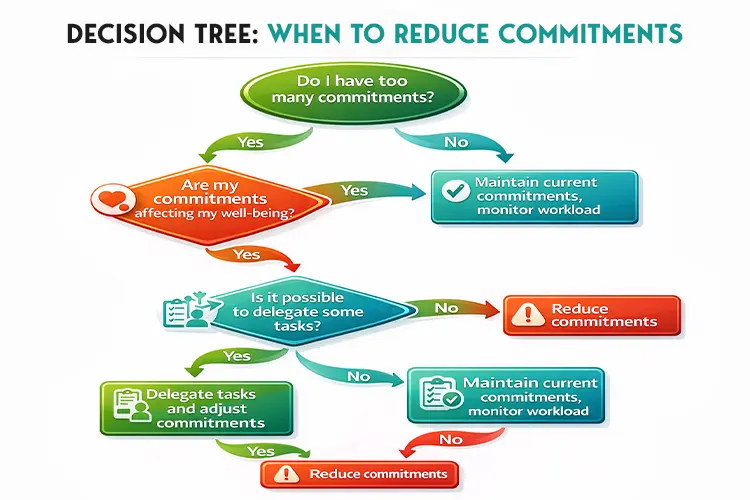
The Reset Protocol
This is a recovery plan to tackle the situation step-by-step when everything is overwhelming:
- Step 1: Priority Triage: Clearly specify what must continue at this moment and, in the meantime, put aside or stop the rest.
- Step 2: Temporary Reduction Strategies: Cut back on the amount of work, make the studying periods shorter, or reduce the intensity to get back the stability.
- Step 3: Support System Activation: Do not hesitate to ask for help - speak with your teachers, bosses, fellow students, relatives, or close friends.
- Step 4: Systematic Rebuilding: After you have regained your strength, reconstruct your timetable and systems in a more realistic, durable way.
Long-Term Success Strategies
It is concerning the mindset of more than just one semester or course. It is the larger view- how to position oneself to be successful academically and in their careers in the long term instead of getting quick fixes.
Semester-to-Semester Optimization
In this case, it is oriented to small improvements at the end of the semester to perfect your strategy.
- Reflect at the End of Each Semester: Look back to see what worked and what did not to know your learning behaviors.
- Adjust Your Approach: Get those strategies that are effective and refine those that are not to achieve improved outcomes.
- Plan for Busy Periods: Be prepared of heavier semesters and plan your time schedule in order to keep pace.
Download PDF Template: Semester Review Worksheet
Career-Academic Integration
It is the relationship between what you study at school and your future job.
- Choose Courses Aligned with Career Goals: Select courses that develop your skills and knowledge that are related to your career of choice and reinforce your academic performance and career preparation.
- Use Academic Projects for Professional Growth: Accept projects and assignments as an opportunity to get some practical experience and create something that can be presented in your portfolio.
- Build a Career-Ready Portfolio: Take your most successful work projects, papers, and presentations to show your accomplishments and prove that you are a professional.
Quick-Reference: Strategy Selector by Situation
It can be hard to juggle how to balance school and work and social life at the same time. Very often, a focused method is more effective than attempting to do everything at once. This manual enables you to swiftly pinpoint your principal problem and offer you a quick action plan together with a method to ensure you’ll be on course.
"If This, Try That" Guide
If This, Try That: School–Work Balance Action Guide | Main Challenge | First Step to Take | Strategy to Use |
| Always feeling short on time | Track your daily tasks | Layer your calendar: fixed, flexible, recovery |
| Feeling drained or overwhelmed | Check your energy levels | Match tasks to your peak energy periods |
| Struggling with work or school expectations | Prepare clear talking points | Set up transparent communication with employers or instructors |
| Falling behind academically | Analyze study habits | Use focused sprints of 90 minutes |
| Personal life suffering | Identify where boundaries are blurred | Schedule dedicated recovery and personal time |
Conclusion
To accomplish a balance between school, work, and personal life, a person needs to plan, be disciplined, and self-aware. With the right goals, prioritization, and the right systems and tools, you can be productive without experiencing burnout. Regular reflection, communication, and energy control can be used to ensure the long-term success and welfare in all aspects of life.