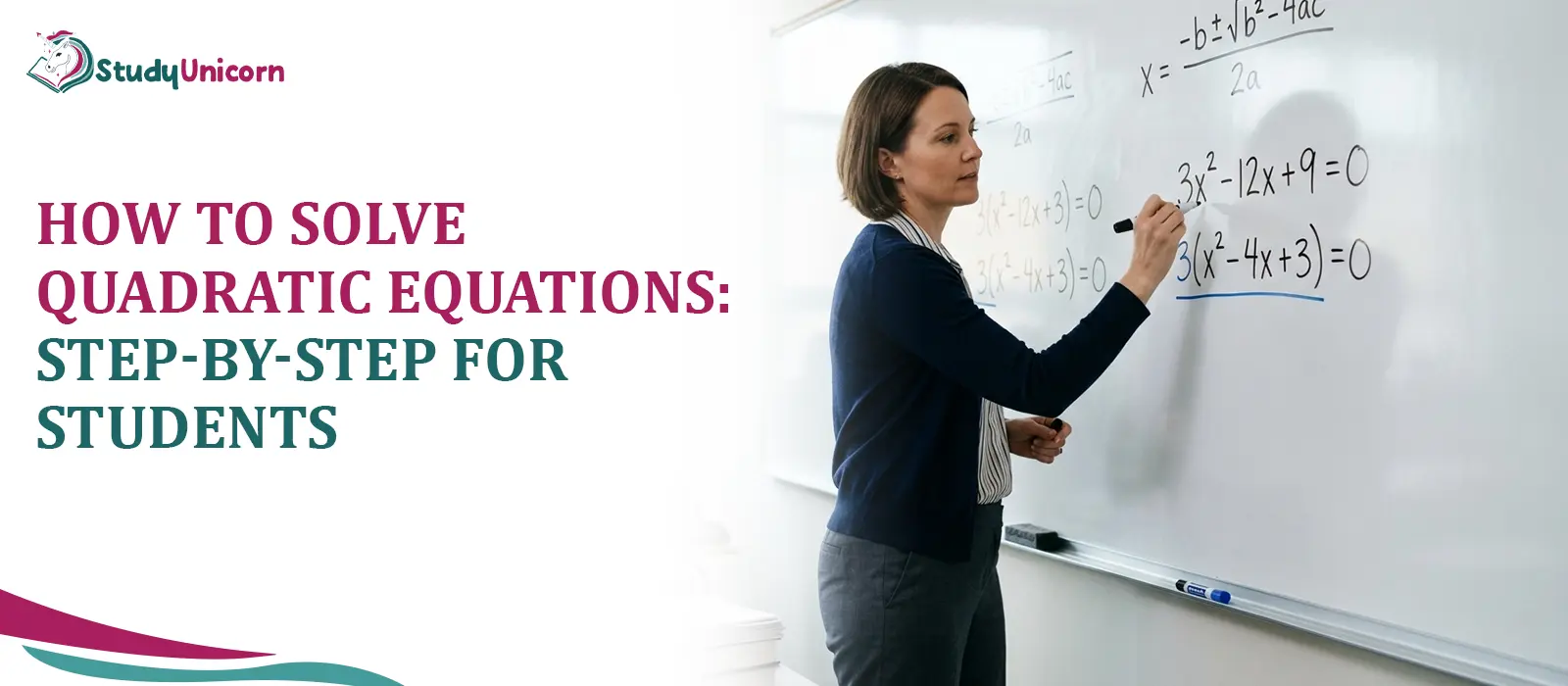
At first, quadratic equations may be daunting to solve but with the right attitude, they are easy to solve. You may be about to take exams or merely boosting your algebra and it is important to every student to know how to solve quadratic equations step by step. We simplify the process in this guide into simple and easy steps that can be undertaken by anyone, even when math is not your best subject.
Factoring, quadratic formula, and so on, you will acquire practical techniques that will not only boost confidence but also precision. And when you are stuck or time-strapped, you can always use our Math homework help service which will provide you with expert advice and fast-time solutions. Confusion can be transformed into clarity and solving quad equations can be a skill that can be mastered.
What Is a Quadratic Equation?
The Quadratic equation is a type of algebraic equation that can be expressed in ax² + bx + c = 0 form in which a, b, c are in the fixed position and is not equal to 0. The presence of squared term x² makes it a quadratic which means that the maximum power of variable is two.
Why It Matters
Quadratic equations are not merely a school concept but are valuable in academics and in practical use:
- They are useful in solving real life problems like finding distances, areas, and paths of objects.
- Their application is common in such subjects as physics, engineering, and economics.
- Knowledge of quadratics provides a solid base to higher mathematical ideas.
- They enhance critical thinking and problem solving abilities, which are crucial to students.
Key Terminology
It is very important for one to have the knowledge of the below mentioned terms to have the complete understanding of Quadratic equations:
- Coefficients: Shape of equation and solution are determined by a, b, c values in the equation.
- Roots (Solutions): The values of x that leave the equation the same.
- Discriminant: This is the symbol of the equation (b² − 4ac) which is applied to assist in the determination of the type of roots (real, equal or complex).
- Parabola: This curve is the u-shaped and curved curve of a quadratic equation.
Learning the definition of a quadratic equation and the main ideas underlying it, you prepare the groundwork on how to solve quadratic equations with great confidence.
Method 1: Solving by Factoring
Factoring is one of the simplest and quickest methods to solve quadratic equations; when it applies. As opposed to the use of complex formulas, this approach splits the equation into two smaller expressions which when multiplied together will produce the original equation. When factored you easily obtain the values of x by setting the factors to zero. Nonetheless, works only when the quadratic can be conveniently represented as a product of two binomials.
When to Use Factoring
It is not always the correct way to factor, but it can save much time in case the equation satisfies some criteria. Understanding when to use solve by factoring method can make you solve problems in a more efficient way and prevent needless complexity.
- In the cases when it is easy to decompose the quadratic equation into two binomial factors.
- In case the coefficients are simple integers.
- When the expression is known to be equal to zero (ax2 + bx + c = 0).
- To discover two numbers which when multiplied together give c and add up to b you can do in a short time.
Step-by-Step Process
Once we have concluded that factoring quadratics is the right course of action, the second step is to make a well-defined and systematic course of action. The process can be broken down into simple steps which allow solving the equation more easily and efficiently.
- Equation needs to be in standard form which is ax² + bx + c = 0.
- Quadratic equations should be expanded into two binomials.
- Assign all factors to zero.
- Solve simple equations obtained to find values of x.
Example 1: Basic Factoring
Quadratic Equation Solved Using Factoring Method | Solve: x² + 5x + 6 = 0 - Factor the equation: (x + 2)(x + 3) = 0
- Assign all factors to zero:
- x + 2 = 0 → x = -2
- x + 3 = 0 → x = -3
Solution: x = -2, -3 |
Example 2: Difference of Squares
Quadratic Equation Using Difference of Squares | Solve: x² - 9 = 0 - Recognize the pattern: a² - b² = (a - b)(a + b)
- Factor the equation: (x - 3)(x + 3) = 0
- Set each factor to zero:
- x - 3 = 0 → x = 3
- x + 3 = 0 → x = -3
Solution: x = 3, -3 |
Example 3: With Leading Coefficient ≠ 1
Quadratic Equation Using Factor by Grouping | Solve: 2x² + 7x + 3 = 0 - Multiply a × c: 2 × 3 = 6
- Locate two numbers that are multiplied to be 6 and sum to be 7: 6 and 1.
- Rewrite the middle term: 2x² + 6x + x + 3 = 0
- Factor by grouping:
- Factor common binomial: (2x + 1)(x + 3) = 0
- Set each factor to zero:
- 2x + 1 = 0 → x = -1/2
- x + 3 = 0 → x = -3
Solution: x = -1/2, -3 |
Common Factoring Mistakes
Factoring is a easy process but still the slightest error can give the wrong answer. You can increase your accuracy by being aware of the common errors and can also avoid them.
- Leaving out the step of setting the equation to zero prior to factoring.
- Selecting the wrong factors that do not meet the conditions of multiplication and addition.
- Omitting or losing negative signs in factoring.
- Leaving out verification of your solutions by substituting them in the original equation.
Learning to factor you will be able to solve a great number of quadratic equations in a fast and efficient way; and this is why it would be a good first technique to attempt to solve before proceeding to the more complex methods.
Method 2: Completing the Square
The square completion is an effective technique to solve quadratic equations by converting them into a perfect square. Although it might be a bit longer than factoring, it applies to a broader set of equations and also enables us to gain a deeper insight into the structure of quadratics.
When to Use Completing the Square
The square is also helpful in cases where the factoring is challenging or impossible. Being aware of the time when this approach should be used may simplify the process of solving equations.
- The quadratic equation can not be easily factored.
- When you would like a way that would always work with any quadratic equation.
- When one must rewrite the equation in vertex form (useful in graphing).
- In getting ready to derive or comprehend the quadratic formula.
Step-by-Step Process
The use of an explicit sequence of steps is essential in solving the square. This is done by rearranging the equation so as to obtain a perfect square. The completing the square explained below will help you to grasp the knowledge used to solve the equation using this methd:
- Shifts the constant term (c) to other side of the equation.
- If a ≠ 1, divide the entire equation by a.
- Multiply half the coefficient of x, square and add to both sides.
- Represent the left hand side as an ideal trinomial square.
- Simplify the right side.
- Both sides square root.
- Solve for x.
Example 1: Simple Completing the Square
Quadratic Equation Using Completing the Square | Solve: x² + 6x + 5 = 0 - Move constant: x² + 6x = -5
- Take half of 6 → 3, square it → 9
- Add to both sides: x² + 6x + 9 = 4
- Rewrite: (x + 3)² = 4
- Square root: x + 3 = ±2
- Solve:
- x = -3 + 2 = -1
- x = -3 - 2 = -5
Solution: x = -1, -5 |
Example 2: With a ≠ 1
Quadratic Equation (a ≠ 1) Using Completing the Square | Solve: 2x² + 8x + 6 = 0 - Divide by 2: x² + 4x + 3 = 0
- Move constant: x² + 4x = -3
- Half of 4 → 2, square → 4
- Add to both sides: x² + 4x + 4 = 1
- Rewrite: (x + 2)² = 1
- Square root: x + 2 = ±1
- Solve:
- x = -2 + 1 = -1
- x = -2 - 1 = -3
Solution: x = -1, -3 |
Why Students Get Stuck
Despite the fact that completing the square is systematic, there is always a problem when students have missed or misunderstood a step. These are the typical problems that you can identify to prevent confusion.
- Missing the division by a when not equal to 1.
- Errors in making half the coefficient and squaring it.
- Failing to add the same value to both sides of the equation.
- Confusion when taking square roots, especially with the ± sign.
- Omitting steps, which will cause error in the final answer.
This process can be done step by step and in the long run you will realize that completing the square is a lot easier. It is a sure method not only to solve equations but also to gain a deeper understanding of quadratic concepts in general.
Method 3: The Quadratic Formula
One of the surest ways of solving quadratic equations is the quadratic formula. As compared to factoring, it can also be used in all sorts of quadratic equations where the solutions are not simple or real. It might appear somewhat complicated initially, but once you know how to use it in a few steps it will become a potent part of your math toolkit.
When to Use the Quadratic Formula
Quadratic formula is particularly useful where the other methods do not come easily. Being able to know when to resort to this technique can save time and effort.
- Where the equation can not be easily factored.
- When filling in the square seems too long or difficult.
- In the event of complex or irrational roots of the equation.
- You need a sure way of doing things.
The Formula
Before applying this method, one must be in a good position to understand the formula and its elements well. The answer to any quadratic equation is this formula literally:
x = (−b ± √(b² − 4ac)) / 2a
a, b, c are the coefficients in the standard form ax² + bx + c = 0 in such case.
Step-by-Step Process
The Quadratic formula is very simple to apply when a systematic approach is taken by you. Replacing values carefully and step-by-step simplification is accurate.
- Rewrite equation (ax² + bx + c = 0) in standard form.
- Find the values of a, b and c.
- Replacement of these values in the quadratic formula.
- Find the discriminant (b² − 4ac).
- Simplify the square root.
- Solve the positive ( + ) and negative (−) cases.
- Simplify your final answers.
The above mentioned quadratic formula step by step must be used by one for solving the questions correctly.
Example 1: Simple Quadratic Formula
Quadratic Equation Using the Quadratic Formula | Solve: x² − 5x + 6 = 0 - Here: a = 1, b = -5, c = 6
- Substitute into formula:
- Simplify:
- x = [5 ± √1] / 2
- x = (5 ± 1)/2
- Solutions:
Solution: x = 2, 3 |
Example 2: With Complex Roots
Quadratic Equation with Complex Roots Using Formula | Solve: x² + 4x + 5 = 0 - Here: a = 1, b = 4, c = 5
- Substitute into formula:
- x = [-4 ± √(16 − 20)] / 2
- Simplify:
- x = [-4 ± √(-4)] / 2
- x = [-4 ± 2i] / 2
- Solutions:
Solution: x = -2 ± i |
These quadratic equation examples provides you with the clear understanding of how to use the formula effectively.
Understanding the Discriminant
The discriminant is important in ascertaining the character of the roots prior to solving the equation. It will make you quickly grasp the kind of solutions to anticipate.
Discriminant and Nature of Roots in Quadratic Equations | Discriminant (b² − 4ac) | Nature of Roots | Explanation |
| > 0 | Two different real roots. | There are two different real solutions of the equation. |
| = 0 | One real root (repeated) | The two solutions are equal. |
| < 0 | Two complex roots | Solutions involve imaginary numbers. |
Learning quadratic formula will give you a reliable formula which can be used in all circumstances, regardless of how complicated the equation might appear. Through rehearsing, it becomes fast and sure of getting the correct answers each time.
Which Method Should You Use? A Decision Guide
There are many different methods to use, so at times it is difficult to know which method to apply. The correct method to be selected is based on the form of the equation and the ease at which it can be simplified.
Choosing the Right Method to Solve Quadratic Equations | Situation | Best Method to Use | Why It Works Best |
| Equation is easy to factor | Factoring | Quickest and simplest method |
| Is not easily factorable. | Quadratic Formula | Solves equations of any kind. |
| Should know how to set up an equation. | Completing the Square | Helps in rewriting equation and understanding graphs |
| Leading coefficient (a) is not 1 | Quadratic Formula | Avoids extra steps required in factoring |
| Equation has complex or irrational roots | Quadratic Formula | Easy to handle any kind of solutions. |
| Getting ready to learn higher-level math. | Completing the Square | Develops more conceptual knowledge. |
The most correct method for solving the quadratic equation can be identified with the help of this guide. Also you can solve the equations fastely and more confidently.
Real-World Applications of Quadratic Equations
Quadratic equations are not simply just theory formulations, because they are important in addressing real-life issues in various fields. Knowing real-world quadratic equation problems and their functionality will make students have an idea of the usefulness of what they are learning in math.
- Projectile Motion: It is the application of quadratic equations to determine the trajectory of a projectile such as a ball, rocket or arrow. They help in determining the height, distance and the time of movement.
- Engineering and Construction: Engineers use quadratics to develop stable and efficient structures such as bridges, arches and roads.
- Business and Economics: Quadratic equations are used to maximize profits, minimise costs through study of revenue and expense functions.
- Physics Problems: Numerous physics equations, particularly equations about motion and energy, are based on the use of quadratic equations to obtain the correct answer.
- Area Optimization: They are applied to compute areas in geometry, e.g. the area of a design subject to constraints.
- Computer Graphics and Gaming: Quadratics are used to make curves appear smooth and realistic movement in animation and video games.
Relating quadratic equations with real life situation makes the students realize how it is important and make them more motivated to learn and apply it in real life situation.
Common Mistakes and How to Avoid Them
Even the small error can give you the wrong answer when solving the quadratic equation. You can get accurate answers when you are aware of the common mistakes and the ways to avoid them.
Common Mistakes in Solving Quadratic Equations and How to Avoid Them | Common Mistake | How to Avoid It (Fix) |
| Failure to put the equation to zero. | It is always important to first write the equation in standard form (= 0). |
| Incorrect factoring | Check that factors not only multiply to c, but also add to b. |
| Neglecting the ± sign in square roots | It is always best to think of both the good and bad ways out. |
| Errors in calculation of the discriminant. | Calculate carefully b² − 4ac in steps |
| Leaving out the division by 2a in the formula. | Make sure that all the expression is split correctly. |
| Errors in signs (primarily with negatives) | Be observant of indications during the process. |
| Failure to simplify final answers. | Reduce fractions and simplify roots fully |
| Skipping steps | Take one method step at a time to prevent confusion. |
| Not checking answers | Replace solutions in the original equation. |
Remembering these errors and implementing the proposed correction methods, you can be more accurate and confident in your solution of quadratic equations.
Practice Problems with Solutions
You have learned various methods now it is time to put them into practice. Do these questions to deepen your knowledge and become confident in solving quadratic equations.
Practice Problem: Quadratic Equation Using Factoring | Problem 1: Easy (Factoring) Solve: x² + 7x + 10 = 0 Solution: - Factor: (x + 5)(x + 2) = 0
- Assign all factors to zero:
- x + 5 = 0 → x = -5
- x + 2 = 0 → x = -2
Answer: x = -5, -2 |
Practice Problem: Difference of Squares Method | Problem 2: Easy (Difference of Squares) Solve: x² − 16 = 0 Solution: - Factor: (x − 4)(x + 4) = 0
- Solve:
Answer: x = 4, -4 |
Practice Problem: Factoring with Leading Coefficient (a ≠ 1) | Problem 3: Medium (Factoring with a ≠ 1) Solve: 3x² + 11x + 6 = 0 Solution: - Multiply a × c = 18
- Numbers: 9 and 2
- Rewrite: 3x² + 9x + 2x + 6 = 0
- Factor: 3x(x + 3) + 2(x + 3)
- Final: (3x + 2)(x + 3) = 0
- Solve:
- 3x + 2 = 0 → x = -2/3
- x + 3 = 0 → x = -3
Answer: x = -2/3, -3 |
Practice Problem: Completing the Square Method | Problem 4: Medium (Completing the Square) Solve: x² + 4x − 5 = 0 Solution: - Move constant: x² + 4x = 5
- Half of 4 → 2, square → 4
- Add: x² + 4x + 4 = 9
- Rewrite: (x + 2)² = 9
- Square root: x + 2 = ±3
- Solve:
Answer: x = 1, -5 |
Practice Problem: Quadratic Formula Method | Problem 5: Hard (Quadratic Formula) Solve: 2x² − 3x − 2 = 0 Solution: - a = 2, b = -3, c = -2
- Discriminant: (-3)² − 4(2)(-2) = 9 + 16 = 25
- Formula:
- x = [3 ± √25] / 4
- x = (3 ± 5)/4
- Solve:
Answer: x = 2, -1/2 |
Practice Problem: Quadratic Formula with Complex Roots | Problem 6: Challenging (Complex Roots) Solve: x² + 2x + 10 = 0 Solution: - a = 1, b = 2, c = 10
- Discriminant: 4 − 40 = -36
- Formula:
- x = [-2 ± √(-36)] / 2
- x = [-2 ± 6i] / 2
- Solve:
Answer: x = -1 ± 3i |
Training on many different types of problems such as these will allow you to determine what method to apply and get faster and more accurate with time.
Conclusion
Quadratic equations can be difficult to solve without the right techniques and practice but once you have the right techniques and have practiced it is far easier to deal with. You can solve any kind of quadratic equation by learning when to apply the factoring, doing the square or the quadratic formula. All the methods have their beneficial side, and the correct choice will save time and efforts. Always keep in mind not to fall into the pitfalls and train to be more accurate. And when you are in need, we have our Math homework help, that is always available to help you find the right answer.
Still Struggling? Get Personalized Math Homework Help
When quadratic equations continue to seem confusing or time-consuming, you are not alone and you do not have to do it all on your own. In some cases, a small expert advice can be of great help in learning to perceive the concepts and do the assignments in due time.
Our Do My Homework service targets students that need proper and proper support in solving their math problems. Are you bogged down on the factoring, completing the square or the quadratic formula? Our specialists have step-by-step solutions that are simple to follow and study.
StudyUnicorn makes the process of studying easy and stress-free with rapid response time, individualized customer service and a centered environment on quality. Then, when you have deadlines or difficult problems to solve, leave it to our experts, and concentrate on studying and enhancing your abilities.
Downloadable Resources