Let’s confront the reality that staying motivated can be challenging. Be it losing the motivation and the willpower to lose weight, or losing motivation in college studies, there are moments when you feel like there is no path to walk through and achieve your goals. This detailed guide provides you with 25 practical, research-backed strategies to help you regain and retain motivation, whether you are facing the mid-semester slump or just looking for such a system that works well for your college lifestyle.
Understanding College Motivation: Why It Fades and How to Reignite It
The college motivation generally starts with a zeal to achieve the set goal, where the student has to balance school, work, relationships, and a social life, sometimes while raising a family on top of it all! Know that it's normal to feel overwhelmed at times, but it doesn’t have to derail your progress. Furthermore, there are smart tips and tools that you can use to get back on track and restore your focus.
The Unique Challenges of College Motivation
- One of the biggest challenges to face is the transition from a highly structured, highly school-based environment to self-directed learning. In college, the students are expected to manage the assignment deadlines independently, and they also have to take responsibility for breaking down the course material. However, with constant reminders or close supervision, procrastination and the lack of discipline can affect academic performance.
- Yet another major challenge comes from competing priorities. The college students often juggle to keep pace with social life, part-time jobs, personal responsibilities, and an internship. When time and energy are stretched beyond normal, academics may lose priority, fatigue, and it also reduces motivation to stay engaged with the coursework.
- The "mid-semester slump" is yet another common concern. After the initial excitement fades and when the exam dates come close, it happens that the students may feel mentally drained. Like with the repeated assignments, exams, and limited breaks, burnout can affect one’s motivation to look forward.
- The impact of remote/hybrid learning environments on motivation has contributed to reshaping motivation. With the reduced face-to-face interaction, blurred boundaries, and feelings of isolation, there is accountability and engagement, together with these many challenges that the student faces, sustaining motivation in college is uniquely demanding.
Intrinsic vs Extrinsic Motivation (Quick Comparison for Students)
Motivation doesn’t come from just one place. For students, it usually comes from inside themselves or from external rewards like grades or praise. Understanding these two types of motivation can help you study smarter, stay consistent, and avoid burnout.
What Are the Two Types of Motivation?
There are two main types of motivation in students: intrinsic motivation and extrinsic motivation. The key difference lies in whether the drive comes from internal satisfaction or external rewards.
- Intrinsic Motivation: Intrinsic motivation is when students engage in learning because they enjoy it, find it meaningful, or feel personally satisfied by the activity itself.
- Extrinsic Motivation: Extrinsic motivation occurs when students are driven by external rewards or consequences, such as grades, praise, money, or avoiding penalties.
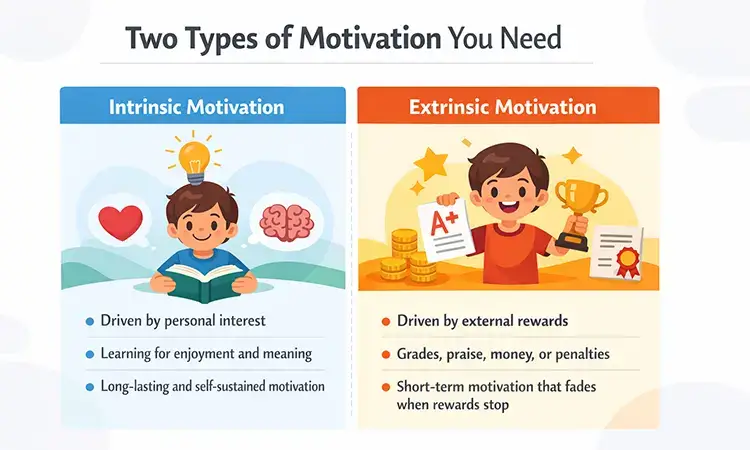
Intrinsic vs Extrinsic Motivation: Key Differences
Intrinsic vs Extrinsic Motivation: Key Differences for Students | Feature | Intrinsic Motivation | Extrinsic Motivation |
| Source | Internal satisfaction and personal interest | External rewards or consequences |
| Student Behavior | Learning for enjoyment or meaning | Learning for grades, praise, or rewards |
| Sustainability | Long-lasting and self-driven | Short-term and reward-dependent |
| Learning Depth | Encourages deep understanding and creativity | Focuses on outcomes rather than mastery |
| Best For | Long-term academic success and lifelong learning | Short-term goals and performance tasks |
Which Type of Motivation Is Better for Students?
Intrinsic motivation is more sustainable and effective for long-term learning, while extrinsic motivation works best for short-term goals, deadlines, and performance-based tasks.
The Foundation: Building Systems That Support Motivation
In the beginning, well, it can be difficult enough to make the lasting changes that can support ‘motivation’. You might be productive for a couple of days, but then you might start procrastinating when the motivation wears off. You may set a target to achieve, only to slip it aside a month later, isn’t it? Now, to prevent this from happening, one has to build a foundation for self-improvement. In other words, just as one must set a level foundation before building a house, one must set a level foundation before taking on larger self-improvement goal is the right thing to do.
Strategy 1-3: Academic Infrastructure
- The Semester Blueprint System: One of the effective approaches here is the Semester Blueprint System. Here, it involves mapping the complete semester at a glance by listing the important dates like the exams, presentations, project deadlines, and personal commitments as well. Seeing the complete timeline organised reduces the anxiety and prevents last-minute stress of completing certain assignments, and it can also help the students to plan ahead with clarity and complete control.
- The "Power Hour" Routine: Starting each day with focused momentum is considered another powerful strategy. This practice involves dedicating the first hour of each study day to focus on academic work. As with this one, it has zero distractions, and the students work on their most important or challenging tasks. Starting the day with progress helps to build momentum and creates a sense of accomplishment that gets carried forward into the rest of the day.
- Environmental Design: Creating study spaces that cue motivation is the ideal thing to do by creating a dedicated study space with good lighting, minimal distractions, and an organised materials space to focus. Simple cues like the comfortable chair, a clean desk, or a consistent study spot can improve concentration and discipline.
Actionable Template: Weekly planning worksheet structure
Strategy 4-6: Goal Architecture
- Micro-Goal Stacking: With a strong goal architecture, you know that it helps to transform the overwhelming academic demands into a much motivating action. One of the most effective ways in this framework is Micro-Goal Stacking. So, instead of viewing a large project such as a research paper or exam preparations as a single task, it's broken into small tasks, which convert into daily goals.
- Progress Visualization: Here, the second pillar is the Progress Visualization, which focuses on making the effort visible. Using the many tools, like checklists, progress bars, or even digital tools, can help the students to see how far they’ve come or that they are still at the same spot. Visual cues here reinforce consistency that provides ultimate motivation during the slow periods, and shift attention from how much remains to what has already been accomplished.
- The "Why" Reinforcement: Last but not least, this strengthens the motivation at a deeper level. Also, when the goal feels disconnected from personal meaning, the motivation here fades quickly. By being able to connect regularly with one’s purpose, whether it's career aspirations, financial independence, or just making a difference, it adds more emotional quotient to the daily effort of studying. So by writing a short “why statement”, you can revisit the long-term visions, or reflect upon it on a weekly basis, on how current tasks can support the future goals to maintain the resilience and clarity hereafter.
Tip: Together, these strategies create a balanced, sustainable system for long-term academic motivation.
Daily and Weekly Motivation Practices
Both daily and weekly motivation practices help to maintain the many focuses and the consistency in academic life. Here, simply the daily habits like setting clear priorities, starting with a study session, and then celebrating the small wins build momentum. With the weekly practices such as reviewing the progress, reflecting on the many challenges that are provided with a focused study session, and then celebrating the small achievements that build momentum.
Strategy 7-10: Daily Rituals
- Morning Intention Setting: One of the powerful habits is Morning Intention Setting, a simple five-minute ritual that sets the tone for the day. By identifying one academic priority, as one personal intention, and one self-care focus, the students here begin the day with clarity and purpose.
- Energy Management: Aligning work accordingly to the essential ritual. Rather than compelling productivity around the clock, students may coordinate challenging tasks with their inherent energy rhythms. For instance, it’s optimal to plan for demanding cognitive work like studying or writing during your energy peaks, whereas less taxing activities like sending emails or organizing notes can be done when your energy levels are lower. By collaborating with the body’s rhythms, one can boost efficiency and lower burnout rates.
- The Pomodoro Adaptation: Modified for college attention spans, this adaptation enables the students to engage more deeply when there is complex material, while still working on the mental fatigue. It's perfect for a college attention span, which focuses on being flexible. So, rather than the rigid 25-minute sessions, the students can use the 30-45-minute focus blocks that can be followed by intentional breaks to calm the mind. These many steps help protect mental boundaries, improve focus, and support balance throughout the day.
- Transition Rituals: Shifting between roles (student, friend, employee). With simple actions like changing clothes, going for a short walk, or doing breathing exercises, all these help to signal the brain to reset.
Strategy 11-14: Weekly Systems
- Sunday Reset Routine: Preparing for the week ahead supports the motivation beyond the daily efforts. Here, one of the most effective is the ‘Sunday Reset Routine, which helps the students both mentally and practically study materials, plan meals, and set weekly appointments. By starting the week organised, it reduces the stress and also increases the self-motivation of the student.
- Reward Scheduling: Building in meaningful breaks and treats, instead of completely depending upon the ‘will power’ alone, the students here have to plan reasonable rewards. The many rewards which are mentioned here could be a social outing, a favorite snack time or downtime for hobbies. Keep in mind that when the ‘breaks’ are scheduled, productivity becomes purposeful rather than exhausting.
- Accountability Partnerships: Beyond just study groups, you should be open to casual study groups. A strong partner makes sure that he/she is accountable enough to track the progress, and also that they encourage consistency. This could be your brother, classmate, friend, or a mentor who can share the goal that you want to achieve and who they provide you with helpful feedback.
- Digital Detox Blocks: In a constantly connected world, protecting focus is really important aspect to scale well in academics. By setting specific time periods to disconnect from social media, unnecessary apps, and general notifications, students can create an environment that supports much deeper concentration. These many blocks are helpful enough to reduce your mental clutter, prevent burnout, and also improve the work quality, which eventually helps to have a weekly motivation that is more sustainable and international.
Strategy 18-20: For Time Period Challenges
- Mid-Semester Slump Solutions (Weeks 6-10): During this time period, the initial enthusiasm fades away while the workloads intensify. However, to be able to overcome this slump, the students should reassess the goals, break assignments into much smaller tasks, and with which the big tasks can be introduced into study routines. Practising short rewards, revisiting progress, and changing the study locations can help restore the momentum and also reduce burnout.
- Pre-Break Motivation Maintenance (avoiding the "coast" mentality) : As the students here may delay the assignment completions or can reduce the effort, assuming that they will be able to catch it later. But it's not a good habit, as it's important to set short-term deadlines before the break and commit to completing the tasks early.
- Senior Year Focus Strategies (combating senioritis): As graduation approaches, the student might feel motivated but often declines due to job hunting, uncertainty, or even mental fatigue. Know that treating the final semester as professional preparation rather than an academic obligation helps to sustain discipline, and also to have a long-term motivation for the long run.
Mindset and Psychological Strategies
A growth mindset approach can assist the students in thinking of the numerous challenges that will arise as future opportunities, and this will enable them to seek solutions to how to be motivated in college. When self-compassion lowers the burnout, as it creates a space to make errors and to take breaks from time to time. Regularity, mindfulness, and the emphasis on making progress rather than perfection are some of the ways to ensure that the student remains mentally agile, motivated, and emotionally ready to meet academic demands.
Strategy 21-22: Cognitive Approaches
- Reframing "Failure": Viewing setbacks as data, not defeat. Unlike viewing the poor grades as defeat or missed goals as personal defeat, the students can treat them as data. Every setback provides information about the study methods, time management, or understanding of the material. As this perspective shifts focus from self-blame to problem-solving, it making improvement feel achievable rather than discouraging.
- Self-Compassion Practices: Avoiding the motivation-killing perfectionism cycle. Know that perfectionism often leads to fear of failure, procrastination, and emotional exhaustion. Practising self-comparison, accepting mistakes, and responding with kindness rather than criticism breaks this cycle. When the students allow themselves to be imperfect learners, motivation becomes more sustainable and is less emotionally draining.
Research Connection: Growth mindset applications in college motivation strategies help to set and to resonate that the students who believe that intelligence and skills can develop through many efforts are more resilient, and persist longer after setbacks. By having a growth mind-set, one will have more adaptive thinking, reinforce self-belief, and support long-term academic motivation and success as well.
Strategy 23-24: Emotional Regulation
- The Motivation-Energy Audit: Identifying what truly drains you helps to work on the pain points in a more constructive manner. Emotional Regulation is a critical but often overlooked part of staying motivated in college. Here, the effective strategy helps the students to recognise what truly drains or restores energy. Instead of assuming the lack of motivation is quite the laziness, as this audit encourages reflection on the various activities, habits, and environments that can cause emotional or mental exhaustion, which could be like having a poor sleep schedule, negative thoughts, excessive multitasking, or an overcommitment.
- Stress-Inoculation Techniques: Building resilience before crises hit, it focuses on building resilience before the major hits. Similar to the physical training, the students here gradually expose themselves to managing out the stress, such as structured deadlines, timed practice tests, or the challenging tasks, along with practicing coping skills like deep breathing, positive reframing, and planning. This solution reduces the panic and the stress during the exams or heavy workload time periods, and that eventually helps to improve emotional confidence.
Tool: A Simple emotional check-in system can be easily done in under a few minutes daily. The students here rate their energy and motivation on a scale of 1-5, and they answer one question: What do I need right now to function better?
The answer could be clarity, support, or movement. As per the experts, with this simple habit, it helps to build emotional awareness, prevents burnout, and allows for proactive adjustments by making motivation a regulated system rather than an emotional struggle.
Strategy 25: Building Your Personal Motivation Toolkit
By now, you can tell that ‘motivation’ is a fickle friend. In a simple context, one day you are bursting with energy, tackling your assignments with a sense of flow. And the next moment, you find yourself stuck in a rut, where you are struggling to get everything done, just like that. It becomes a frustrating cycle that can leave you feeling trapped, unproductive, and helpless. Consider using the many tips for staying motivated.
Creating a Customized Approach
- Assessing which strategies fit your personality and schedule: e.g., do you work best with structure, checklists, morning planning sessions, and tools such as time-blocking, etc., should you consider using these tools to keep yourself focused. And in case you are a person who is more creative and flexible enough, then you may like to have goals which are more loosely defined, short in visual reminders, and bursts of high-energy. Consider the time of the day when you are most productive and schedule strenuous activities within those periods.
- Building a motivation "first aid kit" for emergency slumps: Know that these are simple pre-decisions that help to remove the need for willpower in the low-energy moments, which helps in maintaining academic motivation. If you are feeling overwhelmed by a large task, then commit to working on it for 10 minutes only. Can put reminders of ‘why’ to encourage yourself.
- Template: Personal motivation plan worksheet
Special Considerations for Different College Situations
College life plays a different role for every student, and here the motivation strategies are supposed to adapt to the unique situations. What works for a full-time campus student may not suit someone who is balancing work and many studies simultaneously.
Online/Remote Students
- Creating structure without physical campus cues: It's essential to do so. By setting the fixed study hours, following a consistent daily routine, and designating a specific study space at home. With simple habits like starting the day at the same time or using the many digital partners, the reminders provide a sense of order and direction.
- Digital community building for accountability: Online accountability: The web-based student may enjoy the sample of online community building in building and developing virtual learning groups, share common goal-tracking tools with peers, or participate in the discussion forums. Video calling or messaging apps can be used on a regular basis to recreate peer support, and they can also make learning seem collaborative.
- Combating isolation and screen fatigue: It's another key challenge. By scheduling regular breaks from screens, balancing the online study with many offline activities like journaling can restore focus.
- Specific Tools: Virtual study sessions, focus apps, online study groups
Working Students
- Balancing job and academic motivation: It begins with prioritization and clarity to balance work and motivation for academics. To keep the day manageable while ensuring consistency, it helps to plan study sessions for times when energy levels are high—like the early morning or less hectic periods following work.
- Energy management across multiple responsibilities: With short, focused study sessions, strategic breaks, and proper rest, you can improve productivity. So, instead of studying for long periods, the students should aim for efficient learning blocks that respect both mental and physical limits.
- Integrating learning into work where possible: By applying the academic concepts to the real job tasks, or say choosing the assignments that connect well.
- Strategy: The "transition ritual" between roles is one of the highly effective strategies. This here involves a brief, such as a small walk, or music break, that signals to the brain to shift from the employee's mode to the student mode. These rituals help to reduce stress, reset focus, and create the mental boundaries that enable the working students to perform better.
STEM vs. Humanities Differences
STEM vs Humanities: Key Differences in Motivation and Learning | Motivational Challenges | Difficulty here spikes, exam pressure, cumulative concepts, and the fear of falling behind. | The procrastination, long writing tasks, and having open-ended expectations. |
| Primary Learning Style | It's based on learning with types of formulas, problem-solving, and logic as well. | Doing intensive learning with proper interpretation, analysis, and discussions, |
| Effective Motivation Strategies | With daily practices, spaced repetition, problem solving, and self-testing. | With the many milestones planned, peer discussions, flexible schedules, and creative engagement. |
| Department Resources | By tutoring labs, office hours, study groups, and coding help centres. | Through the writing centres, discussion forums, and research support. |
When to Seek Additional Support
Knowing when you can seek support is quite important for maintaining motivation and well-being in college. And in case you are constantly feeling overwhelmed, or say unable to keep up despite your efforts, then it's time to ask for help. Reaching out to the academic counsellors, advisors, faculty, or the peer support programs can provide resources and reassurances.
Recognizing Beyond-Normal Slumps
- Signs your motivation issues might indicate depression or burnout: By recognising beyond the general slumps. When you have low motivation that lasts for weeks, which can be accompanied by anxiety, loss of interest, sadness - these all may signal burnout or depression rather than the simple academic stress.
- Campus resources: counseling centers, academic support, health services. There are counselling centres that offer mental health support, while the academic advisors, along with the many learning support services, can help to manage your workload and study strategies.
The role of physical health in motivation (sleep, nutrition, exercise)- Just like every other aspect, physical health is a very important thing. When you take continuous sleep, regular exercise, and a well-balanced diet, you ought to focus more on motivation for college students. Here, know that taking care of your body strengthens mental resilience and it also supports sustained.
Maintaining Motivation Long-Term
The motivation usually rises and falls, so here building good habits and having a regular routine is a convenient thing to do by regularly reviewing the goals, tracking progress, and also making sure that you do not miss celebrating the small achievements to help oneself to reinforce momentum. By staying flexible and connected, you can stay connected with your goal.
The Semester-to-Semester Approach
- End-of-semester reflection for continuous improvement: During this time, the focus should be on viewing motivation as a continuous process. Hereby intentionally reflecting, adapting strategies, and maintaining momentum in breaks can all help you to achieve
- Summer/winter break motivation maintenance: For sure, the many breaks are very important. So, while the breaks should include rest and recovery, staying engaged through skill-building and goal-setting prevents loss of momentum, or the short courses. Even with minimal academic or personal development, it helps to keep motivation active.
- Carrying successful strategies forward while adapting to new challenges: With the many techniques that can work in one semester, some changes may occur because of the courses, personal responsibilities, or workload changes.
Building Motivation Resilience
- Developing identity as a lifelong learner: One of the key aspects of resilience is to develop an identity as a learner. When learning has become part of who you are, rather than something you do just for gaining grades or deadlines, the challenges feel less discouraging.
- Creating systems that survive changing circumstances: With loads of work, personal responsibilities, and energy levels often shifting, plans tend to fail. These many systems ensure that development continues even during busts or stressful periods, reducing reliance on short-term motivation.
- The role of curiosity and exploration in sustained motivation: By allowing space to explore the many topics beyond the many requirements, ask questions, and to connect ideas across the many subjects to make learning more engaging.
Quick-Reference: Motivation Strategies by Situation
This quick-reference guide showcases effective motivational strategies for typical college scenarios. When faced with heavy coursework or exam pressure, utilize structured study schedules, set micro-goals, and employ active revision techniques. The students who are remote or online can gain many advantages from established routines, digital accountability groups, and scheduled screen breaks. In times of low motivation, use “if–then” plans and motivation first aid kits. To ensure long-term success, make adjustments to strategies based on evolving needs, place well-being at the forefront, and regularly link daily activities to significant personal and academic objectives.
Strategy Selection Guide
Strategy Selection Guide: What to Do Based on How You Feel | When You're Feeling... | Try These Strategies First | Expected Time to Benefit |
| Overwhelmed by workload | 1, 4, 15 | Immediate relief |
| Bored with material | 16, 21, 23 | 1-3 days |
| Isolated or disconnected | 13, Community strategies | 1 week |
| Generally burnt out | 12, 22, Wellness focus | 2-3 weeks |
Final Takeaway: Motivation Is Built, Not Found
Motivation in college isn’t about feeling inspired every day-it’s about building systems that support you even on low-energy days.When you combine the right strategies, realistic habits, and self-awareness, motivation becomes something you can return to, not chase. Start small, stay consistent, and remember that progress - not perfection-is what keeps motivation alive in the long run.