Reviews have been a significant part when it comes to make choices. How would you choose just one play to read when you have a bundle of amazing plays from the popular playwrights? This is where the reviews become most important. In ancient times, during the beginning of the theatre and playwriting, people used to go to outside theatre and wait for a play to be staged after listening to just the name of the writer, such as Shakespeare, because people had praised his plays. And eventually, the good reviews led him to become one of the best playwrights of his time. From every angle, a play's experience is a source of emotions, performances, and powerful storytelling. However, if you lack the knowledge of how to convey that, it might be quite difficult to find words for such a phenomenon.
The procedure of how to write a play review is not merely a matter of stating your opinion; it also involves scrutinizing the performance, revealing its impacts, and leading the audience through the most significant moments of the play. Thus, this guide with illustrations will make it easy for you to produce a review of the play that is nice, interesting, and organized, and do so with confidence.
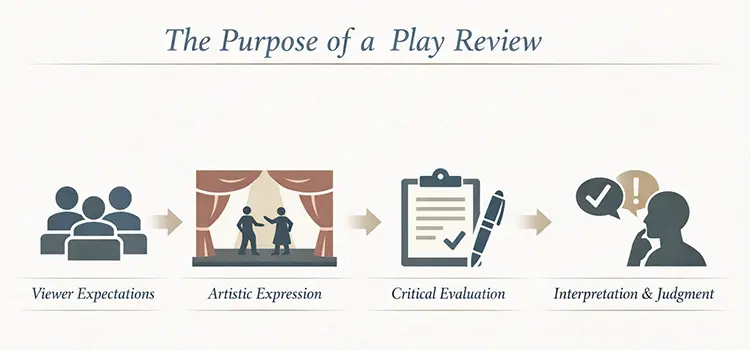
What is the Purpose of a Play Review?
The main aim of a play review is to express your experience and views about a play performance in a transparent and profound manner. It makes it easier for the audience to get the gist of the play, "the performance," and "the case for or against the watching." Besides, a play review gives the writer a chance to tell the audience what aspects of the production were good and what could have been improved with clear illustrations from the performance.
The Essential Elements of Every Play Review
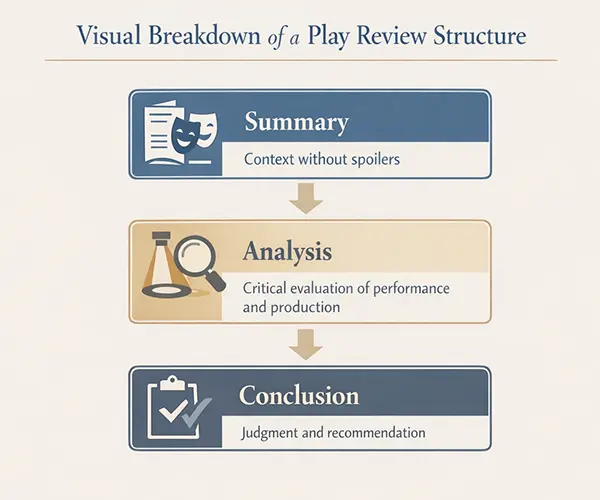
How to write a play review? A good review of a play, without exception, observes a certain layout which assists you in giving a detailed description of the performance and your view, thus making the review readable and comprehensible.
The Summary (Without Spoilers!)
The summary clarifies the main idea or story of the play without disclosing crucial surprises or the conclusion. The audience is supplied with the background of the performance. An appropriate summary will be characterized by a shorter length, greater clarity, and a focus mainly on its qualities and where it lacks, without revealing the story.
The Analysis: The Heart of Your Review
Analysis is the part of your paper where you share your point of view regarding the performance. It is a thorough and detailed discussion covering acting, directing, staging, costumes, lighting, and the central idea of the play. This part should consist of subjective statements that are backed up by illustrations from the performance.
The Conclusion: Your Verdict and Recommendation
The conclusion of your review summarizes your overall opinion by restating it. It indicates unambiguously if you would recommend the play and to whom. This last part gives the readers a definite takeaway and an impression of closure.
Your Step-by-Step Guide to Writing a Review
Breaking down the process of how to write a critical review of a play into several steps makes it far easier to write a review that is impactful. With some preliminary work, attention during the play, and then proper classification of your thoughts, you will end up with a review that is deep, properly organized, and engaging.
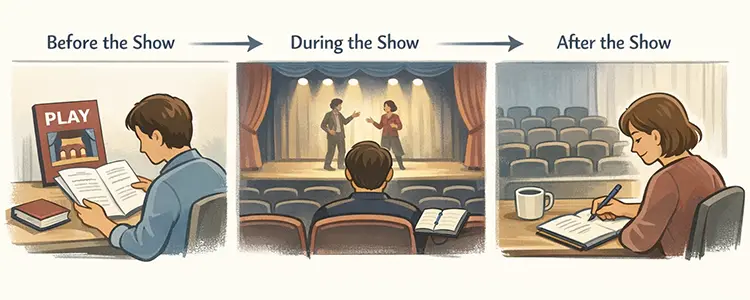
Before You Go: Doing Your Homework
To review a play, watching it with an analytic sense is paramount, as only then will you be able to collect the information that is required to be written in a review. This requires you to be alert and focus on your own reactions, emotions, and thought process. Knowing how the play is affecting you helps to write a genuine review:
- Research: Discover the artist, concept, and category of the play. Know its topic and if it requires some historical or factual information then gain it.
- Context: Realize the history or place in time to better comprehend the plot. The setting helps to understand the intent.
- Preparation: Be in the right frame of mind to observe and critically examine the show. Ensure you are not surrounded by any prejudices.
During the Show: Note-Taking Strategies
Being alert about your surroundings, which includes the people and their reactions, is necessary. The reaction of people in different settings, events, dialogues, and scenes helps you understand what athe udience likely to enjoy:
- Observation: Carefully observe the performers, the settings, and the movements on stage.
- Attention: Concentrate on the conversation, the feelings expressed, and the significant events.
- Details: Write down the crucial shots or acting that make an impression.
After the Curtain Call: Structuring Your Thoughts
Once the play is ended, take a deep breath, without leaving your seat, and recall what you watched, what you are feeling and what the events are that are impacting you the most, and note them down:
- Organization: Divide your notes into parts that are very clear and that have a precise definition.
- Reflection: Think about the emotions that the play unleashed in you and the reasons for it.
- Evaluation: Make a final inference that is formed on your personal opinion.
Play Review Examples (Annotated)
There are some play review example from important critics or writers. They gained positive and sometimes even negative responses. Let’s have a look at them:
A Contemporary Drama
The plays are centered on social or personal problems of the current day, with a realistic emphasis, and emphasize more on raw emotion and depth of character psychology. They tend to use a contemporary dialogue and bare staging that mirrors the intricacies of contemporary life.
The Inheritance Review: A Contemporary Epic of Queer History and Identity | The Inheritance (Review) Critiques of a 2018 play written by Matthew Lopez, which led to a London premiere before being staged in Broadway, were likened to Angels in America by critics such as those of Front Mezz Junkies (2019), and praised the play as an epic homage to queer history and the AIDS legacy through subtle motifs of prosperity and privilege. In 2019, NPR criticized its emotional punch in discussing the lives of gays after the crisis, but discussions were glib with contemporary references that made depth a stretch. As pointed out by Hyperallergic (2020), Lopez defends against the old tropes, where the theme of class and inequality within the gay community in the midst of a mixed New York reception is addressed. |
A Classic Comedy
Based on the time-honored humor and plot twists, these works tend to be satirical or farcical in nature in their attempt to mock the societal conventions and the human foibles. They usually count on puns and false identities and a light comedy end to conflict.
A Midsummer Night’s Dream Review: Shakespeare’s Magical Comedy of Love and Illusion | A Midsummer Night's Dream (Review) In 1660, Shakespeare performed insipid and ridiculous plays before Samuel Pepys, and the play is supernaturally based, which is quite popular among mixed audiences in the 17th century. Samuel Taylor Coleridge (18111812) regarded the play as a long dream, and the insincere disloyalty of Helena to Hermia in his view was evidence of the frenzied passion that drives women rather than righteousness. William Hazlitt (early 19th century) termed it a pleasant fiction that became a boring pantomime in performance, and Francis Jeffrey had described its prolific natural and supernatural beauty as opening up all Eden. |
A Large-Scale Musical
It is a genre that involves dramatic choreography, sweeping orchestral backdrops, and large scale sets to narrate a high energy story. These productions have a big cast and choose visual effects and emotional appeal via song and dance.
Hadestown Review: A Powerful Folk-Opera Retelling of the Orpheus Myth | Hadestown (Review) In 2019, a musical by anaïs Mitchell, based on her 2006 album of the same title, got early acclaim in previews on 2019 Broadway, in its folk-opera victory as a myth of Orpheus, with political shades of love and greed. Director Rachel Chavkin was praised in Stage Left NYC (2019) as having breathtaking stage builds that combined mesmerizing construction with uplifting politics that outdid the contemporaries. According to Riley Runnells in The Post (2019), his lights-down experience was entertaining and worth seeing, so it was a must-visit destination to gain colorful mythological tours. |
Common Mistakes to Avoid in Theatre Reviews
The theatre review sample is embedded in the conception of patience, organization, and critical observation. If one keeps away from the usual pitfalls, the review will be fair, clear, and interesting at the same time.
Common Mistakes in Play Reviews and How to Avoid Them | Typical Mistake | Why It’s a Problem | What to Do Instead |
| Revealing spoilers | Ruins the experience for readers | Keep the plot summary brief and spoiler-free |
| Focusing only on opinion | Makes the review feel biased | Support opinions with clear examples |
| Ignoring technical elements | Gives an incomplete review | Comment on sets, lighting, and sound |
| Being too vague | Leaves readers confused | Use specific scenes or moments |
| Poor structure | Makes the review hard to follow | Organize content into clear sections |
| Overusing summary | Reduces critical analysis | Balance summary with evaluation |
Free Play Review Template & Checklist
This free play review template and checklist is designed to help you analyze a theatrical production clearly and effectively, covering performance, direction, design, and overall impact.
Download: Play Review Template
Conclusion
A play review is the result of a calm mind that fuses one's personal views with a critical assessment. You can produce a review that is both captivating and didactic by giving the plot a brief retelling, evaluating the main components, and arranging your ideas logically. In order to understand a theme, students must be capable of distinguishing symbolism from story throughout the learning process.