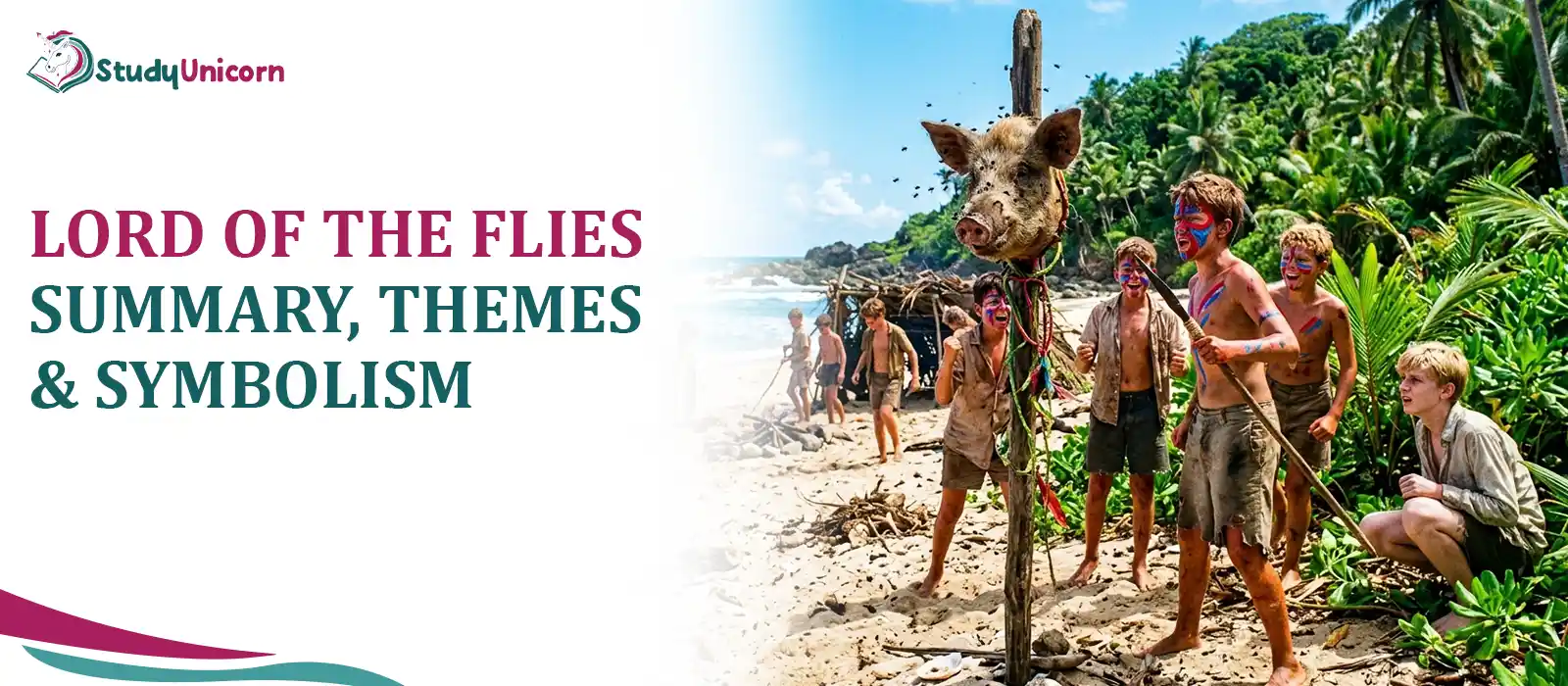
The William Golding Lord of the Flies is a dystopian fiction. The book which was published in 1954 exists as a post-World War II novel. It demonstrates the way human nature evolved based on the circumstance. The band of schoolboys marooned on the deserted island sink into savagery showing the chore face of social order. This blog makes you know all the plot summary with an adequate analysis of the significant themes, the breakdown of the main characters and symbols used in the story.
Quick Overview: Lord of the Flies in 60 Seconds
The table provides basic facts about the writers, settings and the core conflict of the William Golding Lord of the Flies.
| Category | Details |
| Author | William Golding (1911–1993) |
| Published | 1954 |
| Major Awards | Nobel Prize in Literature (1983) |
| Genre | Allegorical novel, dystopian fiction, psychological drama |
| Setting | A deserted tropical island during an unspecified wartime period (likely World War II) |
| Premise | A group of British schoolboys survives a plane crash and must govern themselves until rescue. |
| Core Conflict | The struggle between civilized order (Ralph) and savage instinct (Jack). |
| Famous Quote | "The mask was a thing on its own, behind which Jack hid, liberated from shame and self-consciousness." |
Detailed Plot Summary
In the upcoming sections you will learn the full, detailed lord of the flies plot summary which shows how the story starts, evolves and takes a turn throughout.
Chapters 1-4: The Rise of Order
Ralph and Piggy found the conch shell while exploring the island. Jack’s obsession with hunting was increasing and the election was held to choose the leader to guide the students present on the island.
The Assembly
Ralph and Piggy discover a vibrant conch shell in the lagoon recognizing its potential as a tool for communication. When Ralph blows into it the booming sound summons boys from across the island. The conch immediately becomes a sacred symbol of authority, democratic order and the hope for organized survival.
The Election
During the first formal assembly the boys hold a vote to choose a chief. Ralph is elected leader largely due to his charisma and the conch. Jack the head of the choir is deeply stung by this rejection planting the seeds of a bitter and destructive power struggle ahead.
Establishing Order
Ralph tries to recreate civilization by the arrangement of the boys to create shelters and a signal fire on top of the mountain. Nevertheless, the difference between the long-term rescue of Ralph and instant play and meat of the boys is slowly undermining the fragile stability of their new society.
The Missed Chance
Disaster strikes when a ship passes the island while the signal fire is out. Jack and his hunters preoccupied with their first successful pig hunt let the flames die out. The missed rescue opportunity leads to an explosive confrontation marking the moment Jack’s bloodlust outweighs the group’s collective safety.
The Descent into Hunting
Jack becomes increasingly obsessed with the hunt, masking his face with charcoal and clay to hide his humanity. This "mask" allows him to descend into savagery without shame. His first kill brings a sense of dark empowerment shifting his focus entirely from being rescued to dominating the island's wildlife.
The Beastie
The "littluns" begin suffering from vivid nightmares claiming a "beastie" or "snake-thing" lurks in the jungle at night. While Piggy dismisses this as irrational fear the concept of a physical monster takes root. This collective paranoia provides Jack a way to gain power by promising to hunt and kill the beast.
Chapters 5-8: The Fracture
Boys mistake the dead parachutist for a beast and after losing the election, Jack made his own tribe. The Lord of the Flies summary from chapter 5-8 are explained below.
The Struggle for Order
Ralph is having a hard time to promote democratic values using the conch but as the boys become increasingly lazy and scared to rebel against his power, the conch fails to support his objective. His concentration on signal fire collided with primal urges of the group and lost rescue chances and eventual destruction of the weak social system he had strived to establish.
The Parachutist "Beast"
In the darkness of the mountain, Samneric mistakes the tangled corpse of a dead parachutist for a terrifying monster. This physical manifestation of "the beast" paralyzes the group with fear, shifting the boys' focus from rescue to survival and giving Jack the leverage he needs to militarize his hunters.
Jack’s Rebellion
Tensions peak when Jack openly challenges Ralph’s leadership during an assembly. Although he fails to win a formal vote Jack angrily departs to form his own tribe at Castle Rock. This schism marks the end of civil discourse replacing Ralph’s rules with Jack’s promise of hunting, meat and fun.
The Great Defection
Attracted by the allure of roasted pig and the freedom from chores, the majority of the older boys abandon Ralph’s camp. This mass defection leaves Ralph, Piggy and Samneric isolated. The shift demonstrates how easily the veneer of civilization dissolves when tempted by tribalism and the fulfillment of primal urges.
Simon’s Revelation
Simon retreats to his secret glade, where he finds the parachutist and realizes the "beast" is merely a human corpse. He understands that the true evil resides within the boys themselves. Tragically before he can share this liberating truth he is killed by the group in a ritualistic frenzy.
The Offering
Jack kills a sow brutally and hangs its head in a sharpened stick as a present to the beast by his tribe. This master of the violence becomes a hideous image of how barbaric they have become. It is representative of the triumph of anarchy of the corporeal strength that Jack has over his subjects.
Chapters 9-12: The Descent
Simon was killed by Jack’s tribe after Ralph confronted Jack and they tried to kill Ralph but did not accomplish that plan.
The Death of Simon
Simon crawls toward the feast to reveal that the beast is only a dead man. However, the boys caught up in a tribal dance and a thunderstorm mistook him for the monster. They descend upon him with teeth and claws murdering him on the beach effectively killing the island's only moral compass.
The Theft of Fire
Jack’s tribe raids Ralph’s camp under the cover of darkness not to steal the conch but to seize Piggy’s glasses. By taking the lenses Jack gains the power to start fires leaving Ralph’s group helpless and unable to maintain a signal to fire their last tether to the civilized world.
The Fall of Piggy
During a confrontation at Castle Rock Roger deliberately heaves a massive boulder from the cliff. The rock strikes Piggy, killing him instantly and shattering the conch into white fragments. This moment represents the total destruction of law, intellectualism and democratic order leaving the island in a state of anarchy.
The Manhunt
With the conch destroyed Jack orders a full-scale hunt to kill Ralph. The tribe ignites the island's vegetation to smoke him out, abandoning any hope of sustainable survival for the sake of bloodlust. Ralph becomes a literal prey animal, frantically running for his life through the burning ruins of the jungle.
The Return of Civilization
Exhausted and surrounded Ralph collapses on the beach at the feet of a British naval officer. The officer drawn by the wildfire's smoke offers an ironic rescue. The arrival of the "adult world" brings an immediate jarring halt to the boys' savagery turning hunters back into children.
The End of Innocence
Safe at last, Ralph cries his eyes out at the death of his friend Piggy and the death of his lost innocence. He cries over the blackness of the human soul as he realizes that though he is getting physically saved, the things he has seen and got involved in, will leave a scar on his soul permanently.
This story of survival is intense—but here’s another novel that will keep you thinking: The Catcher in the Rye, which explores inner conflict in a completely different way.
Three Key Themes
Each story is informed by a theme communicating something to the audience. This novel has three dominant themes. This part will give you a sort of review about the novel Lord of the Flies and its major concepts.
Theme 1: Civilization vs. Savagery
The civilization vs savagery theme explores the tension between the instinct to live by rules and the impulse toward selfish chaos. Ralph represents ordered society, while Jack’s descent into tribalism reveals how quickly civilization crumbles without authority.
- The Conch as a Symbol of Order: The boys first introduce a system of democracy that is governed by using the conch to ensure order and everyone is heard. This is their effort to reorganize their civilized world that had been structured in the past to warrant their survival and subsequent salvage.
- The Slide into Tribalism: As Jack's influence increases, the boys start to forget the rules and turn to primitive practices and hunting. This change also depicts the ease with which the thin layer of civilization can be peeled off when people are entrenched in the urge to indulge in immediate gratification and power at the expense of societal duty.
- The Struggle of Leadership: The organized group of Ralph and the violent tribe of Jack appears as a micro-world war between democracy and anarchy that is happening in the world in general. It puts emphasis on the point in which Golding believes that human nature will automatically drift toward chaos in the absence of law to maintain order.
Theme 2: The Inherent Evil in Human Nature
Golding suggests that evil is not an external force, but an internal one. The "Beast" is a manifestation of the boys' own primitive fears and the darkness residing within every human heart. This core concept is central to any lord of the flies analysis regarding the psychological impact of isolation on the boys.
- The Beast as an Internal Reality: Although the boys are originally afraid of a physical monster roaming on the island Simon understands that the so-called Beast is not a tangible creature but the darkness which is inside them all. This change in attitude goes to show that Golding feels that evil is not something that exists out there to be hunted but is an inherent component of the human condition.
- The Lord of the Flies as a Psychological Reflection: The head of the pig that is cut off or the Lord of the Flies is the embodiment of Beelzebub and it is addressing the subconscious of Simon. This dialogue proves that the boys are become cruel due to their inner urges and not the supernatural power or conditions.
- The Collapse of Moral Restraint: Without the oversight of adult authority or the fear of punishment the boys' transition from schoolboys to killers reveals a naturally brutal state. This suggests that the rules of society are the only thing keeping the "beast" of human nature from taking complete control over individual behavior.
Theme 3: The Loss of Innocence
This is the most important theme from all lord of the flies themes as the boys swap British school uniforms for face paint and spears, their childhood wonder vanishes. This transition from play to murder highlights the irreversible end of their moral and spiritual purity.
- The cruelty of the Autobiography: The boys came to the island as an obedient schoolboy, and they leave as traumatized murderer. This change draws attention to the fact that children are being pushed to forget their innocence as adults and enter into a bleak adult lifestyle by death itself and the lack of parental supervision.
- The Death of Reason and Purity: What happens to Simon and Piggy is more of a literal killing of innocence and intellectual clarity on the island. In the process of such deaths Ralph is compelled to deal with the darkness of the human heart as he finds out that the security and ethical assurance of his previous life are destroyed forever.
- The Sadness of the Adult World: As the naval officer comes to save the boys his realization of how the boys have failed to behave makes a sharp contrast with the world war that the boys engage in and the world war that is represented by the naval officer. This experience is an indication that the so-called civilized world of adults is nothing more than a bigger, better-organized form of aggressiveness that the boys exhibited.
Two Major Characters Analyzed
In this section, the two main characters of the Lord of the Flies will be discussed and how the story unfolds to captivate the reader and make him/her eager to read more and more. The two characters of the novel are Ralph and Jack. You will also find out how their characters, nature and values influence the plot of the main conflict.
Ralph: The Reluctant Leader
Ralph, the protagonist of the story represents the civilisation. He never wants power but is forced into responsibility. As the elected chief he embodies the fragile nature of democratic leadership when confronted with humanity's primal, chaotic instincts ultimately symbolizing the desperate struggle to remain "human" in that survival condition. Here is the complete Ralph Character analysis for your better understanding.
| Category | Explanation |
| Role | Protagonist and elected leader; represents the values of civilization order and democracy. |
| Physical Description | Fair-haired, athletic and charismatic the "golden boy" archetype possesses a natural approachable authority. |
| Leadership Style | Democratic and rule-based. He prioritizes the long-term goal of rescue (symbolized by the signal fire) over short-term survival or fun. |
| Character Arc | Begins as a proud, positive leader; when the social fabric starts to unfold he becomes alone and has no other option but to confront the darkness, which is the dark side of a human being.. |
| Internal Conflict | There is always an internal tug-of-war between his wish to be a good leader and the fact that he cannot express the need of civilization; at times he is pulled by the primal savagery. |
| Symbolism | Representative of the human condition of trying to maintain moral and civilized values amid the burden of primitiveness and anarchy. |
| Key Quote Insight | "He was old enough... to have lost the prominent tummy of childhood... There was a mildness about his mouth and eyes that proclaimed no devil." |
| Quote Analysis | This passage highlights Ralph's transition from childhood to maturity suggesting he has the physical strength for power (shoulders of a boxer) but lacks innate malice (the "mildness"). |
Jack Merridew: The Descent into Savagery
This Jack character analysis, the antagonist of the story whose motivation is savagery, violence and lust of power. He was too obsessive and brutal in hunting. Being the animal instinct of strength and aggressiveness, his denial of civilized ways makes the island which could be a perfect utopia into a habitat of predators where fear and bloodlust are the main concerns.
| Feature | Details |
| Role | Antagonist and leader of the hunters; represents tyranny, primal instinct and the breakdown of social order. |
| Physical Description | Tall, thin and bony with red hair and a face described as "ugly"; he fits the classic "villain" archetype from his first appearance. |
| Leadership Style | Authoritarian and fear-based. He maintains control by offering immediate gratification, meat hunting and total freedom from rules. |
| Character Arc | Evolves from a frustrated, disciplined choir leader into a painted savage, eventually becoming a murderous, lawless tyrant. |
| Key Transformation | The Mask: Painting his face provides him with anonymity effectively liberating him from the constraints of shame and civilization. |
| Symbolism | Represents the Id, the part of the human psyche driven by basic impulses the urge for power and the desire for domination. |
| Key Quote Insight | "He began to dance and his laughter became a bloodthirsty snarling... the mask was a thing on its own... liberated from shame." |
| Quote Analysis | The mask acts as a psychological shield. Once Jack hides his identity he is no longer bound by British morality, allowing his "bloodthirsty" nature to take over. |
Minor Characters and Their Significance
In the novel Lord of the Flies the minor characters play a crucial role in making the story more impactful to the audience. Minor characters serve as the moral crucible for a decaying society.
Piggy: The Voice of Reason
- Piggy is presented as a vulnerable intellectual marked by his physical limitations and reliance on his glasses. While the others dismiss him because of his appearance and asthma he serves as the group’s essential moral compass.
- His personality suggests a high level of clarity of mind, which has always been disregarded by a society that has gone blind due to prejudice. He symbolizes scientific and logical thought processes that enable human beings to exist in an ordered world.
- As the story progresses Piggy becomes the steadfast symbol of science and civilization. His character reflects a profound clarity of mind that is constantly dismissed by a society blinded to appearances. His tragic death caused by a boulder that shatters both his body and his glasses represents the final violent destruction of reason and orderly life on the island.
Simon: The Christ Figure
- Simon is a mystic and visionary often seen as an oddity because of his fainting spells and solitary nature. Unlike the other boys he possesses a deep intuitive bravery and a compassionate spirit that allows him to face the island's terrors.
- His significance lies in his realization that the "beast" is not a physical monster but an internal darkness within the human heart. He is the only character who truly understands that evil is a part of their own nature.
- His brutal death at the hands of the frenzied tribe while attempting to deliver the truth about the beast creates a clear Christ parallel. His murder marks the moment when the boys' collective humanity is completely sacrificed to primal savagery.
- Through a detailed Simon character analysis, we see him emerge as the island’s only true visionary, representing a spiritual and moral clarity that the other boys are too blinded by fear to understand.
Roger: Pure Evil
- Roger is initially introduced as a quiet intense boy but he quickly becomes Jack’s cruel lieutenant. While others struggle with their conscience, Roger represents a terrifying shift toward violence without any moral restraint.
- His character is significant because he proves that once the threat of punishment is removed some individuals become purely destructive. He is the only character who seems to truly enjoy the act of inflicting pain for its own sake.
- His ultimate act of releasing the lever to kill Piggy and his preparation to impale Ralph’s head show a total descent into bloodlust. He represents the most terrifying potential of human nature when freed from the rules of the "old world".
Symbols and Their Meanings
In the novel, the Lord of the Flies symbolism represents the societal evils inherent in human nature that surface when situations go out of control. In this novel there are symbols that signify hope and rescue
The Conch Shell
- In Lord of the Flies, the conch shell symbolism represents the fragile power of order and democracy, showing how quickly civilization shatters once the rules are ignored.In the beginning it serves as the essential tool that brings the boys together, establishing a fair society where whoever holds the shell has the right to speak.
- Its progression shows the boys' growing lawlessness; as Jack’s tribe gains power the conch is increasingly ignored, indicating that democratic power is only as strong as the people’s willingness to follow it.
- The moment the rock strikes Piggy and the conch "exploded into a thousand white fragments" it signifies the final and irreversible destruction of rational society. With the shell gone all traces of formal boundaries and peace cease to exist
Piggy's Glasses
- The spectacles represent intelligence, science and the human ability to innovate. They are the only piece of modern technology on the island used to harness the sun’s rays to create life-saving fire.
- As the boys descend into savagery the physical state of the glasses mirrors their mental state. When one lens is cracked it symbolizes a partial loss of reason; when they are stolen it shows that the "vision" for rescue has been lost.
- The final destruction of the glasses represents the total death of the rational mind. Without them the boys are left "blind" to the consequences of their actions guided only by primitive instinct.
The Beast
- The beast symbolism in the Lord of the Flies represents the primal fear of the unknown. Initially the children visualize it as a physical monster, a "snake-thing" or a "beast from the air" to avoid admitting the terror they feel about their own behavior.
- The Beast is used as a representation of the inner evil of a human being as the story continues. The fact that Simon realizes that perhaps it is just us, shows that the real monster is not a creature in the woods but the ability of boys to turn cruel.
- The Beast is another justification that the boys want to join the violent leadership of Jack. By hunting and making sacrifices to it they substitute the reason of the conch with the madness of a bloodthirsty religion. This use of lord of the flies symbolism reinforces the novel's dark message about human instinct.
The Lord of the Flies (The Pig's Head)
- The physical representation of the sow on a stick is a manifestation of the Beelzebub or the devil. It is the systematic corruption and darkness that comes out when structures of the society are lost.
- During Simon’s hallucination the head speaks to the "beast" inside him mockingly confirming that the chaos on the island is the boys' own fault. It functions as a warning that evil cannot be hunted or killed because it is part of them.
- The conch represents the symbol of the old world (law) whereas the pig head is the symbol of the new world (savagery). It is a chilling account of how when people lose their moral compass the only thing that can be left is destruction.
The Signal Fire
- The fire represents hope and the desire to return to an ordered world. Tending the smoke is the boys' only way to signal for rescue making it a measure of how much they still value their connection to the adult world.
- Its progression from a carefully tended signal to a neglected pile of ash mirrors the boys' psychological shift. When they choose hunting over the fire they choose the thrill of the present moment over the future of being saved.
- By the end of the novel the fire meant for rescue is turned into a weapon of war used to smoke Ralph out of hiding. Ironically this destructive fire is what finally attracts the navy proving that chaos not order brought their stay to an end.
The Island Itself
- The island symbolizes the world in general that forms a mini-stage of the battle between good and evil. It begins as some kind of a paradise of fruits and fresh water, a new Eden.
- The physical destruction of the island by the first scar created by the plane crash up to the last forest fire resembles the inner destruction that the boys perform on their souls.
- Eventually, the island turns into a desert of slaughter and flames. This is the gloomy face of a fact that in the event that human beings fail to safeguard their moral duty, they are the ones who destroy the very thing called paradise, which was supposed to nourish them.
Historical and Literary Context
Lord of the Flies was composed following World War II as a reaction of Golding to his horror of human cruelty and the instability of human civilization. It corrects cold war fears of nuclear war and undermines old island-adventure narratives in which boys are soon slipping into barbarism rather than being heroic and civilized.
Post-World War II Context
- The novel was written in 1954 and is very strongly based on the trauma of World War II and the then rising Cold War. Golding who served in the Royal Navy saw with his own eyes the atrocities that humans can commit during war.
- Sea life had broken his hopes of innate kindliness of individuals. The novel is a metaphorical demonstration of the world political situation where civilized countries were at the same time frightened by the risk of nuclear destruction.
- Golding takes the island of boys as a miniature of the world of adults. He insinuates that the war the boys are engaging in is not any different with the war the adults are engaged in fighting in the sky above them.
Response to The Coral Island
- The novel was written as a direct cynical response to R.M. Ballantyne’s 1858 book The Coral Island. While Ballantyne’s story portrayed British boys as heroic and perfectly civilized when shipwrecked Golding presents a much darker more realistic outcome.
- Golding intentionally uses the same names (Ralph and Jack) from Ballantyne's work to highlight the contrast. He argues that without the "protective crust" of society children would not build a utopia but would instead succumb to primal instincts.
- This change in Victorian romanticism to Modernist pessimism is a kind of shift in literature. It transits the theme of the noble savage and shifts to the understanding that evil is a human aspect within.
Cold War Anxiety
- The novel was written in the early of the Cold War and the world was in fear of nuclear destruction. The falling of the dead parachutist is a reminder that the world beyond the Island is also at war of complete destruction.
- Another similarity here is the use of charisma, fear and the creation of the beast, which is used in the fascist regimes as a scapegoat to dominate the group, and this case is also a clear parallel of fascist regimes. This is a reflection of the political changes that Golding observed in Europe when he was alive.
- The clash of the democracy of Ralph and the dictatorship of Jack is the battle of ideas of the middle part of the 20th century that demonstrate the possibility to use fear in order to kill freedom easily.
Nobel Prize Recognition
- In 1983, Golding was awarded the Nobel Prize and the committee hailed the novel as a myth which delved into the darker aspects of a human being. This was what made the book a classic work of analysis of the human condition.
- The committee has observed that the work by Golding sheds light on the darkness of the heart of man indicating that the themes of the island that the battle between order and chaos apply to all generations and cultures.
- This is what has made the novel a staple of literature since the book compels people to look at the painful truths about themselves. It is still a strong caution that civilization is a precious gift that has to be vigorously preserved.
Downloadable Study Guide (PDF Concept)
Conclusion
The end of Lord of the Flies depicts the extent to which the boys have destroyed the society they lived in. When Jack finally arrives at the tribe where he lives, the place has been burned down, Piggy is dead, and Ralph is alone and is being hunted like a rabbit. Salvation occurs when a naval officer enters with a shock to see children behaving like savages. The conclusion emphasizes the point of Golding that cruelty and savagery can be found in every human being not only in the evil individuals. Ralph laments about the loss of innocence and the darkness he saw in him and the rest that civilization is thin and is easily ruined when rules and sympathy are disregarded.