Writing clearly relies not just on vocabulary but heavily on structure. The understanding of parallel structure aids in the expression of ideas. It is a rule of grammar according to which things are ordered in a similar way to form balance and rhythm. Such a strategy is important to be clear and effective, particularly in lists, comparisons, and orders of actions or features.
Let’s understand this with an example:
“She prefers reading, to hike, and podcasts.”
Why does that parallel structure example sound vague, even when you cannot explain the rule of grammar?
There is nothing that is technically confusing. The meaning is clear. And yet, it feels awkward. Uneven. Unpolished. That discomposing sense is due to want of harmony. The first part of the sentence is composed of a gerund (reading), which is replaced by an infinitive (to hike), and concludes with a noun (podcasts). The form is not in keeping, and your ear recognises it at once.
It is precisely that imbalance which parallel structure corrects.
Parallelism (also known as parallel structure) is not some dead grammar rule in textbooks. It is the secret structure behind the writing that is easy, confident, and professional. It makes resumes sound good rather than shoddy. It is what makes speeches rhythmic and powerful. It is what makes the ordinary sentences convincing.
To understand parallel structure, one has to understand balance. Your grammar should be equal, since your ideas are equal. The closer you are to your structure, the greater, more comprehensive, and memorable your message will be.
In this guide, parallelism is simplified into a three-part system:
- Understanding the Core Principle - How to understand what parallel structure is (in simple English) and why you need to know it.
- Diagnosing Errors in Your Work - Find out with a practical "repair kit" and fix erroneous parallelism quickly.
- Applying It for Impact - How to use parallel structure to make essays, presentations, resumes, and normal communication stronger.
You will not merely be able to tell when anything is off at the end. You will know why, you will know how to put it right.
Part 1: The Core Principle - What Exactly Is Parallel Structure?
It is impossible to correct faulty parallelism without first grasping the simple concept of it. Parallel structure does not have to do with memorization of some complicated grammar rules; it is the awareness of the patterns. The grammatical structure of the ideas should be equal as well when they are given as not inferior. In this section, I dissect the definition, provide you with an easy-to-remember analogy, and explain why being able to master this principle will make your writing change.
A Simple, Effective Definition
Parallel structure simply represents the application of the same grammatical construction to objects in a list, pair, or series to indicate that they are equally important.
When you have three things, then they must have the same verb. When two ideas are compared, they must be organized in a similar manner. The sentence is balanced and deliberate when the structure is the same.
Imagine that it is framing pictures on a wall. At the same size and with a uniform spacing between the frames, the display appears clean, deliberate, and aesthetically pleasing. And when one picture is oversized, another is tilted, and the third one is crowded in the wrong place, the composition is distracting and unbalanced, even when the subject of the pictures is beautiful. Writing works the same way. The ideas may be excellent, but the grammatical structure does not correspond, and the sentence is clumsy. Parallel structure lines up your frames and gives it a sense of balance, clarity, and harmonic appearance and wording.
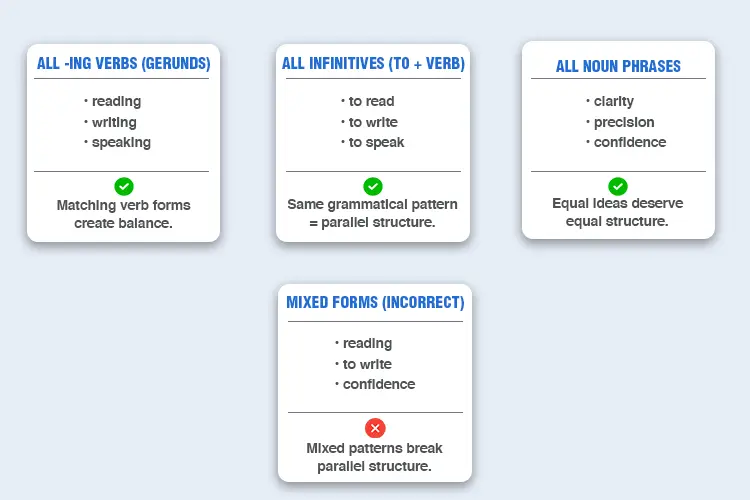
Here are some parallel structure example:
- She enjoys painting, drawing, and to sculpt.
- painting, drawing, and sculpting
- The system is efficient, reliability, and scalable.
- efficient, reliable, and scalable
- He promised honesty, to be transparent, and fairness.
- honesty, transparency, and fairness
- They debated costs, benefits, and whether it was ethical.
- costs, benefits, and ethics
- The strategy focuses on growth, sustainability, and to innovate.
- growth, sustainability, and innovation
Why You Should Care: The 3 Benefits of Parallelism
This is not the knowledge of parallel structure, but rather the knowledge of impact. Your sentence structure can be aligned, and your ideas can be easier to understand, sound more professional, and sound stronger. Parallelism enhances both the ordinary and the stakes writing.
- Clarity: Parallelism is used to avoid confusion. As we have sentence elements that are similar, readers get to see instantly the way ideas relate. Structure does not need any mental work to decode.
- Professionalism: Structural imbalance is the cause of awkward phrasing. Clean parallelism is what makes writing sound professional, confidence-filled, and credible, be it in an essay, email, or report.
- Persuasive Power: Parallel structure establishes both rhythm and stress, particularly when it comes to speeches. Think of this line he repeated several times by Martin Luther King Jr:
"I have a dream..."
The repetition of the same form develops the emotional weight and the memorability. Parallelism does not merely systematize thoughts--but intensifies them.
Part 2: The Diagnostic Toolkit – How to Spot (and Fix) Faulty Parallelism
Now you know the principle, now it is time to put it into practice. The majority of parallel structure errors are not complicated, and they are simply ignored. In this section, you will have an easy-to-use diagnostic system to diagnose and fix faulty parallelism in your personal writing.
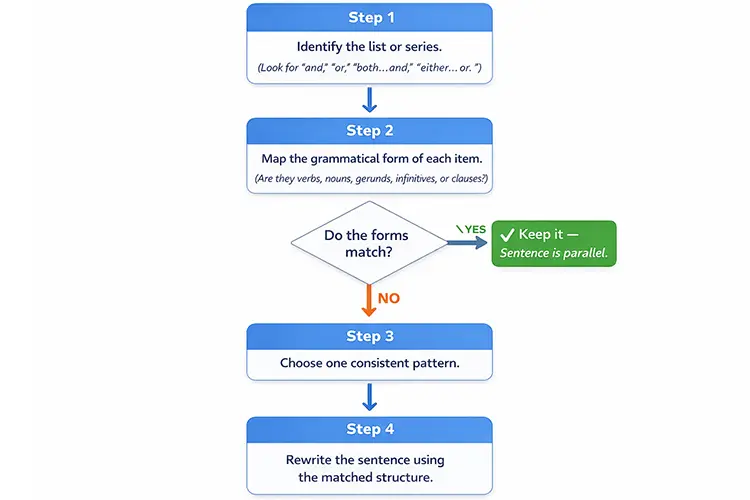
The “Parallelism Repair Kit” Flowchart
The Parallelism Repair Kit is an easy four-step editing system that aids you in rapidly identifying, assessing, and repairing incorrect parallel structure by examining patterns and rewriting inappropriate grammatical forms.
Common Error Patterns & Their Fixes (With 20+ Examples)
Most parallel structure errors are predictable. You simply need to recognize the three most common types to diagnose mismatched grammar quickly and rewrite sentences with confident precision. Below are 20+ faulty parallel structure examples:
Pattern 1: Mixing Verb Forms
Fix: Select one consistent verb form (all infinitives, all gerunds, or all simple present).
Faulty: She likes to read, hiking, and watches TV.
Diagnosis: Infinitive + gerund + simple present.
Corrected: She likes to read, to hike, and to watch TV.
Faulty: He enjoys swimming, to bike, and runs daily.
Diagnosis: Gerund + infinitive + simple present.
Corrected: He enjoys swimming, biking, and running daily.
Faulty: They plan to expand, hiring staff, and increase marketing.
Diagnosis: Infinitive + gerund + base verb.
Corrected: They plan to expand, hire staff, and increase marketing.
Faulty: She started crying, to shout, and leaving early.
Diagnosis: Gerund + infinitive + gerund mismatch.
Corrected: She started crying, shouting, and leaving early.
Faulty: The job requires managing teams, to communicate clearly, and leadership.
Diagnosis: Gerund + infinitive + noun.
Corrected: The job requires managing teams, communicating clearly, and demonstrating leadership.
Faulty: He promised to call, texting updates, and visiting soon.
Diagnosis: Infinitive + gerund + gerund inconsistency.
Corrected: He promised to call, to text updates, and to visit soon.
Faulty: She practices singing, to dance, and acts confidently.
Diagnosis: Gerund + infinitive + simple present.
Corrected: She practices singing, dancing, and acting confidently.
Pattern 2: Mixing Noun and Clause Structures
Fix: Maintain grammatical equality among items (all nouns, all phrases, or all clauses).
Faulty: The goal is improving sales, customer satisfaction, and that profits grow.
Diagnosis: Gerund + noun + clause.
Corrected: The goal is improving sales, increasing customer satisfaction, and growing profits.
Faulty: He wanted success, that he would earn respect, and financial freedom.
Diagnosis: Noun + clause + noun mismatch.
Corrected: He wanted success, respect, and financial freedom.
Faulty: The report explains costs, why delays happened, and revenue loss.
Diagnosis: Noun + clause + noun inconsistency.
Corrected: The report explains costs, delays, and revenue loss.
Faulty: She values honesty, that people are accountable, and fairness.
Diagnosis: Noun + clause + noun.
Corrected: She values honesty, accountability, and fairness.
Faulty: The strategy focuses on growth, sustainability, and that innovation matters.
Diagnosis: Noun + noun + clause mismatch.
Corrected: The strategy focuses on growth, sustainability, and innovation.
Faulty: The presentation covered market trends, analyzing competitors, and customer feedback.
Diagnosis: Noun + gerund + noun.
Corrected: The presentation covered market trends, competitor analysis, and customer feedback.
Faulty: He is responsible for hiring staff, budget management, and that projects finish on time.
Diagnosis: Gerund + noun + clause mismatch.
Corrected: He is responsible for hiring staff, managing budgets, and finishing projects on time.
Pattern 3: Faulty Pairs with Correlative Conjunctions
Fix: Both parts of correlative pairs must be grammatically parallel.
Faulty: She is not only talented but also works hard.
Diagnosis: Adjective + verb mismatch.
Corrected: She is not only talented but also hardworking.
Faulty: Either you apologize or taking responsibility.
Diagnosis: Clause + gerund mismatch.
Corrected: Either you apologize or you take responsibility.
Faulty: Both improving efficiency and the company cut costs were goals.
Diagnosis: Gerund + clause mismatch.
Corrected: Both improving efficiency and cutting costs were goals.
Faulty: Not only did he study hard but also passing the exam.
Diagnosis: Clause + gerund mismatch.
Corrected: Not only did he study hard, but he also passed the exam.
Faulty: Whether you win or losing, stay positive.
Diagnosis: Base verb + gerund mismatch.
Corrected: Whether you win or lose, stay positive.
Faulty: She likes both to swim and biking.
Diagnosis: Infinitive + gerund mismatch.
Corrected: She likes both swimming and biking.
Faulty: The policy aims not only to reduce costs but also improving quality.
Diagnosis: Infinitive + gerund mismatch.
Corrected: The policy aims not only to reduce costs but also to improve quality.
Click Here: Download the Parallel Structure Checklist (Free PDF)
Part 3: Applied Parallelism - Examples from Classics to Career
Parallel structure is not a grammatical construct but a tactic. Parallelism influences the reception, retention, and respect of messages in literature and speeches, resumes, and posts in social media.
In Literature & Rhetoric: Creating Impact
Parallelism enhances rhetoric through repetition of grammatical constructions, formation of a rhythm, emphasis of contrast, and intensities of emotion of some of the most memorable lines in history. The examples of parallel structure are shown here:

In Professional & Academic Writing: Building Credibility
The parallel structure implies the credibility of formal writing, since it establishes regularity, clarity, and coherence, which are indicators of skill and critical thinking. In this, explore various parallel structure in writing examples and understand better.
Resume / Bullet Points
Parallel action verbs possess a tangible accomplishment and professionalism.
- Weak: Oversight of training, schedules, and reports.
- Strong: New employees trained, scheduled shifts, and ready reports.
Presentation Slides
Parallel phrasing is the arrangement of ideas in a way that makes the audience understand it within a short time.
- Weak: Quality, cost cut, we became more efficient.
- Strong: Quality improvement, cost reduction, and efficiency.
Thesis Statements
Analytical arguments are made stronger by the presence of balanced structures.
- Weak: The policy affects jobs, how taxes are collected, and healthcare access.
- Strong: The policy has impacts on employment, taxation, and access to healthcare.
In Everyday Communication: Making It Stick
The everyday messages are made more coherent, punchy, and memorable by parallel structure, particularly where there is a lot of rapidity in communication.
Social Media
The paralleling phrases bring rhythm, clarity, and a greater emotional appeal.
- Example: Dream bigger. Work harder. Achieve more.
Email Subject Lines
Repetition enhances readability and gives more appeal to the open rate.
- Example: Cut Costs. Save Time. Boost Profits.
Advertising Slogans
Memorability is created through repetition, and brand messaging is also created by repetition in a powerful manner.
- Example: Simple design. Powerful performance. Lasting value.
Interactive Practice Zone
Practice what you learned in a guided practice that aims to hone your skills of recognizing, repairing, and confidently applying parallel structure.
Quiz 1: Identify the Error (Beginner)
Determine how you recognize bad parallelism by choosing the sentence with irregular grammatical composition.
- She enjoys reading, to swim, and biking.
A) No error
B) Faulty parallelism
Show Answer: B - “reading, swimming, and biking.”
- The job requires attention to detail, strong communication skills, and time management.
A) No error
B) Faulty parallelism
Show Answer: A - All noun phrases.
- He likes to cook, jogging, and to paint.
A) No error
B) Faulty parallelism
Show Answer: B - Choose one form: “to cook, to jog, and to paint.”
- The project was challenging, rewarding, and educational.
A) No error
B) Faulty parallelism
Show Answer: A - All adjectives.
- She is responsible for hiring staff, training them, and payroll processing.
A) No error
B) Faulty parallelism
Show Answer: B - “processing payroll.”
Quiz 2: Repair the Sentence (Intermediate)
Restate every sentence to fix the grammatical inconsistencies.
- His favorite activities are hiking, to swim, and biking.
- Show Answer: hiking, swimming, and biking.
- It is aimed at increasing sales, expand market, and retention of customers.
- Show Answer: increasing sales, growing markets, and customer retention.
- She considers honesty, being punctual, and hard work.
- Show Answer: honesty, punctuality, and hard work.
- Their strategy is to introduce a product, advertising it, and distribution.
- Show Answer: to introduce a product, advertise it, and distribute it.
- The policy impacts on teachers, the way students learn, and the funds.
- Show Answer: teachers, student learning, and funding.
Challenge: Improve the Paragraph (Advanced)
Make changes in the following paragraph to produce coherence, better rhythm and more effective links between ideas.
Paragraph:
The company desires to improving productivity, to lower costs, and better morale of workers. Managers are prioritizing training employees, improving communication, and install new software.
Show Answer:
The company desires to improve productivity, lower costs, and better morale of workers. Managers are prioritizing training employees, improving communication, and installing new software.
Conclusion
“Parallel structure is where similar grammatical constructions are used to show similar ideas in an easy, rhythmical, and balanced manner.”
When your organization works, your writing is refined and businesslike. Even good ideas may sound clumsy or half-baked when this is not. In this guide, with a parallel structure example, you have learned the way parallelism can make a text easier to understand, the arguments it can make stronger, the credibility it can give an argument or email, and the persuasive rhythm it can provide to an essay, an essay or even an email.
Now apply it intentionally. The next critical email, report, or presentation should be sent with the help of the Parallelism Repair Kit: define the list, check the grammatical form of each item, make sure they are the same, and rewrite, if necessary.
This is just a habit that you need to take a few seconds to change in your writing.
Balanced thinking is marked by balanced grammar and thinking even evolves strong communication.