The difference between a Statement of Purpose and a Personal Statement needs to be understood because it forms the foundation for successful graduate or college admissions applications. The two documents which applicants often confuse with each other serve different purposes but maintain distinct functions.
The guide on statement of purpose vs personal statement explains the two documents through their intended functions, their organizational patterns and their writing styles. The admissions committee assessment process enables you to create focused persuasive essays that enhance your college essay application.
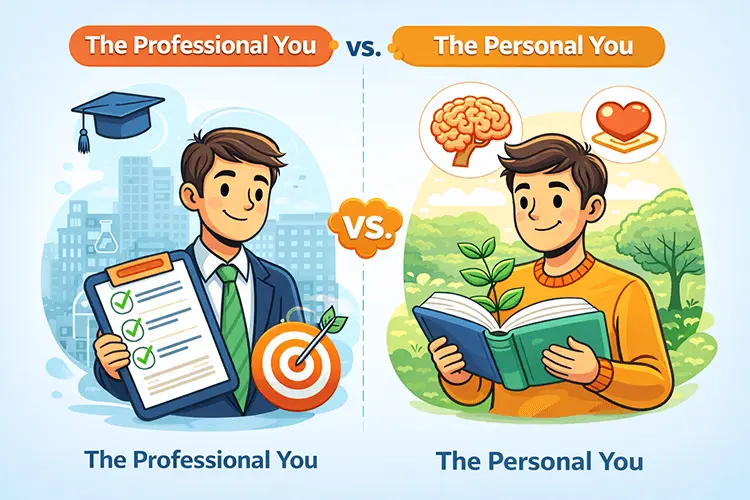
The Core Difference: “The Professional You” vs. “The Personal You”
The difference between SOP and personal statement lies in the specific aspects of your identity that the admissions committee wants to evaluate. One path shows your academic and career objectives while the other path reveals your personal life experiences and core beliefs with the reasons behind your actions.
Statement of Purpose (SOP): Presenting the Professional You
The Statement of Purpose is about your professional objectives and your further direction. It should elaborate who you are and show your commitment to the program.
- Academic Background: The document provides details about your academic history while showcasing your relevant academic projects and work experience and research activities.
- Career Goals: Your document presents your professional objectives for both the immediate future and the distant future in an organized fashion.
- Program Fit: The program selection shows your future goals while demonstrating how the program supports your professional development.
- Formal Tone: The use of formal language to maintain a focused tone which supports clear communication of its intended message.
Personal Statement (PS): Revealing the Personal You
The Personal Statement describes your personal identity together with your core values and your personal experiences which created your academic interest in the field.
- Personal Experiences: The document shares your personal experiences which led you to choose your academic path and career path.
- Personal Growth: The document outlines your personal development journey together with your ability to overcome challenges and the knowledge you acquired throughout your life.
- Motivation Beyond Academics: The text establishes your personal background as a basis for your application motivation which extends beyond your academic performance and accomplishments.
- Reflective Tone: An emotional connection between the target audiences and the author is established with the incorporation of reflective writing components.
Side-by-Side Comparison: Purpose, Content, and Tone
The application process requires two main components which serve their separate purposes. The different writing purposes of the Statement of Purpose and Personal Statement become evident through a direct comparison which shows their different structural elements. Understanding these two different elements will help you meet admissions committee requirements for each document while maintaining proper writing style and avoiding repetition.
Statement of Purpose vs. Personal Statement: Key Differences Explained | Aspect | Statement of Purpose (SOP) | Personal Statement (PS) |
| Primary Purpose | Explains your academic objectives and career goals | Explores your personal background and motivations |
| Main Focus | Academic interests, research direction, and professional plans | Life experiences, values, and personal growth |
| Content Type | Facts, goals, qualifications, and program alignment | Stories, reflections, and meaningful moments |
| Tone | Formal, focused, and professional | Personal, reflective, and authentic |
| Writing Style | Structured and analytical | Narrative and expressive |
| Key Questions Answered | Why this field and why this program? | Who are you beyond academics? |
| Use of Examples | Academic projects, internships, research, work experience | Personal challenges, turning points, influences |
| Program Fit Emphasis | Strong and direct | Indirect and contextual |
| Length Expectation | Usually longer and more detailed | Usually shorter and more concise |
| Evaluation Criteria | Clarity of goals, preparation, and alignment | Character, mindset, and personal insight |
| Common Mistakes | Being too personal or vague | Repeating the SOP or lacking reflection |
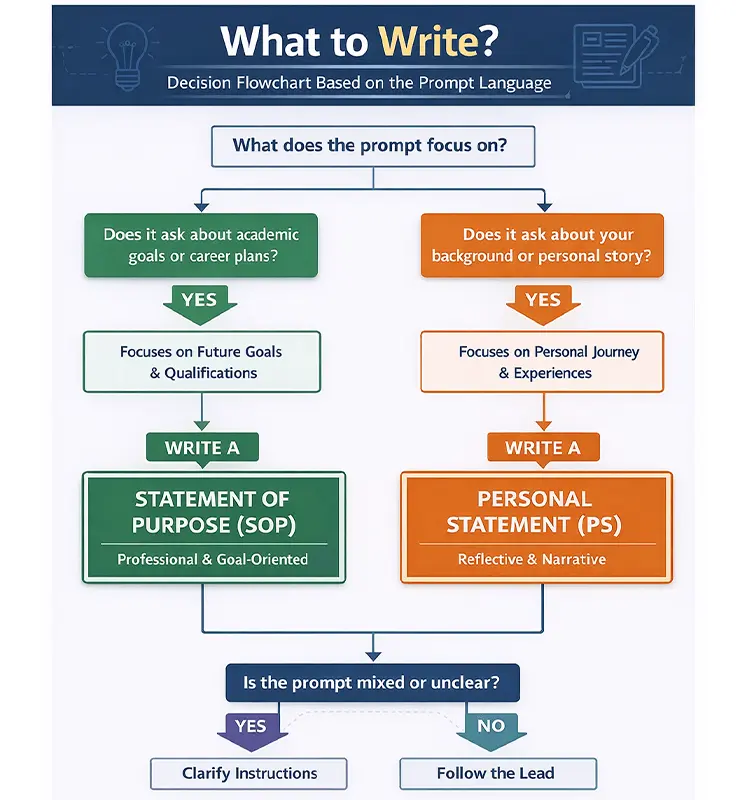
How to Decode the Prompt: A Decision Guide
Application prompts give admissions committees information about which essay type they expect from applicants. The process of selecting between what is a statement of purpose and a Personal Statement and their combined form requires you to examine particular words and phrases.
Keywords That Signal a Statement of Purpose (SOP)
The keyword terms substantially imply a question related to your academic goals, preparation, and future goals.
- Goal-Driven Language: When such terms as academic goals, research interests, career objectives, and professional plans are used, they implicitly refer to a statement of intervention.
- Purpose-Focused Prompts: Queries about why the program, why the field, and how this degree fits one's goals aim at an answer that is directed by intention.
- Professional Framing: Responses should involve structured and formal descriptions around the queries of skills, background, or experience.
Keywords That Signal a Personal Statement (PS)
The existence of these keywords shows that the prompt requires personal reflection, together with storytelling about oneself.
- Identity-Focused Language: The PS requirement needs words that show personal journey, background, identity, and life experiences.
- Reflective Evaluation: The evaluation of challenges, growth, values, and motivation requires candidates to perform self-evaluation through their answers.
- Storytelling Cues: Narrative storytelling becomes necessary when prompts request you to share a personal story or explain an important life event.
Parallel Examples: The Same Applicant, Two Different Essays
The comparison of two essays enables you to see how one applicant creates two opposing stories. The SOP demonstrates academic readiness while showing future goals, whereas the PS emphasizes personal motivation together with actual life experiences. The two things differ because they demonstrate different achievements through their distinct ways of presenting information with different goals.
Understanding the SOP Example:
The example shows how an SOP maintains its professional nature while maintaining its objective focus. The assessment process gives priority to academic qualifications and research experience and program suitability instead of personal narratives. The writing demonstrates SOP for masters organized structure which maintains its central focus while projecting future goals and academic research readiness.
Sample of SOP:
Example of a Strong Statement of Purpose for Computer Science | “My goal for entering the Master’s program in Computer Science is to achieve greater knowledge about data analytics and machine learning through academic studies. My undergraduate studies showed me that statistics and database systems courses provided essential knowledge about data usage for solving real-world issues. My final-year project demonstrated my research interest when I conducted predictive modeling research on consumer behavior. The project presented difficulties, yet it provided me with skills to perform data cleaning and assumption testing and to extract knowledge from unexpected outcomes. I learned that analytical thinking is vital for success in research work through this experience. My internships and academic work provided me with fundamental skills in Python and data visualization software. The experiences enabled me to see how theoretical knowledge fails to translate into effective real-world implementation. I need a program that will help me build my technical skills while providing guidance toward my objectives in applied data research. The program will help me reach my academic goals through its course structure and teaching methods”. |
Understanding the PS Example:
The example demonstrates that a graduate school personal statement directs its attention to the applicant's inner self. The document shows the applicant's character and motivation and development through their life experiences instead of presenting their qualifications. The applicant uses a personal and reflective tone to show their academic journey through their human experiences to admissions officers.
Sample of PS:
Example of a Personal Statement Focused on Self-Reflection and Growth | “The academic profile which I built throughout my studies became my primary identity as a student. The process of learning requires students to complete work assignments and take tests which I discovered during my undergraduate studies. The experiences which created my strongest development occurred during moments when I needed to think about my decisions before facing new situations. The path I wanted to follow through my studies remained unclear to me during my academic research. I discovered that my ability to explore different fields of study increased when I stopped viewing my uncertainty about direction as a personal fault. My experience with mentors and peers taught me thatI should ask questions whileI maintain an attitude that prepares me for personal development. My academic and personal development process underwent changes through my self-reflection activities. I currently practice three essential values which include transparency and enduring improvement. The experiences I have encountered throughout my life journey have given me a strong sense of purpose which now enables me to begin my educational path with confidence and self-knowledge”. |
The Graduate School Application Checklist will save you time once you follow that:
How to Write a Winning Statement of Purpose (The “GPS” Formula)
The "GPS" formula helps you stay focused while writing your Statement of Purpose by guiding the reader from where you are, to where you want to go, and why this program is the right route. This structure keeps your SOP clear, logical and easy for admissions committees to follow the document.
1. Introduction: Setting Your Direction
You need to start your academic statement by describing your main academic interest and your future career objective. Your study plan should begin with your academic field choice and the reasons behind your decision to study that particular field.
2. Academic Preparation: Showing You’re Ready
You must present all your essential academic coursework together with your research activities and your work experience to support your application. You should study this section because it demonstrates your ability to handle graduate-level academic work.
3. Program Fit: Why This Route Works
Explain why this specific program aligns with your goals. You should provide evidence about the program's curriculum which covers academic content and teaching methods used in the learning environment. You need to demonstrate your understanding of the program's offerings which will help you attain your future goals.
4. Conclusion: Confirming Your Destination
Your academic objectives and program readiness should serve as your concluding statement. Your training should be used to establish your future professional contributions which you should present with both confidence and realism.
Template: Download the Statement of Purpose Writing Template (PDF)
How to Write a Winning Personal Statement (The “Story Arc” Formula)
The “Story Arc” formula helps you shape your Personal Statement into a clear, meaningful narrative. The approach requires the reader to follow your story through your experiences and reflections and your personal development instead of presenting your accomplishments through a list, making personal statement writing more engaging and impactful.
1. Hook: Opening With a Real Moment
Your story needs an introductory moment which presents the truth about your main character. The hook should feel natural and personal, which helps the reader to connect with the story without using any forced or theatrical elements.
2. Journey: Showing Growth Over Time
You should explain your experiences through their actual impact on your life which developed your current outlook on life. The focus of your response should show your personal development through learning instead of describing the events that took place. The emotional center of your statement exists in this section.
3. Academic or Professional Link: Connecting Story to Purpose
Your personal experiences should be connected to your academic and professional interests. Your learning path needs to show how your experiences brought you to your current educational objectives.
4. Contribution: Looking Forward
Your academic contribution to the academic community requires explanation through your personal assessment of your academic strengths and values which you will bring to your educational journey.
Template: Download the Personal Statement Writing Template (PDF)
The Most Common Fatal Mistake & How to Avoid It
The main mistake that applicants make in their application process occurs when they fail to understand why each essay exists. Your writing will reach better standards through the knowledge of this mistake which you already possess.
- The Mistake: The most common mistake is treating the Statement of Purpose and Personal Statement as interchangeable which leads to repetitive content and results in an essay that fails to meet the requirements of admissions committees.
- The Fix: The solution requires complete separation of purpose and perspective. The use of SOP to explain academic goals and preparation, and the Personal Statement to reflect on personal growth, motivation, and values.
The following table of mistakes and how to fix that will guide you in detail:
Common SOP vs Personal Statement Mistakes—and How to Fix Them | Aspect | The Mistake | Why It Hurts Your Application | The Fix | How the Fix Improves Your Essay |
| Understanding Essay Purpose | Treating the SOP and Personal Statement as the same type of essay | Admissions readers cannot tell what role each essay plays | Clearly defining the purpose of each essay before writing | Creates clarity and shows awareness of application expectations |
| Content Selection | Repeating the same academic details in both essays | Wastes space and adds no new insight | Assigning academic details to the SOP and personal experiences to the PS | Ensures each essay adds unique value |
| Focus | Writing both essays around achievements only | Makes the application feel one-dimensional | Balancing achievements with reflection and motivation | Presents a well-rounded applicant profile |
| Tone and Voice | Using a formal, professional tone everywhere | Makes the Personal Statement feel impersonal | Adapting tone to suit each essay’s goal | Builds authenticity and reader engagement |
| Use of Examples | Listing experiences without reflection | Fails to show learning or growth | Explaining lessons learned from experiences | Demonstrates maturity and self-awareness |
| Program Alignment | Mentioning program details in the Personal Statement | Blurs the role of each essay | Reserving program-specific details for the SOP | Keeps essays purposeful and focused |
| Reader Experience | Causing confusion about who the applicant is | Weakens emotional and academic impact | Creating a clear narrative flow across essays | Makes the application memorable |
| Overall Impression | Essays feel repetitive and unfocused | Reduces competitiveness | Essays feel intentional and complementary | Strengthens the application as a complete story |
Conclusion
The difference between a Statement of Purpose and a Personal Statement exists because people need to select the most suitable approach to show their personal identity. The application process becomes clear and intentional with memorable results when each admission essay fulfills its intended function. The separation of your professional path from your personal development enables admission committees to assess both your professional capabilities and your personal attributes. The ability to maintain this equilibrium enables people to transform their uncertainty into self-assurance which leads to successful college admissions outcomes.