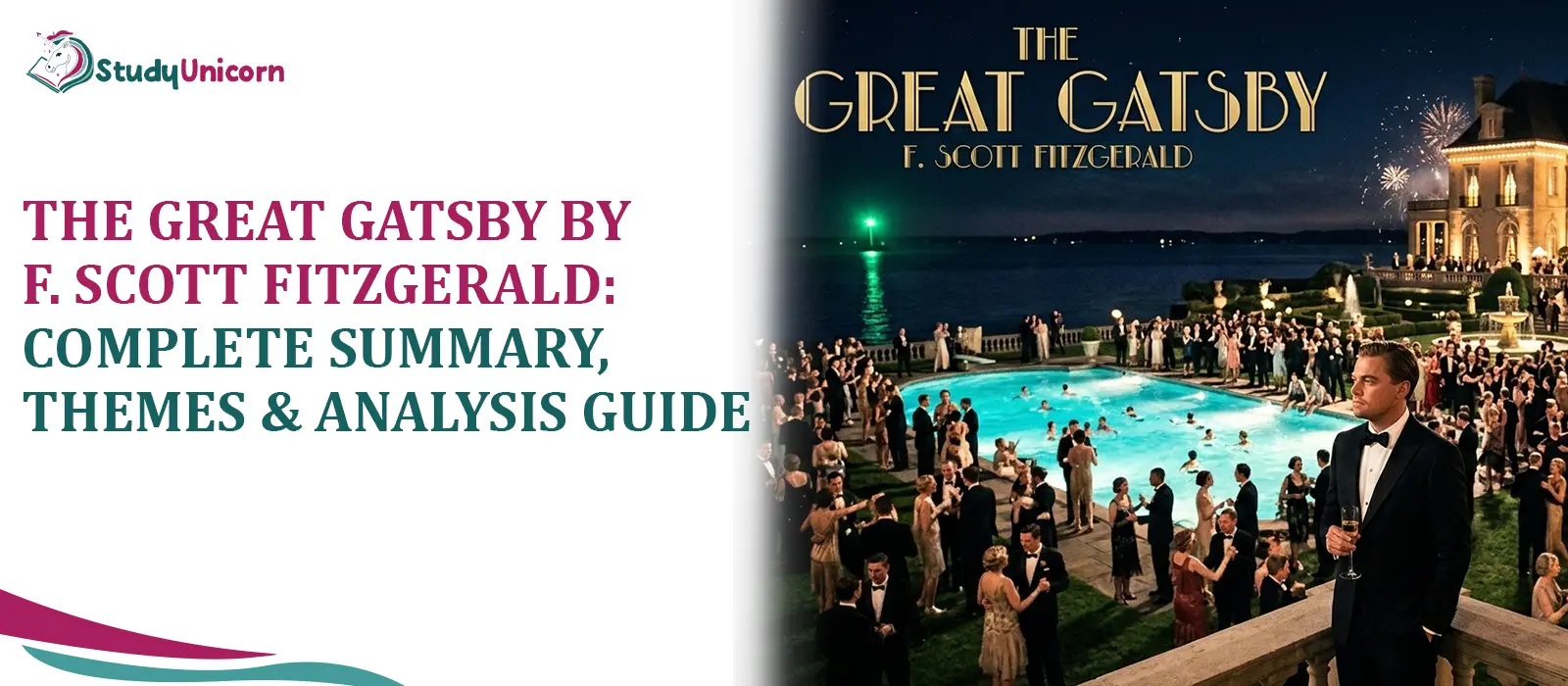
The Great Gatsby by F. Scott Fitzgerald is the most widely known novel in American literary history. The story plot is situated in the 1920s and such themes as the rich, love, ambition, and the illusion of the American Dream are discussed with the assistance of the mysterious life of Jay Gatsby. In order to give a clear idea of what is being dealt with, The Great Gatsby Study Guide illustrates the general topics with the story part, the chief themes, along with the main characters of this masterpiece.
Quick Overview: The Great Gatsby in 60 Seconds
The author of the text provides a brief overview of himself and his writing work while describing the novel's setting, its storytelling approach, its main plot conflict, and crucial points, and the book's central The Great Gatsby themes.
Quick Overview of The Great Gatsby (Key Facts & Summary) | Category | Information |
| Author | F. Scott Fitzgerald |
| Published | 1925 |
| Genre | Tragedy / Classic American Fiction |
| Setting | Long Island during the 1920s Jazz Age |
| Narrator | Nick Carraway |
| Protagonist | Jay Gatsby |
| Core Conflict | Gatsby’s pursuit of love and the illusion of the American Dream |
| Famous Closing Line | “So we beat on, boats against the current, borne back ceaselessly into the past.” |
Detailed Plot Summary
The Great Gatsby by F. Scott Fitzgerald is a novel. It explains the plot of the story through the eyes of the narrator Nick Carraway. Jay Gatsby and his hidden life is revealed to the readers through Nick. The Great Gatsby Summary the overwhelming love Gatsby has for someone together with his desire for money and his wish to revive his last life. The book is set in 1920 that is both a challenging and a prosperous setting.
Chapter 1–3: Entering Gatsby's World
- Nick Moves to West Egg: Nick Carraway, who is his cousin, visits Daisy Buchanan and her husband, Tom Buchanan, at West Egg. He soon observes that there is a strain in their marriage, and he gets to wonder about his new neighbor, Gatsby.
- Gatsby’s Grand Parties: Nick learns about the well-known parties that Gatsby throws where he gathers rich people every weekend. The guests who attend the parties spend their time at the events which feature musical performances and dancing while they experience luxurious conditions and most guests do not know their host.
- Encountering Jay Gatsby: Jay Gatsby is finally encountered during one of the parties that Nick attends. However, unlike the rumors surrounding his image, Gatsby is not mean or furious and such an incident shocks Nick and initiates the formation of their weird friendship.
Chapter 4–6: The Past Revealed
- Background Story of Gatsby: Gatsby tells Nick an account of his life and tells him that he loved Daisy. The fame and the lifestyle he built for himself are all aimed at bringing her back so that she can see that he deserves her love.
- The Reunion with Daisy: Gatsby informs Nick that he would like Daisy visit his house to have tea. The two are emotionally reunited after a couple of years but nostalgic feelings of each other resurface shortly.
- Attempting to recreate the Past: Gatsby feels that he can get back into their last relationship with Daisy as it was before they were separated. Nick later realizes how obsessed Gatsby is over this dream.
Chapter 7–9: Tragedy and Collapse
- The Tension between Gatsby and Tom: The tension heightens as Tom listens to the fact that Daisy can love Gatsby. Gatsby employs his hotel room in persuading Daisy that she should tell him that she loves him since he feels she did not love Tom.
- A Tragic Accident: Daisy runs over Myrtle Wilson with a car belonging to Gatsby by an accident after the argument. Myrtle wife of George Wilson believes this is because of Gatsby due to the actions of Tom.
- Gatsby’s Death and Nick’s Reflection: Gatsby is shot by George Wilson who also kills himself. There are hardly any people present at the funeral of Gatsby. Nick is no more surprised by the world of the rich that proves to be selfish and he runs away.
Three Key Themes of The Great Gatsby
This section provides a brief The Great Gatsby Analysis, the conceptualizations of the key ideas of the story authored by F. Scott Fitzgerald. The novel through Jay Gatsby character and the eyes of Nick Carraway talks about dreams and divisions of classes and the desire to live the past.
Theme 1: The American Dream and Its Corruption
- Gatsby’s Dream of Success: Jay Gatsby is confident that money and fame will assist him to take Daisy Buchanan back. The dream is mirror of the thought that anyone can be happy in case of determination and ambition.
- Wealth Without True Happiness: The characters Tom Buchanan and Daisy display emotional detachment because they live an extravagant lifestyle. Their wealth demonstrates that money cannot provide genuine connections or actual fulfillment.
- The Dream Becomes Corrupted: Gatsby acquires riches in a dubious way in pursuit of his dream. This reveals that the American Dream in The Great Gatsby can be twisted when the individuals are centered on the only aspects of money, status, and personal wishes.
Theme 2: Class and Social Stratification
- Old Money vs. New Money: The novel shows how there is a difference between old wealth and newly acquired wealth. Gatsby is a symbol of new money and on the other hand Tom and Daisy belong to old families of money and consider someone like Gatsby a despotic individual.
- Various Worlds of Society: The characters live in various social environments such as East Egg and West Egg. These are the places and areas that depict the stark difference between the old money and the new wealth.
- Social Class Separations: Gatsby achieves wealth through his success yet he remains unable to compete with the established upper class. The novel shows how social class determines both social interactions and available opportunities and social status in society.
Theme 3: The Impossibility of Repeating the Past
- Gatsby’s Desire to Relive the Past: Gatsby strongly believes that he can travel back on the time when he and Daisy fell in love. His aspiration is the driving force of the majority of his decisions and the intention to become rich.
- Reality vs. Idealized Memories: Whereas Gatsby recollects the past as ideal, Daisy has continued with her life. This contrast shows that memories may turn impractical when individuals are too attached to them.
- The Limits of Time: The book shows that one of the things that can never be reversed is time and as a result of that tragic ending of Gatsby. The past will never come again, no matter how powerful the dreams and the desires of a certain individual are.
Two Major Characters Analyzed
This section will present you two major characters of the novel written by F. Scott Fitzgerald. Their positions, their characters and their objectives demonstrate the role that they play in the formation of the narrative, the conflicts and the general theme of the book.
Jay Gatsby: The Self-Made Myth
Jay Gatsby is someone who invented himself using money, ambition, and drive while pursuing the ideal dream. Here’s a quick “Jay Gatsby character analysis” chart that breaks down his function, background, motives, and symbolism in the novel.
Jay Gatsby Character Analysis (Role, Traits, and Symbolism) | Aspect | Explanation |
| Role | Jay Gatsby is the main character who hosts famous parties and becomes the center of the story’s mystery and fascination. |
| Background | He was born poor as James Gatz, but later created a new identity and gained great wealth to change his life. |
| Appearance | Gatsby is handsome, stylish, and always dressed in expensive clothes, which reflects his wealthy lifestyle. |
| Motivation | His biggest dream is to win back Daisy Buchanan and relive the love they shared in the past. |
| Tragic Flaw | Gatsby strongly believes that the past can be repeated, which makes him chase an unrealistic dream. |
| Symbolism | Gatsby represents ambition, hope, and the desire to achieve the American Dream. |
| Key Quote | “Can’t repeat the past? Why of course you can!” |
Nick Carraway: The Moral Compass
The story uses Nick Carraway as its narrator who observes the behaviors of everyone around him. The table below presents a "Nick Carraway character analysis" which explains his function in the novel.
Nick Carraway Character Analysis (Narrator, Role & Perspective) | Aspect | Explanation |
| Role | Nick is the narrator of the story. He observes events and shares his experiences with the readers. |
| Background | He comes from a respectable Midwestern family and moves to West Egg to work in the bond business. |
| Narrative Function | Nick describes the personalities, actions, and conflicts of other characters, especially Jay Gatsby. |
| Character Arc | At first, Nick is curious about the luxurious lifestyle of the rich, but later he becomes disappointed by their careless behavior. |
| Reliability | Nick tries to remain fair and honest while telling the story, although his personal opinions sometimes influence his view of events. |
| Key Insight | Through his experiences, Nick realizes that many wealthy characters are selfish and irresponsible despite their social status. |
| Key Quote | “They’re a rotten crowd… You’re worth the whole damn bunch put together.” This line shows Nick’s respect for Gatsby compared to others. |
Symbols and Motifs
The symbolism in The Great Gatsby enables the readers to enjoy the more hidden messages that touch on wealth, society, morality, and dreams in the Novel of F. Scott Fitzgerald. These symbols demonstrate hidden meanings of the lives of such characters as Jay Gatsby.
The Eyes of Dr. T.J. Eckleburg
- A Watching Presence: Dr. T. J. Eckleburg is above the land with the billboard eyes wherein he is simply watching the land on the Valley of Ashes and it is a mysterious picture of watchful waiting.
- Symbol of Moral Judgment: The eyes can be seen by many readers as the visual symbol of some superior moral power observing human conduct silently and reminding characters that their actions and decisions can be still judged.
- Reminder of Lost Values: The decaying billboard provides evidence that modern society has experienced moral decline which occurs when people prioritize material wealth and pleasure above all else.
East Egg vs. West Egg
- Two Different Worlds: East Egg and West Egg are two sides of the wealthy society, who are located in the same location and are separated by the background and customs.
- Old Money vs New Money: East Egg is a symbol of old wealth and old families, but West Egg is a symbol of new money of people who are newly rich, like Jay Gatsby who had only inherited his money.
- Symbol of Social Division: The difference between the two places reveals how disparity of classes influences the interrelatedness, respect and social acceptance among the wealthy characters in the story.
The Valley of Ashes
- A Place of Poverty: The Valley of Ashes is a pessimistic and unhygienic suburb between the wealthy neighborhood and the city, where poor laborers can hardly survive.
- Symbol of Decay: It is the symbol of bad sides of money and industrialization, and it reveals the ugly background of the glamorous life of wealthy characters.
- Life of Struggle: Characters such as George Wilson survive here and this represents the harsh living conditions that people are subjected to in the outside world that is not the wealthy social world.
Gatsby's Mansion
- Symbol of Wealth and Success: The big and glamorous mansion which Jay Gatsby possesses symbolizes his considerable wealth and his trying to depict himself as a successful person in society.
- Place of Grand Parties: Gatsby superbly throws lavish parties at the mansion where he invites a number of guests hoping that Daisy Buchanan would come to one of the parties.
- Dream Behind the Luxury: Though the mansion appears as an impressive symbol, it also represents another dream that Gatsby had of love, acceptance, and a new life he thinks he could relive.
Historical and Literary Context
The context of the F. Scott Fitzgerald novel allows the reader to realize that the history and culture had various impacts on the novel itself, its themes, and experiences of such people as Jay Gatsby.
The Jazz Age and the Roaring Twenties
- A Time of Wealth and Parties: The book takes place in the 1920s Jazz Age which featured economic expansion and musical growth and a society that celebrated wealthy people through their lavish parties and extravagant way of life.
- The Emergence of Consumer Culture: The majority of people at this time feared about money, style, and culture. The position and material success in those days are desired as demonstrated through such characters as Jay Gatsby.
- Hidden Social Problems: Despite the decade appearing to be exciting and a prosperous one, there are other issues that are deeper and overruling like social inequality, moral decay and the vacuum behind the glamorous lifestyle that is apparent through the novel.
The Lost Generation
- A Generation After War: The process is known as the Lost Generation and is used to refer to the post-World War 1 writers and youths who had suffered the negative emotional and social impact of the war.
- Feelings of Disillusionment: The generation was confused by traditional values and did not know how to find a meaning and direction in the modern society that was being rapidly changing.
- Search for Meaning: Authors tended to discuss the lost ideals, identity, and doubt, with how people were attempting to discover the meaning and life in the world that had radically transformed.
Modernist Literature
- A New Writing Style: The new styles of modernism brought about new styles of literature concerned with psychological depth, symbolism and inner thoughts of characters.
- Focus on Inner Experiences: Contemporary authors were very attentive to feelings, recollections and personal attitudes that enable readers to know much more about characters and their sophisticated motives.
- Symbolism and Meaning: The novel employs some very strong symbols, one of them being the so-called green light meaning great gatsby, which symbolizes hope and dreams as well as the human aspiration to something truly impossible.
Fitzgerald's Life and Influences
- Connection to the Jazz Age: F. Scott Fitzgerald was a person living in the 1920s and he was exposed to the excitement, the richness and the social transformations which shaped the setting and characters in the novel.
- Personal Experiences: A lot of love, ambition, and success issues of Fitzgerald were used in his emotional conflicts and explored in the story.
- Reflection of Society: Fitzgerald in the novel was able to depict the glitz and nothingness of the times, and came up with an effective reflection of the American society of the Jazz Age.
Download Free Great Gatsby Study Resources
Then list all PDFs together so students can easily scan and download.
Example Structure:
Conclusion
The Great Gatsby is a robust piece of literature regarding dreams, money, and love, and the social class system. F. Scott Fitzgerald illustrates how the past, ambition, and deception can affect people and ultimately give them hope as well as disaster through the experiences of Jay Gatsby and the viewpoint of Nick Carraway.