Think of a snickering campfire thousands of years prior, and the first teller of a tale put his foot in the fire, and altered his voice and his position and became someone he was not. It was just one second of make-believe, but that gave birth to an art form that has outlived even empires and the digital revolutions. The stage was ever our mirror, left to our ancestors in the sun-burnt amphitheaters of Ancient Greece, where acting men wore masks and wrestled with inevitable destiny, and to our own London, with its rowdy timber-framed Globe, still. Plays are not scripts; they are plans for human activity.
They may be a punch to the gut of tragedy, leaving you in reflective silence, or they may be a vertiginous comedy of banging doors and false identities that causes a room full of strangers to burst into laughter. Knowledge of genres, styles, and drama forms is equivalent to learning the secret language of empathy. It is a tour of the diverse topography of the theater and follows the development of the theatrical stage from classic tragedies to cross-border experimentation of contemporary theater.
What Are the Major Genres of Plays?
Although there is unlimited experimentation in the theater, there are broad categories of most performances. These genres give the DNA of a play, and warn the audience that it will be an evening of solid emotional catharsis, stinging social commentary, or feel-good escapism. Knowing these dramatic categories better, you will be in a better position to appreciate how dramatists employ certain conventions to mirror the intricacies of the human condition.
Tragedy
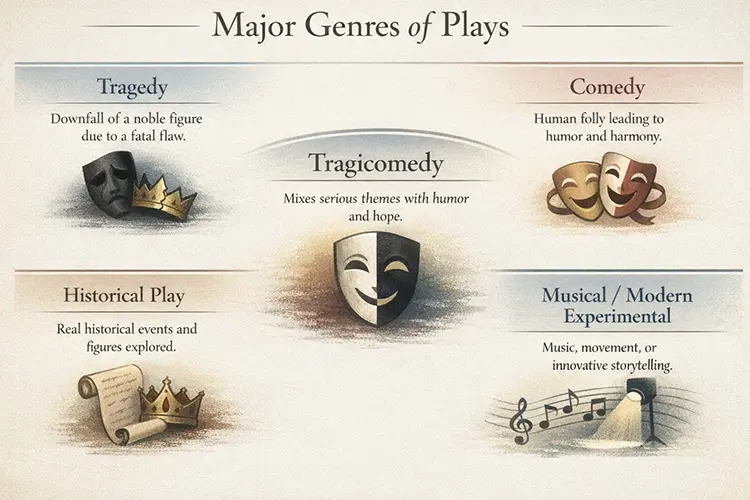
Tragedy is among the oldest and most sacred types of drama which focuses on the eventual destruction of a noble or high-status hero. Because of the tragic flaw called hamartia, e.g., pride, ambition, jealousy, etc., the hero becomes doomed to insurmountable odds, resulting in a disastrous, and in many cases fatal, ending. This is all intended to create a catharsis, as Aristotle was known to have defined it: an emotional purification in the viewer of pity and fear.
Examples:
- Henry V by William Shakespeare (A patriotic exploration of leadership and war)
- The Crucible by Arthur Miller (Uses the Salem witch trials as a historical lens for McCarthyism)
- Hamilton by Lin-Manuel Miranda (A modern reimagining of the American
Historical Plays
Historical plays are plays that portray important events, characters or periods that took place in the past. Although they are based on factual accounts, the playwrights tend to employ dramatic license that allows them to create dialogues and manipulate the chronology in order to address universal themes, such as power, national identity, and the burden of legacy.
Examples:
- Henry V by William Shakespeare: A patriotic exploration of leadership and war, following the young King Henry's invasion of France and his victory at the Battle of Agincourt.
- The Crucible by Arthur Miller: While set during the 1692 Salem witch trials, Miller wrote this as an allegory for the "Red Scare" and McCarthyism in the 1950s, showing how historical settings can comment on current political climates.
- Saint Joan by George Bernard Shaw: Dramatizes the life and trial of Joan of Arc, exploring the conflict between individual conscience and institutional authority.
- Hamilton by Lin-Manuel Miranda: A modern "sung-through" historical musical that uses hip-hop to tell the story of Founding Father Alexander Hamilton, emphasizing the theme of "who lives, who dies, who tells your story."
- Oppenheimer by Heinar Kipphardt: A "docudrama" focused on the 1954 security hearing of J. Robert Oppenheimer, exploring the moral responsibility of scientists in the atomic age.
Comedy
Comedy is meant to entertain and bring out humor by exposing the foolishness, quirks, and ridiculousness of people and society. As opposed to tragedy, the comedies usually start with disorder and eventually lead to normalcy, followed by a joyful ending that is usually a wedding or a party.
Subtypes:
- Farce: A very dramatic, quick-paced comedy which makes use of physical humor, ridiculous events, and "slapping door" humor.
- Satire: A type of intellectual comedy, which employs satire and sarcasm in order to criticize a social institution, politics or vices of mankind with the aim of causing a change.
- Romantic Comedy: It focuses on the misfortunes and struggles of two people in love who have to surmount all barriers to be united.
Examples:
- A Midsummer Night's Dream by William Shakespeare (Romance Comedy)
- Importance of Being Earnest by Oscar Wilde (Satire/Comedy of Manners)
- The Play That Goes Wrong by Henry Lewis, Jonathan Sayer, and Henry Shields (Farce)
Tragicomedy
Tragicomedy is a complicated genre that consciously erases the boundaries between the two names of this genre. It can be a tragic and serious plot, that ends up having a happy ending, or it can employ humor in order to highlight the absurdity and irony in a disastrous situation. It reflects real life which is a chaotic affair where laughter and tears can coexist at the same time.
Examples:
- Waiting by Samuel Beckett (The definitive "Absurdist" tragicomedy)
- The Cherry Orchard by Anton Chekhov (A fine line between social corruption and comedy)
- The Winter's Tale by William Shakespeare (A problem play in which the main storyline changes between a strong tragedy and some magical and comic ending)
Historical Plays
Historical plays are those that are based on major events, people or times of the past. Although they have real-life foundations, playwrights usually have leeway with dramatic license to create dialogue and change the order of events to allow exploration of universal themes, such as power, national identity, and the heavy burden of legacy.
Examples:
- Waiting by Samuel Beckett (The definitive "Absurdist" tragicomedy)
- The Cherry Orchard by Anton Chekhov (A fine line between social corruption and comedy)
- The Winter's Tale by William Shakespeare (A problem play in which the main storyline changes between a strong tragedy and some magical and comic ending)
Theatrical Styles and Movements
A genre is used to describe the type of story being told whereas theatrical style is used to describe the way the story is told on stage. During the past century, there have been numerous movements that appeared as responses to the social and political shifts in the world. These styles determine not only the manner in which an actor speaks but even the design of the set that makes the viewers feel like flies on the wall in a real home to that of the surreal feverish dream.
Realism
Realism, which came into existence in the late 19th century, aimed at depicting life in a scientifically accurate manner. It substituted the poetic verse with ordinary speech and the epic, heroic designs with the mundane problems of the lower and middle classes. This may be performed on stage making use of the so-called Fourth Wall convention, meaning that the audience is observing the action through a fictional, transparent wall into a real room.
Examples:
- A Doll's House by Henrik Ibsen (A prototype of domestic realism)
- Magnolia by Tennessee Williams (Psychological realism)
- August Wilson (Realism exploring the Black experience) Fences.
Expressionism
Expressionism denies the objective truth of realism but distorts the physical world to represent the internal subjective feelings of a character. The sets can also have jagged angles and rough lighting and the play can be stylized or exaggerated to depict the internal violence, anxiety or spiritual crisis of a character.
Examples:
- The Hairy Ape by Eugene O'Neill (A criticism of industrialization with deformed reality)
- Machial by Sophie Treadwell ( Expressionist view of the limitations on women )
- The Adding Machine by Elmer Rice (One of the surrealist interpretations of the dehumanization of work)
Epic Theatre
Epic Theatre, which was developed mostly by Bertolt Brecht, is meant to stimulate the mind, but not the heart. It makes use of alienation effects (Verfremdungseffekt) to show the audience they are watching a play. The fourth wall is broken, the lighting is minimal and non-mood, signs or projections are displayed to ensure that the audience is intellectually detached to enable them to critically analyze the social or political message.
Examples:
- Bertolt Brecht Mother Courage and Her Children (An anti-war masterpiece)
- The Caucasian Chalk Circle, a play by Bertolt Brecht (A parable on justice and ownership).
- Angels in America by Tony Kushner (Employs numerous Epic theatre techniques to comment on politics)
Absurdist Theatre
The Theatre of the Absurd emerged in the aftermath of the atrocities of World War II and deals with the notion that human life lacks any definite meaning and purpose. The plays are characterized by repetition of dialogue, unreasonable story lines as well as characters being stuck in a loop scenario. The absurdity is the struggle between humans to find order in the essentially chaotic and irrational universe.
Examples:
- Waiting by Samuel Beckett (Two men wait)
- Bald Soprano by Eugene Ionesco (A domestic life comedy of nonsensical events)
- The confusion of minor characters in a larger, incomprehensible plot Rosencrantz and Guildenstern Are Dead by Tom Stoppard.
Shakespearean Play Types
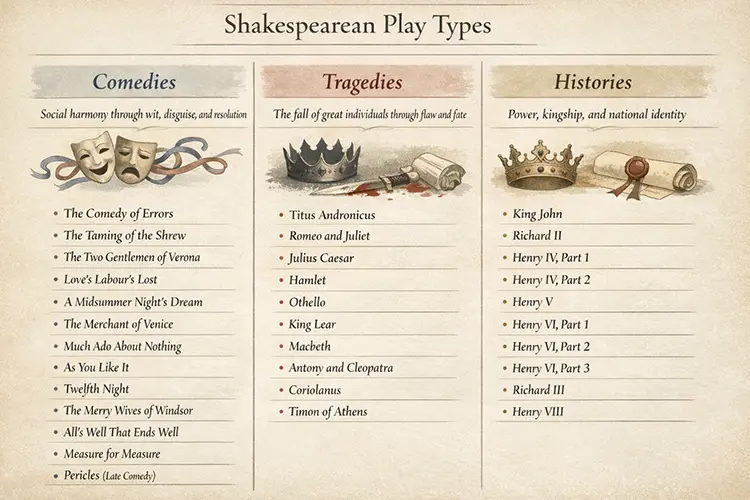
The works of William Shakespeare are so fundamental that they tend to warrant their own classification. His plays were notoriously split into three different buckets when the First Folio was published in 1623. Although there are cases when contemporary scholars include one more type: the Romances or Problem Plays, it still makes no sense to investigate the heritage of the Bard without understanding the three major types.
Comedies
Shakespearean comedies are not necessarily funny in the modern meaning of this word, but this genre is identified by its structure and tone. Key elements include:
- The Conflict to Marriage Movement: This is the kind of movement in most comedies, with a wedding (or several weddings), representing a symbol of social peace.
- Mistaken Identity and Disguise: Characters are prone to cross-dressing or hiding their identity in order to find their way through social obstacles.
- Complex Plots: This convention is common with multiple crossed subplots and servants who play tricks on their masters.
- Wordplay: High-frequency puns, metaphors and verbal jokes.
Examples:
- Twelfth Night (A masterpiece of unrequited love and mistaken identity).
- Much Ado about Nothing (A battle of wits about the two quarrelling lovers)
- The Taming of the Shrew (A scandalous investigation of the dating game and social roles)
Tragedies
The tragedies of Shakespeare are considered to be one of the most powerful works of Western literature. They are normally of a certain pattern:
- A Hero of High Stakes: The hero is typically someone of very high status (a king, general or a prince) whose downfall will involve a whole country.
- The Tragic Flaw (Hamartia): A certain personal quality, such as pride or indecisiveness, which causes his/her demise.
- Supernatural Elements: Presence of ghosts, witches or ominous signs that increase the feeling of something dreadful being imminent.
- The Body Count: Tragedies nearly always conclude with the demise of the main character and a few of the supporting characters.
Examples:
- Hamlet (The paradigm of the tragedy of revenge and existential crisis)
- Othello (Lethal Weapon of Jealousy and Manipulation)
- Romeo and Juliet (The classic tragedy of cross-starved lovers and family feuds)
Histories
These were more so political plays, dramatizing the lives of the English kings to find out the validity of authority and the responsibilities of a king.
- Concentrate on English Royalty: Majority of them are named after the king who ruled during that time such as the Henry and Richard plays.
- Social and Political Criticism: They tend to reflect on the worries of the Elizabethan and Jacobean times about succession and civil war.
- A Blend of Historical Records and Fiction: Shakespeare mostly skewed results since he had to write about past events and had to do it to make the story more interesting or he had to please the ruling king.
Examples:
- Richard III (With one of the most villainous and charismatic kings in the history)
- Henry V (An epic drama of war, kingship, and nationality)
- Richard II (A poetical tragedy about the right of kings that is divinely granted and the suffering of being deposed)
Modern and Contemporary Play Types
The theater of the previous century has radically changed, although the classics made the basis. Contemporary theatre writers have shunned the traditional forms and are experimenting with the ways in which music, technology and real-life information can be incorporated into the onstage experience.
Musical Theatre
Musical theatre genres is a genre of drama, which integrates verbal communication, acting and dancing with singing and instrumental music. In contrast with an opera, where the whole plot is often sung, a musical employs book scenes to drive the action along, with songs being sung to convey strong emotion, intensify a dramatic scene, or comment socially.
Examples:
- West Side Story by Leonard Bernstein and Stephen Sondheim (A contemporary, musical reenactment of Romeo and Juliet)
- Les Misérables (Alain Boublil and Claude-Michel Schoenberg) (An epic "sung-through" musical, adapted by Victor Hugo novel)
- The book Wicked by Stephen Schwartz and Winnie Holzman (A revisionist look at the Land of Oz)
Monologues
A monologue is a theatre form in which a mono actor speaks at length. Although monologues do appear in other plays, a one-person show uses this form to narrate an entire story. These types of plays are very dependent on an actor to make an audience believe in the actor not assisted by the scenes, frequently flitting between multiple characters, recollections or through internal turmoil to produce an innermost setting.
Examples:
- Vagina Monologues, Eve Ensler (A compilation of different women's views and experiences).
- Fires in the Mirror by Anna Deavere Smith (A solo performance based on the racial tensions with the help of real-world interviews)
- Thom Pain (based on nothing) by Will Eno (A modern, existential monologue about loss and the human condition)
Documentary Theatre
Also known as "Verbatim Theatre," this genre uses pre-existing documents such as trial transcripts, news reports, and recorded interviews as the primary source material for the script.11 Playwrights in this genre act more like journalists or curators, arranging real-world words into a dramatic structure to shine a light on specific social issues, historical injustices, or community tragedies.12
Examples:
- The Laramie Project by Moisés Kaufman and the Tectonic Theater Project (A play constructed from interviews regarding the murder of Matthew Shepard)
- Notes from the Field by Anna Deavere Smith (Investigates the "school-to-prison pipeline" using verbatim testimony)
- The Exonerated by Jessica Blank and Erik Jensen (Based on interviews with former death row inmates who were later found innocent)
How to Identify Play Types
The genre or style of a play is like a detective game most of the time; you must examine the evidence presented in the text by the playwright. Using the four pillars you can always tell in a short period of time whether you are reading a traditional Tragedy, an Absurdist theatre genres or a scathing Satire.
Major Types of Plays Explained: Plot Structure, Characters, Themes & Settings | Play Type | Plot Structure | Character Archetypes | Primary Themes | Setting & Atmosphere |
| Tragedy | Linear; leads to the hero's inevitable downfall or death. | Noble figures with a "Tragic Flaw" (Hubris). | Fate, justice, pride, and moral struggle. | Grand, formal, or somber; often high-stakes environments. |
| Comedy | Circular or complex; moves from chaos to a happy resolution. | Ordinary people, clever servants, or eccentric fools. | Love, social status, and human folly. | Often domestic or bright; lighthearted and energetic. |
| Realism | Realistic "slice of life" with logical cause-and-effect. | Relatable, multi-dimensional middle-class individuals. | Family dynamics, social problems, and personal truth. | Recognizable indoor spaces (the "Living Room" set). |
| Epic Theatre | Episodic; fragmented scenes often interrupted by signs/songs. | Representational types used to illustrate a social point. | Politics, class struggle, and systemic change. | Minimalist; lighting and set pieces are visible to the audience. |
| Absurdism | Repetitive or illogical; often ends where it began. | Isolated, confused characters waiting or repeating tasks. | Meaninglessness, isolation, and the passage of time. | Sparse, surreal, or "nowhere" spaces (e.g., a roadside tree). |
Conclusion
While looking at the various types of plays, you will see that the theatre constantly changes its shape according to humans' fears, pleasures, disputes, and aspirations. Ancient tragedy, for instance, and modern documentary drama represent different ways of seeing the world, each genre and style giving a different perspective. By getting acquainted with these drama forms, you can increase your enjoyment of the performing arts and also reveal theatre as one of the main mediums for communication throughout time, between cultures, and even human experience, although in some cases it is just that the theatre is viewed as a source of amusement.