You are still confused on whether to use was or were, when writing an if clause? You're in very good company. It is not confusion over a rule of grammar, it is not knowing that the English conditional sentences belong to two entirely different grammatical worlds. When one can clearly see those worlds, then the issue of was or were in the if clause ceases to be a stressor and begins to be logical.
This manual is aimed at providing you with a thorough mastery system, rather than mere tips on the surface. You will also know how to make confident decisions on whether if I was vs if I were, you will know past unreal conditional examples and how to use your grammar in relation to formality, context and purpose. By the end, you won’t just “know the rule,” you’ll understand it.
The Core Framework: Two Different Grammatical Worlds
There is nothing about formality or individual use of was or were in the if clause when referring to something in the past that needs to be considered in the use of the if clause in the sentence. English splits conditional sentences into two grammatical worlds, the world which describes imagined or unreal situations and the other which is real or possible past events. This is because by knowing the world your sentence is in you immediately know what the correct verb should be.
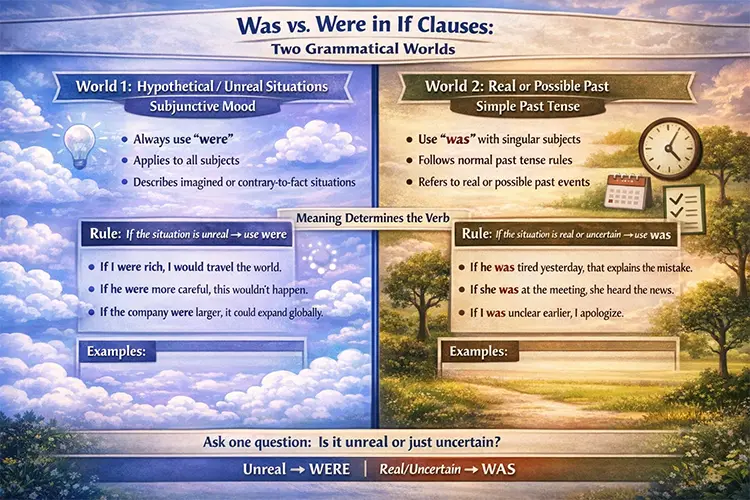
World 1: The Hypothetical Realm (Always “Were”)
It is because the hypothetical realm is governed by the subjunctive mood, a mode of English that is used to describe situations that are not real, not true, or just imagined. Such cases are commonly referred to as wishes, dreams, advice, or situations that are against reality.
Subjunctive mood
Subjunctive mood does not deal with time, but with being out of touch with reality.
In case where the situation is imagined, impossible, or contrary to fact, English indicates the distance by using the form of were with all subjects.
This is why we say:
- If I were you...
- If she were taller...
- If he were the manager...
Although I, she, and he take was, normal agreement, as in subjunctive, is dominated by subjunctive.
This principle is key to the explanation of the subjunctive mood was were grammar.
The universal rule: “were” for all subjects in unreal situations
Where there is an unreal or hypothetical if clause, English will use the present tense one subject and the past tense one subject to make it clear that the situation is imaginary, not real or factual. In hypothetical clauses:
- I - were
- He/She/It - were
- We/They - were
Formal English has no grammar exceptions.
Examples:
- If I were rich, I would travel the world.
- If he were more careful, this wouldn’t happen.
- If the company were larger, it could expand globally.
Even though they are discussing the present or the future, these are the typical past unreal conditional examples.
Present/Future unreal conditionals framework
Hypothetical results are expressed using present and future unreal conditionals, which relate to imaginary or contrary-to-fact scenarios.
Structure:
If + subject + were, … would/could/might + base verb
- If she were here now, she would help us.
- If I were to quit my job, I would start a business.
This framework will clarify the majority of the queries regarding if I was vs if I were:
In the event that it is not real at the moment, decide where.
World 2: The Real Past (Correctly Using “Was”)
In real conditional clauses, the simple past tense with was is employed in describing the things that really occurred or might have occurred. These sentences do not construct another reality; they mention the actual events of the past even when the speaker does not know certainly what the facts are.
Key Distinction: Uncertainty vs. Unreality
The biggest distinction is the one of meaning. Uncertainty implies that the speaker is not sure what occurred but acknowledges that it might have or could have occurred- this needs was. Unreality, conversely, signifies the speaker is aware of the fact that the situation is false or something that is not true, and this would entail were.
Examples that clarify the boundary
- If he was tired yesterday, that explains his mistake. (Uncertain but possible)
- If she was at the office this morning, she saw the memo. (Real past situation)
- If I was unclear earlier, I apologize. (Acknowledging a real past moment)
In both instances, the use of was is appropriate as the condition is a real or hypothetical event of the past, as opposed to an imagined one.
The Decision System: Your Step-by-Step Guide
The decision system is an effective process that aims to eliminate confusion in the use of was or were in the if clause. This system does not teach you separate rules but takes you through a series of meaning-driven questions.
The Reality Test Flowchart
When you have a good system of decision, you can easily choose between was and were. This mind mapping map can assist you to find meaning, followed by grammar.
Question 1: Am I talking about an unreal or impossible situation?
In case the answer is yes the situation is contrary to fact. This immediately relegates the sentence to the hypothetical world where all subjects must be "were" mandatory.
Question 2: Is this a hypothetical present or future scenario?
When you are trying to imagine things could be different now or in the future, you are finding yourself dealing with a present or future unreal conditional. In this situation, the construction, if + were … would/could/might applies, and “were”, must be used.
Question 3: Am I discussing a past possibility?
When the sentence talks about something real in the past and there is no specific knowledge whether it occurred or not, what is meant is ambiguous but not imaginary. This puts the sentence in the actual past state of things where the “was” is grammatically correct.
This interactive decision tree is instant work as it is concerned with meaning rather than memorization. The appropriate use of the verb becomes apparent once you determine reality and imagination.
Download: Download the Was vs Were Cheat Sheet (Free PDF)
The Formality Spectrum: When Rules Bend
The rule is rigid in formal writing and academic situations, professional communication, and exams: one should always use the tense were in hinting at a hypothetical situation. Such consistency is an indicator of accuracy and grammatical control.
In more relaxed speech, particularly in informal speech, native speakers at times will provide the unreal clause "I was" as opposed to the more correct "I were" (e.g. If I was taller...). Although this use is widespread in speech, in writing, this is a nonstandard use that is to be discouraged.
Certain expressions are fixed, not even when it is formal. Such fixed expressions as If I were you are fixed permanently in the subjunctive mood and never respond to was. These phrases do not change the original law and are absolutely right in any case.
Mastery Through Examples: Pattern Recognition System
Pattern recognition is the only way to master the use of was or were in the if clause. This system does not force you to memorize rules but rather to be able to view repetitive sentence frameworks and immediately understand the correct verb. The first step toward becoming unconsciously aware of grammatical signals is to cluster examples based on meaning: real past possibility vs hypothetical. With time, your brain connects some of the sentence structures with the word were and others with the word was and proper usage becomes quick, instinctive, and dependable.
The Pattern Bank: 20 Must-Know Examples
- Green (Was): Past, real, possible, or uncertain.
- Red (Were): Imagined, unreal, contrary to the fact.
10 examples where “were” is mandatory
- If I were the CEO, I’d change the policy.
- If she were more confident, she’d succeed.
- If he were aware of the risk, he’d stop.
- If the weather were better, we’d leave.
- If it were possible, we’d try again.
- If they were honest, this wouldn’t happen.
- If I were you, I’d reconsider.
- If the rules were different, outcomes would change.
- If she were here, she’d explain.
- If he were taller, he’d play basketball.
They are all past unreal conditional examples and hypothetically located in the subjunctive mood.
10 examples where “was” is correct
- If I was unclear, let me restate.
- If he was sick yesterday, that explains it.
- If she was offended, I didn’t mean to.
- If the call was recorded, we’ll review it.
- If I was late, I apologize.
- If he was at home, he didn’t answer.
- If it was raining, the delay makes sense.
- If she was responsible, she’ll fix it.
- If the system was down, we need logs.
- If he was informed, he ignored it.
These are actual past possibility and not imagination.
The Exception Framework
Although there are current rules of grammar that determine daily use, there are grammar exceptions given by historical tradition, regional variations, and language changes. These are reasons why we find were at times out of modern conditional strict rules.
- Historical and Literary Usage: In older English, the subjunctive mood was still much more eminent than in the present day. Hypothetical and expressive clauses also had the constant use of were as writers like Shakespeare continually used it. It was still used in classical literature and formal prose and has an impact on traditional grammar rules that are still taught today.
- Regional Variations: There is a regional variation in the use of was and were in speech. The American dialect of the English language is more willing to use was in hypothetical and careless statements, particularly during a conversation. British English still prefers the use of were more regularly in unreal or imagined conditions.
- Modern Language Evolution: Due to the nature of spoken English and its development, it tends to go towards simplification and efficiency and become more used in informal situations in the form of was. Although this has changed, the use of the traditional rules of subjunctive in formal writing, academic English examination and professional communication requires the use of the traditional rules using the past tense, which is were.
Professional Application Systems
The if I was vs if I were rules are demonstrated in professional application systems. This division will put grammar to practice and show how writers/teachers can use conditional logic correctly in academic English, work, and teaching environments and still be clear, credible, and write with the correct tone to the target audience.
The Writer’s Toolkit
The toolkit of the writer is dedicated to the correct application of conditional rules to various writing purposes, the grammar accuracy or the audience expectations, intent, and tone of writing in the formal context, professional writing, and in creative writing.
Academic Writing
- Hypotheticals should always be marked with were, i.e., it has to comply with the formal rules of grammar.
- Remain consistent with style guidelines and referencing standards.
- Do not use informal substitutes such as; “if I was”.
Business Communication
- Use were in offers, reports, and official emails.
- Was should only be used in the explanations of the past that are real or uncertain.
- Clearness and professionalism would prevail over chatting manners.
Creative Writing
- Bending of rules can be done to portray voice or realism.
- Was may indicate informal speech or linguistic background.
- Deviations are to be planned and not unplanned.
Editing Checklist (5-Point Verification)
- Discriminate between real and unreal meaning.
- Check time reference (present/future vs. past)
- Confirm formality level
- Look out (If I were you)
- Be consistent in the text.
The Teacher's Framework
The teacher frame gives systematic ways to expound on conditional choices in an understandable way, error correction in an efficient manner and incorporating if I was vs if I were education into grammar instruction and the overall linguistic learning outcomes.
Teaching Strategies
- Flowcharts as drawings that are visual to understand.
- Pattern recognition example banks.
- Auditory speaking exercises.
Common Student Mistakes
- Using “was” in unreal hypotheticals
- Confusing uncertainty with imagination
- Overgeneralizing informal speech rules
Lesson Plan Integration
- Meaning should be introduced before rules.
- Use contrastive examples
- Quick decision test reinforcement.
Technology & AI Integration
The use of AI-driven tools in the development of modern language learning grows. Knowing the way technology works with the distinction of was vs. were can assist learners to apply these tools wisely, taking advantage of their strengths and understanding their weaknesses in order to master grammar correctly.
How LLMs Handle This Rule
Large Language Models (LLMs), such as ChatGPT, Claude, and Bard, tend to describe the rule was vs. were based on meaning and not strict rules. They rightfully underline unreality vs. reality usually with examples and rephrasing to lead the learners to the subjunctive mood.
Nonetheless, typical AI errors are possible. Some models may accept “if I was” in hypothetical contexts without clarifying that it is informal or nonstandard. The rule can be simplified by other people who can use both options as acceptable without defining formality and exam expectations. Students must be on the lookout of missed information regarding the formal standards of writing.
AI is best applied during practice and tests. You can ask it to:
- Produce corrections in conditional sentences.
- Discuss why one course is inappropriate.
- Make mini quizzes or change exercises.
The point is that AI is an assistant to be treated, rather than the ultimate authority.
Digital Tools for Mastery
The majority of grammar checkers are customizable. For this rule:
- Allow formal or scholarly tone environments.
- Switch on warnings on subjunctive mood errors.
- Not corrections, reviews.
Online resources and practice applications are best when they emphasize the ability to recognize patterns, i.e., sort sentences into real and unreal or correct incorrect conditionals.
Effective systems to be adopted in self-testing include:
- Decision drills in a timing manner (was or were?)
- Short-text error-spotting.
- Rewriting informal sentences in formal English.
Deliberate use of digital tools strengthens the decision system and speeds up the accuracy of the long-term.
Scenario-Based Learning System
The learning system was taught using scenarios, which teach if I was vs if I were by inserting the rule into real-life situations. Rather than learning abstract grammar rules, learners practice selecting the right form based on the situation, recipients, and implications, which builds accuracy and confidence over time.
Formal Context Scenarios
Formal contexts require minimal deviation of the conventional was vs. were rules so as to maintain precision, accuracy and professional integrity.
- Academic Paper Writing: In scholarly writing, there should be a logical order in the use of hypothetical arguments, assumptions and theories in compliance with formal grammar. To be credible and conform to the academic English requirements, unreal conditions must always include the presence of were.
- Professional Email Composition: Business emails are not only required to be clear but also professional. Hypothetical statements using the word were would not be informal, whereas the use of the word was is limited to real or uncertain something that happened in the past.
- Legal and Document Preparation: Legal processes must use language that is accurate. The use of conditional clauses should be subject to conventional guidelines since improper use of verbs may lead to confusion or misunderstanding.
Informal Context Scenarios
The informal situations permit relaxed usage due to the habits and style of speech but there are standard rules governing correct written English.
- Casual Conversation: In a colloquial practice, a native speaker can employ the use of was in a hypothetical sense. Though it is widely used, it is informal and should not be used in formal writing.
- Social Media Communication: Social media values pace and volume. The rules of grammar are not always strict; however, the knowledge of the standard rules assists a user in changing styles when necessary.
- Creative Writing and Dialogue: Deviations are stylistic but not accidental, as authors may deliberately violate rules to capture the voice of a character, to be realistic, or to speak in a local manner.
High-Stakes Contexts
The stakes are high in these situations, and the grammar cannot be poor, as the misuse of conditional matters may influence the results directly as the scores are incorrect or the possibilities are lost.
- Standardized Tests (TOEFL, IELTS, etc.): Exams demand a lot of conformity to grammar. Unreal conditionals should employ the use of were.
- Professional Certification Exam: Correct use of conditionals is a sign of technical competence and detail.
- Job Application Materials: Proper grammar helps to build professionalism, credibility whereas poor grammar may have adverse effects on the first impressions.
Quick-Reference: Strategy Selector by Situation
This strategy picker is fast, a situation-guided approach that enables you to select the appropriate was or were in the if clause usage immediately as you develop the long-term grammatical accuracy and confidence.
“If This, Use That” Decision Matrix
| Your Situation | Immediate Action | Long-Term Strategy |
| Formal writing | Always use were for hypotheticals | Internalize the subjunctive |
| Casual speech | Recognize when was appears | Understand flexibility |
| Test preparation | Memorize fixed expressions | Practice exam patterns |
| Teaching others | Use the two-worlds model | Build pattern recognition |
Final Takeaway
The debate over was or were in the if clause is not about memorizing grammar trivia; it is about understanding meaning. Once you clearly recognize the divide between real past possibility and the hypothetical, confusion around if I was vs if I were naturally disappears. When you learn to think in worlds and consistently test reality, the correct choice becomes logical, automatic, and confident rather than uncertain or memorized.