Forget gentle romance. It is not a love story; it is a ghost story, a possession saga. Wuthering Heights is a storm of literature and volcanic in its vehemence, and in the same breath thrilling; it is a novel in which the land is as rough and unrestrained as the human hearts incarcerated therein.
“He's more myself than I am. Whatever our souls are made of, his and mine are the same.” - Catherine
We start into this darkness, misguidedly, with the snobbish, out-of-place tenant, Mr. Lockwood. He enters the portals of the house of Wuthering Heights in 1801 and is instantly welcomed by the devastating, silent repercussion of the violent master, Heathcliff, and the despondent, mutilated youth of the household. However, the housekeeper, Nelly Dean, drags the past into the present and, by revealing the horrifying back story of a foundling and a wild, willful girl who adopted him as her soulmate, removes the soothing and innocent atmosphere of the story. The final, terminal decision made by Catherine Earnshaw to embrace social status through marriage instead of sticking to the innate, shared identity with Heathcliff brought about a couple of generations of curses.
Quick Plot Overview: Wuthering Heights in 5 Minutes
The wuthering heights summary starts in 1801 when Lockwood, the new tenant in Thrushcross Grange pays a visit to his reclusive landlord Heathcliff at the barren Wuthering Heights. The environment is unfriendly and foreign. Lockwood becomes sick after a scary night with the Heights. He requests the housekeeper Nelly Dean, to narrate him about the past of Heathcliff and the families of the two great houses.
Consider getting professional Do My Assignment help if you find it difficult to write your own detailed analysis or summary of Wuthering Heights. This will help you to connect with an expert and achieve better grades.
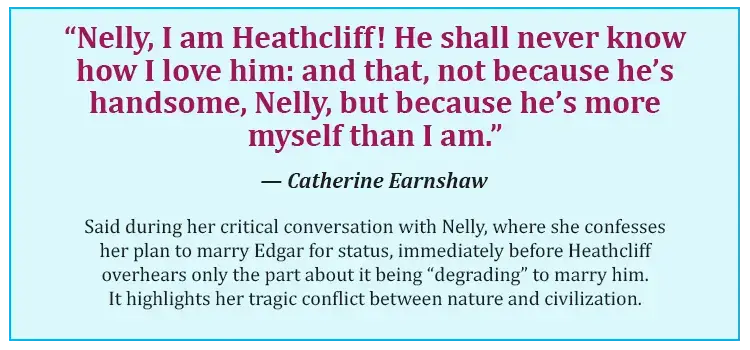
Quick Plot Overview: Wuthering Heights in 5 Minutes A Destined Connection Nelly Dean starts her story three decades ago. The owner of Wuthering Heights is Earnshaw, who adopts a homeless orphan called Heathcliff. Earnshaw has a daughter, Catherine who accepts Heathcliff, but his brother Hindley does not like him. Catherine and Heathcliff develop an irreconcilable wild relationship where they both spend their days wandering around the moors. The Betrayal When Mr. Earnshaw dies, Heathcliff is now under the ownership of Hindley, who then treats him like a servant, and in the process separates him from Catherine. As Catherine cuts herself in the process of spying on the elegant Linton family at Thrushcross Grange, she spends five weeks in the shop and comes back with elegant ways and a newfound desire to be social. She becomes affectionate toward the kind, rich Edgar Linton. Catherine makes her fateful choice, torn between her stormy, elemental love for Heathcliff and her need to belong to society. She informs Nelly that she will get married to Edgar, and that it will be a humiliation to her social standing to marry Heathcliff, but sadly tells her: I am Heathcliff. Heathcliff is only capable of hearing the bit that she is being degraded by him, and dashes out of Wuthering Heights. The Return and Revenge Catherine is married and has been living happily for three years at Thrushcross Grange with Edgar Linton. Now, Heathcliff is rich, educated, and sophisticated, but his nature is savage. Heathcliff is only thinking about revenge. He starts an exquisite scheme to destroy all who wronged him: - He takes advantage of the now-alcoholic Hindley, acquiring Wuthering Heights.
- He gets married to Edgar's sister, Isabella Linton, just to torment both her and Edgar.
- The Tragedy and the Second Generation.
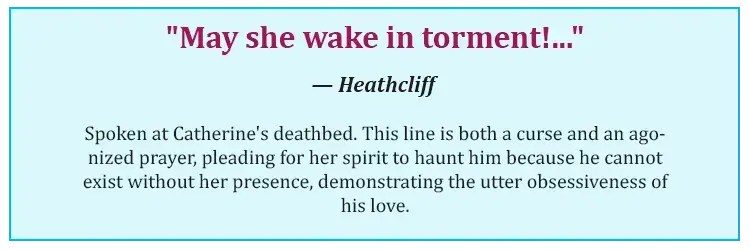
Tragedy and the Second Generation The emotional crisis and contradiction between Heathcliff, Catherine, and Edgar cause the death of the latter soon after giving birth to her child, Cathy Linton. The demise of the woman destroys the two men. Edgar cries a lot, and Heathcliff curses the spirit of Catherine to follow him, and cannot stand being separated. The interest now comes to the children of the new generation: - Catherine and Edgar had a daughter named Cathy Linton.
- Linton Heathcliff (young and ailing son of Heathcliff and Isabella)
- Hareton Earnshaw (young, uneducated son of Hindley)
Heathcliff also helps to devise a wicked scheme through which he acquires Thrushcross Grange. He marries off his weak son Linton to young Cathy. Edgar and Linton end up dying soon after the union and Cathy is left at Wuthering Heights and Heathcliff is the lord of the two estates. The Resolution and Peace For years, Heathcliff lives just to watch the face of Catherine in young Cathy and to be obsessed with his own death. He treats Hareton inhumanely, denying him education, just as Hindley did to him. But the second Cathy and Hareton, sharing the spirit of Earnshaw but the actual features of the family of his mother, start developing a faltering relationship. Their love, a reflection of the initial, naive love of Catherine and Heathcliff, starts to calm the years of bitter moments. Heathcliff grows more isolated and unnerved by the view of Cathy and Hareton falling in love, and loses the desire to live. He is killed and buried close to Catherine. The novel concludes with a reconciliation: Cathy and Hareton intend to get married and go to Thrushcross Grange, and Lockwood sees the silent graves of Catherine and Heathcliff on the moors, at last united. |
Detailed Chapter-by-Chapter Summary
After a short wuthering heights summary, it is time that we explore a detailed summary of the book for proper understanding, clarity and analysic:
Volume I: The First Generation - Chapters 1-14
This first book preconditions the whole tragedy by immersing us into the undressed, bestial passion of the young Catherine and Heathcliff, which led to the ill-fated choice that ripped the relationship apart and caused decades of devastating revenge.
Chapter 1-3: Lockwood's Arrival
The early part of the novel explains how the fastidious new arrival, Mr. Lockwood, visits his surly landlord Heathcliff in Wuthering Heights in 1801. The antagonistic environment and the people, the young and beautiful Cathy Heathcliff and the angry Hareton Earnshaw, confuse Lockwood at once. Lockwood is trapped in a snowstorm and is so desperate that he has had to stay the night and finds the desperate diary writings of the dead Catherine Earnshaw scratched into a window ledge. His nightmare, which the ghost of Catherine begs to be allowed in attracts Heathcliff to the room. The next, and suffering, collapse of Heathcliff with the plea to the ghost to come back exemplifies the animal instinct of the loss of the master, and with this, the central and everlasting obsession of the story is formed.
Chapter 4-10: Childhood and Young Love
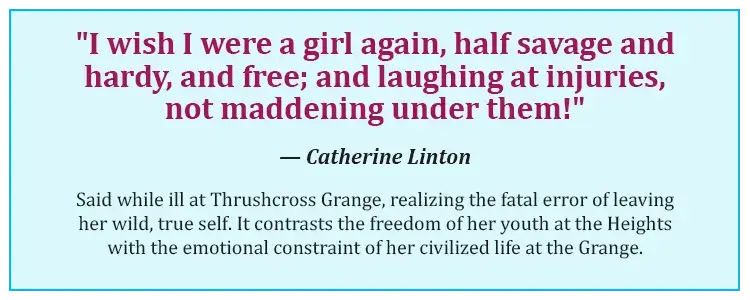
The main wuthering heights book summary starts with the account of the past by the housekeeper, Nelly Dean. Heathcliff comes to the Heights as a vagrant and immediately connects with Catherine and becomes a wild couple that no one can separate. Her elder brother Hindley despises the intruder. When the father Mr. Earnshaw passes away, Hindley replaces him and mistreats Heathcliff, turning him into his servant. The fate of Catherine alters since a dog bite compels her to reside in Thrushcross Grange, the civilized place with the Lintons. She comes back changed as a lady. She agrees to marry the kind, rich Edgar Linton to get social rank though she is very attached to Heathcliff. Her love of Heathcliff is elemental as she admits to Nelly in the scene where it culminates that her love of him would make her debase herself to marry him (I am Heathcliff). Heathcliff hears this and dashes to Wuthering Heights in despair and the revenge plot is initiated.
Chapter 11-14: Separation and Return
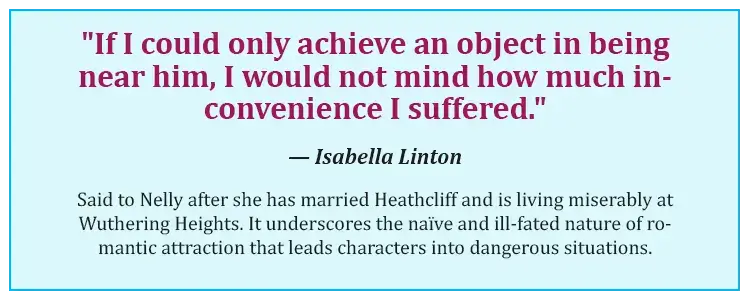
Three years afterwards, Heathcliff comes back, mysteriously rich and educated, and sets out to ruin his tormentors. He starts right away to destroy Hindley systematically by gambling money and drinking, and he has a secret motive of owning the Heights. He also aims at the Linton family, where he entangles Edgar's sister, Isabella, into a vicious, untrue romance. An enraged battle breaks out between Heathcliff and Edgar over Catherine, which leads to Catherine's life-destroying fever. She becomes seriously ill after believing that she has ruined her life by her decision. Heathcliff elopes with Isabella, whom he marries just to avenge Edgar. Nelly goes to the Heights and recognises Isabella as unhappy and oppressed, and it is true that Heathcliff has become a single-minded, vengeful power.
Volume II: The Second Generation - Chapters 15-34
This last wuthering heights book summary chronicles the horrible reaping of the consequences of the decisions of the first generation, and how the vengeance scheme by Heathcliff is executed, only to end up taking the lives of the innocent children, and only to take an unforeseen route to the path of peace and redemption.
Chapter 15-20: The Next Generation
The dying Catherine and Heathcliff enjoy their last painful clash, accusing each other of their spiritual destruction. She passed on a few hours later, delivering a baby who is her daughter, Cathy Linton. Heathcliff makes sure that he is buried beside her secretly. Isabella elopes out of the Heights, where she conceives Linton Heathcliff. Hindley dies six months later, leaving Heathcliff in an excessive amount of debt, thus making him the master of Wuthering Heights and guardian of Hareton Earnshaw, whom he purposely nurtures into a dumb working man. Twelve years pass. Isabella passes away, and her ill son, Linton, is taken to Thrushcross Grange, but Heathcliff takes him at once, making him a chess piece in his final scheme of owning the two estates.
Chapter 21-34: Resolution and Redemption
Heathcliff, who is out to acquire Thrushcross Grange, schemes encounters between Cathy Linton and Thrushcross Grange and the desperate, scheming Linton Heathcliff. The first pleas of Linton fall upon the unsuspecting Cathy, who is naive and sheltered. At a time when Edgar Linton is about to die, Heathcliff forcefully entraps Cathy at the Heights and forces her into a marriage with Linton. Cathy is a widow and a captive in the Heights when Edgar dies, leaving her in abject poverty and a subject of the tyrannical rule of Heathcliff.
However, the wuthering heights chapter summaries that the vicious cycle starts to break. Being increasingly troubled by the spirit of Catherine, Heathcliff loses concentration on revenge. He cannot bring harm to the new generation because he sees a lot of similarity between Cathy and Hareton and his beloved Catherine. Instead, he observes the real relationship develop between Cathy and Hareton as Cathy teaches Hareton to read, and the social barriers that were the bane of the first generation are destroyed. Heathcliff turns into a madman who refuses to eat and attempts to roam across the moors. He is discovered dead in the old room, where he has finally got his way. The wuthering heights chapter summary finishes as Cathy and Hareton become heirs to the estates and intend to get married, representing the restoration of harmony and tranquility. Lockwood pays a visit to the graves and, in the process, concludes that the tortured souls have at last rest.
Major Themes & Literary Analysis
Emily Brontue turns a family tragedy into a great adventure of human passion, social, and the hope of a spiritual redemption as we have seen in wuthering heights plot summary. The novel works based on an advanced literary device use in order to express elemental confrontation and generational repetition.
Visit our Expert Page to connect with professionals if you need more in-depth analysis or expert help with your assignment on Wuthering Heights.
Central Themes
It is based on the conflict between nature and society, the cyclic character of the revenge, and the opportunity of redemption that Emily Brontue turns a household novel into a deep analysis of human passion and its outcomes.
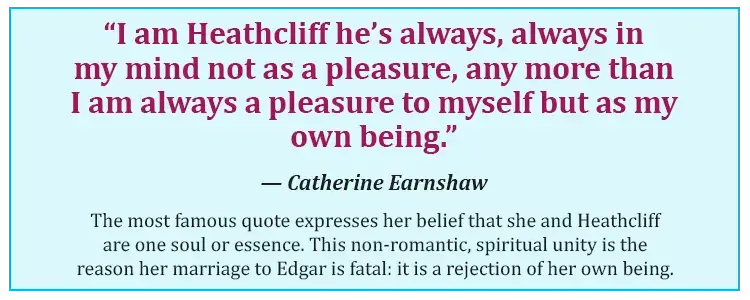
- Love and Obsession: Wuthering Heights is a destructive kind of love that crosses the borders of the earth. Catherine and Heathcliff do not have a sweet, romantic passion but an essential, symbiotic identity: I am Heathcliff. This is a spiritual, primal, and passionate relationship. With Catherine selecting the soft-spoken Edgar Linton as her social status, she is effectively rejecting half of her soul, predetermining the tragedy.
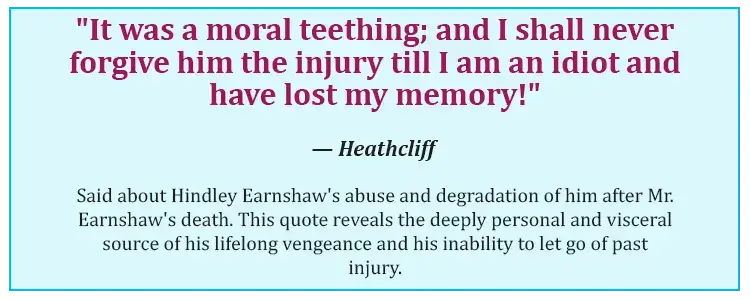
- Revenge and Its Consequences: The chapter summaries for wuthering heights are also dominated by the careful and calculated actions of revenge against Earnshaw and the Lintons that Heathcliff takes upon himself because they are the ones responsible for parting him from Catherine. He humiliates Hareton to punish Hindley and he lures Isabella and uses her son Linton to take Thrushcross Grange from Edgar.
- Social Class and Mobility: The war between Catherine and her heart and her aspiration brings out the social order that was strict during that period. The fact that Heathcliff is a dubious foundling who has no social status in society makes marrying him degrading to Catherine, who desires the sophistication and the social status of marrying Edgar Linton. The wealth obtained by Heathcliff enables him to obtain social mobility, but not with happiness or approval.
- Nature vs. Civilization: This theme is explicitly dealt with in the two central settings and the characters of the setting. Wuthering Heights is the Nature wild, passionate, stormy, untamed, and primal. This spirit is represented by Heathcliff, Catherine, and Hareton. Thrushcross Grange is Civilization: sophisticated, elegant, closed, and dormant, superficial. This spirit is represented by Edgar and Isabella Linton and the second Cathy.
Literary Devices and Structure
The format of the novel itself is quite innovative as it is based on a frame story and several, biased views to overlay the past and make the reader figure out the objective truth. Moreover, a lot of symbolism and stark gothic romance elements take the story beyond mere romance to the realm of mythic psychological drama that is richly atmospheric.
Literary Devices and Structure Element | Description | Examples / Function in the Novel |
| Narrative Structure | A complex frame narrative with nested storytellers. | Mr. Lockwood tells the story of the outer frame. Nelly Dean is the speaker of the inner core where most of the action takes place. This framework offers several, and in most cases, unreliable views. |
| Symbolism: The Manors | The two houses represent opposing forces. | Wuthering Heights is a representation of the wild, natural, passionate and primal. Thrushcross Grange is a symbol of civilization, the elegance, the restraint of emotions and the superficiality. |
| Symbolism: The Moors | The landscape itself reflects the characters' inner world. | The barren wild moors represent the strong, long-living and destructive love and parting between Catherine and Heathcliff. |
| Gothic Elements | Literary conventions used to create a dark mysterious and emotional atmosphere. | The remoteness, the emergence of the ghost of Catherine as well as the depiction of wild passion and cruelty and attention to darkness, death and decay. |
| Imagery: Nature | The frequent use of weather, animals and landscape to parallel human emotion. | The stormy and tempestuous nature of the inhabitants is manifested in the fierce wuthering winds. Heathcliff is also likened to a wolf or a wild animal. |
| Metaphor | Figurative language used to equate two unlike things. | The most notable quote of the novel, Catherine declaring herself Heathcliff, is the main metaphor of the book which presents a strong spiritual unity and not the typical romantic feeling. |
| Foreshadowing | Hints or clues about events that will happen later in the story. | The ghost of Catherine that Lockwood sees in Chapter 3 pre-empts the obsessive nature of the tortures by the man, Heathcliff, and the final tragic result. |
Study Guide & Discussion Resources
In this section, an additional activity to engage more with Wuthering Heights is the key quotes to provide textual analysis and questions to discuss the intricate themes, characters, and structure of the novel.
Key Quotes and Analysis
The following quotes represent the main philosophical and emotional contradictions of the novel, especially those related to love, identity, and social restraint:
Discussion Questions
Use these questions to explore the narrative choices character motivations and thematic significance of Emily Bronte’s work. They are designed to prompt critical thinking about the novel's enduring impact and interpretations.
- Is Heathcliff a villain or a romantic hero?
- What is important about the two houses, Wuthering Heights and Thrushcross Grange?
- Examine how Nelly Dean is the main narrator.
- Develop a theme of repetition and cycling events.
- Talk about the kind of love in the novel.
- What is a Gothic Novel?
- How does the social class affect Catherine's decision?
Chapter Summary Reference Table
The table below gives a brief and overview view of the primary plot structure, major events, time frame and main characters in the various parts of the novel.
Wuthering Heights Chapter-by-Chapter Summary Table | Chapter Range | Time Period | Key Events | Main Characters |
| 1-3 | 1801 | Lockwood's visits, ghost encounter | Lockwood, Heathcliff |
| 4-7 | 1770s | Childhood, Heathcliff's arrival | Young Catherine, Heathcliff |
| 8-10 | 1778-1780 | Teen years, Catherine's choice | Catherine, Heathcliff, Edgar |
| 11-17 | 1780-1784 | Heathcliff's return, marriages | All main characters |
| 18-24 | 1784-1797 | Second generation introduced | Young Catherine, Linton |
| 25-34 | 1797-1802 | Resolution, deaths, redemption | Second generation, Heathcliff |
Reading Wuthering Heights Today -Tips for Modern Readers
Wuthering Heights is an intricate, frequently shocking novel that needs time and a desire to indulge in its darkness. If you are visiting this classic for the first time the following points will assist you in facing its more peculiarities and enjoying its lasting strength:
- It has several Catherines, Heathcliffs and Lintons. Differentiate them by use of character description or the period of time.
- The first narrator is an outsider, pompous and he tends to misjudge the characters and occurrences. Do not accept his judgments as truth.
- Catherine and Heathcliff are attracted not by the love between a man and a woman but by a spiritual recognition and fatal attraction.
- The weather and landscape tend to reflect the moods of the characters.
- These contrasts between the wild and the open moors and the incarcerated and drawing-rooms of the Grange are the key to the theme of nature versus civilization.
- Do not be shy about an annotated version or citing a chapter summary once you finish a part to ensure that you have followed the difficult twists of the plot.
Conclusion
Wuthering Heights can still be considered the eternal classic as it is a strong tool to choose the destructive passion and spiritual identity, as well as the never-ending circle of vengeance. Emily Brontte narrates the history of the Earnshaw and Linton families with the help of a complicated frame story and a Gothic mood. The black story eventually gets a redemption in the second generation as the tender marriage between Cathy Linton and Hareton Earnshaw eventually seals the curse of obsession and meanness that Heathcliff and the original Catherine had been perpetrating. The novel can be viewed as a deep meditation on the ways in which nature, love, and social constraints bring people to their destiny.