You can determine your chances of attending graduate school through your existing capabilities and determination, and the environmental factors that surround you. Your resource availability and the timing of academic deadlines, the assistance from your mentors, and your everyday activities will determine your capacity to handle tests, essays, and applications. The month-by-month plan you developed for the process will establish conditions that help you make decisions while decreasing your stress levels and improving your chances of submitting a strong application that has been thoroughly prepared.
Are you looking for the College Application Essay Guide? Click here:
The Foundation: Adopt the Project Manager Mindset
You need to approach your grad school application process as a complete project. A project manager creates a task plan which includes establishing deadlines and maintaining project progress. The application process can be divided into three components, which include tests, essays, and recommendations. You can then schedule these components and monitor your development. This method helps to decrease your stress levels while maintaining your organization and preventing you from forgetting essential tasks.
From Applicant to Architect
- Think Like an Architect: You should establish your academic path through the creation of a detailed plan which includes both your educational objectives and your time management needs.
- Break It Into Phases: The process should be divided into parts which include research, tests, essays, recommendations, and submissions.
- Track Progress: The calendar, together with the checklist and spreadsheet, serves as a tool that helps monitor tasks while determining their progress towards meeting scheduled deadlines.
- Stay Flexible: Your planning structure needs to change when you experience shifts in project deadlines or changes in requirements, or when your priorities determine which tasks to complete first.
Core Principles of the Systematic Applicant
- Prioritize Tasks: Your time will be best used when you concentrate on essential elements during every development phase.
- Set Deadlines: The assignment of practical due dates for tests and essays and submission dates will help students prevent emergency situations.
- Organize Everything: All documents, notes, and contacts should be stored in a single system that provides quick access to all information.
- Review and Refine: The application process requires continuous progress assessment and material improvement until a final version is ready for submission.
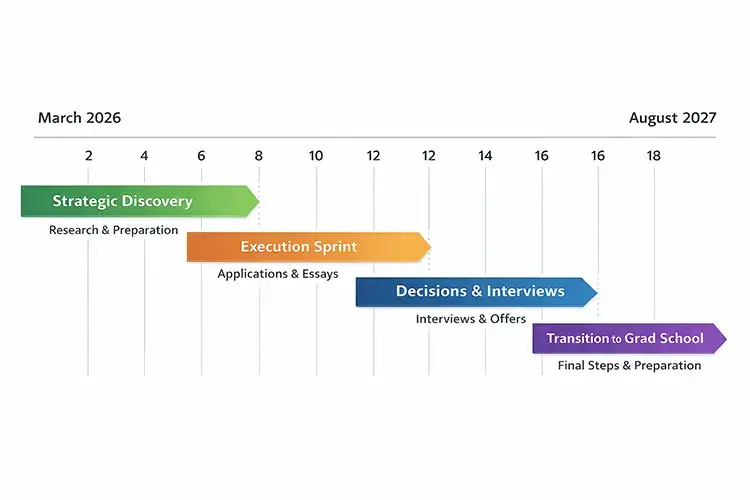
2026–2027 Grad School Application Timeline: Month-by-Month Checklist | Phase | Time Span (Approx.) | What happens here |
| Strategic Discovery | Mar–Jul 2026 | Research, fit analysis, testing prep, shortlist |
| Execution Sprint | Aug–Dec 2026 | Essays, recommendations, submissions |
| Decisions & Interviews | Jan–Mar 2027 | Interviews, follow-ups, offers |
| Transition to Grad School | Apr–Aug 2027 | Choosing school, visa, housing, prep |
Phase 1: Strategic Discovery & Foundation (March – July 2026)
You need to create your first graduate school application base at this moment. The process requires you to identify your reasons for attending graduate school while you research suitable programs and prepare your application materials for an efficient workflow. Your grad school application process will become easier to handle because your solid base establishes a clear path to follow.
- Define Your Why: Know your motivation through three different paths which include career goals, research interests, and personal development.
- Research Programs: Search for educational institutions which include both departments and faculty members who match your research interests.
- Check Fit Factors: The program evaluation process requires assessment of its geographical location together with financial aid options and student enrollment figures, and institutional values.
- Make a Shortlist: Create an initial list which includes educational programs that you will later analyze in detail.
Months 4-5 (June–July): Building Your Base
- Start Test Preparation: Register now to begin your study preparation for GRE, GMAT, and other required examinations.
- Draft Resume/CV: The document needs to display academic achievements, together with research work and professional experience.
- Connect with Mentors: Students should contact their professors and advisors to request their expert guidance on academic matters.
- Plan Recommendation Letters: The process requires us to select individuals who can create strong personalized letters of recommendation.
Download Excel: Graduate Program Comparison Matrix (Excel)
Phase 2: The Execution Sprint (August – December 2026)
The period of these months requires you to complete three tasks which include writing and editing essays, creating essential documents and applying to programs. You need to maintain focus during this time because your document improvement work will determine your ability to submit applications on time.
Months 6-7 (August–September): Drafting & Synthesis
- Start Your Essays: Begin writing your personal statements, statements of purpose, and any other application essays. Your writing needs to demonstrate your objectives together with your past experiences and reasons for your actions.
- Synthesize Experiences: You need to create a strong narrative about your strengths by combining your research work experience and academic work.
- Seek Feedback: You should share your writing drafts with mentors, professors, and peers to receive their feedback which will help you enhance your essays.
- Refine Your Resume/CV: Your document needs to establish a professional appearance while containing your complete achievements which support the content of your essays.
Months 8-9 (October–November): Early Submissions
- Complete Your Writing Assignment: You need to implement the feedback to improve your writing and make it more understandable, impactful and better organized.
- Verify Your Recommendations: You need to contact your letter writers to verify their submission of letters before the deadline.
- Submit Your Applications: You should first send your applications to your most preferred programs because this will reduce your stress in last-minute situations and help you handle potential problems.
- Monitor Your Application Process: The checklist provides a record of your submitted items and all remaining items, which helps you avoid missing anything.
Month 10 (December): The Final Push
- Submit Remaining Applications: Complete the application process for all outstanding programs which remain to be applied to.
- Double-Check Everything: The reviewer will check all forms, essays and additional materials to find any potential mistakes.
- Celebrate Milestones: Your current accomplishments should be acknowledged because they sustain your motivation to work.
Download Excel: Application Submission Tracker & Checklist (Excel)
Phase 3: Decision & Transition (January – August 2027)
The grad school application timeline 2027 enters its final stage when applicants complete their application requirements and prepare to start their next phase. The application process requires you to wait for replies while you conduct interviews and assess job offers after you submit your application. The phase starts when you receive decisions because it requires you to select your last choice, complete your enrollment process, and prepare to start graduate school.
Months 11-13 (January–March): The Waiting Game & Interviews
- Monitor Application Status: The system monitors program responses while it tracks the status of pending documents.
- Prepare for Interviews: You need to research each school and practice answer delivery while preparing to describe your professional objectives and personal background.
- Follow Up Professionally: The candidate needs to send thank-you notes after their interviews while maintaining quick response times to program requests.
- Stay Productive: People should use the waiting time to continue their educational and professional development activities without stopping their work.
Months 14-18 (April–August): Making Your Choice & Preparing
- Compare Offers: Evaluate programs based on five criteria which include fit and funding, location, faculty, and opportunities.
- Make Your Decision: You should select the program that matches your goals and inform all schools of your decision.
- Handle Logistics: You must organize housing, financing, and visa applications, and course registration.
- Prepare for Grad School: If you're unsure when to apply for grad school, review syllabi and collect materials to begin your mental and practical preparation for the transition.
Scenario-Specific Application Systems
The academic background, professional experience, and application requirements of graduate school applicants show distinct differences. Therefore, application strategies must be tailored to specific applicant profiles. The different applicants will benefit from the ability to prioritize their tasks and manage their time effectively, and improve their application results through this understanding. The following categories establish different expectations and strategic goals that apply to each type of applicant.
The PhD Applicant
Approval of an applicant for a PhD to conduct research is mostly on an intellectual basis rather than on the basis of professional experience alone.
Key priorities and their importance:
- Research Alignment: You need to match your research interests with the faculty members' research areas because this connection will determine your chances of admission and financial aid.
- Faculty Fit: Students who discover advisors with matching research interests will receive improved mentorship which will help them succeed in their academic and research endeavors.
- Academic Record: The academic record establishes your capability to handle demanding doctoral academic work.
- Research Experience: Your research experience demonstrates your capacity to perform scholarly research without assistance.
- Strong Academic Recommendation: The recommendation letter offers independent confirmation of your research abilities to external parties.
- Clear Research Statement: Your research statement establishes your academic focus while presenting your unique research contributions.
The MBA Applicant
The MBA applicant evaluation process uses leadership potential and career impact and professional maturity as assessment criteria instead of using academic achievements as the sole basis for evaluation.
Key priorities and their importance:
- Professional Experience: The candidate now demonstrates real-world business skills together with decision-making capabilities.
- Leadership Evidence: The candidate shows him or her readiness to assume managerial responsibilities.
- Career Clarity: The system helps admissions officers predict your career path after you complete your MBA program.
- Standardized Test Performance: The test results demonstrate the candidate's skills in both analytical thinking and quantitative problem solving.
- Strong Resume: The document shows the applicant's achievements which they have recorded together with their impact on their professional field.
- Interview Skills: The candidate shows their ability to communicate with others while demonstrating confidence to work in various professional environments.
The Master’s (Coursework) Applicant
The coursework master’s applicant is assessed on academic readiness and professional alignment. Students who want to become masters in the program should possess their research abilities.
Key priorities and their importance:
- Academic Foundation: This program guarantees your readiness for advanced academic study.
- Relevant Experience: The experience improves your degree program because it enables you to use your academic knowledge in actual professional settings.
- Clear Statement of Purpose: The statement establishes a connection between your previous studies and the objectives you intend to achieve in the future.
- Skill Alignment: The evaluation shows that you possess the qualifications needed for advanced specialized training.
- Strong Recommendations: The recommendations demonstrate your potential for success in both academic and professional fields.
- Career Direction: Your degree selection demonstrates that you have made a calculated and deliberate choice.
Get more assistance on Admission Essay Examples with just one click:
The International Applicant
International aspirants must juggle the academic and administrative requirements above and beyond what can be managed in regular admission processes.
Key priorities and their importance:
- Early Test Preparation: The process helps students to decrease their anxiety while they prepare their applications.
- English Proficiency: The test results confirm that students can effectively communicate in academic settings.
- Financial Planning: The process shows that organizations have permanent funding resources which they need to demonstrate to both educational institutions and visa officials.
- Visa Readiness: The process helps to eliminate administrative problems that might occur before students start their studies.
- Cultural Adaptability: The ability to adapt to different cultural environments helps students to succeed academically while maintaining their mental health during international studies.
- Clear Motivation for Studying Abroad: Your motivation to study abroad will enhance your academic essays and your grad school interview questions.
Communication Frameworks & Templates
Communication skills stand as essential yet frequently neglected requirements for graduate school applications. Your application will benefit from your ability to deliver clear and respectful messages that maintain a proper structure throughout your communication. The following frameworks deliver dependable yet formal templates that can be used at important times during the application process.
How to Email a Potential Advisor (PhD/Master’s Research)
Before emailing, you should:
- Read the professor’s recent papers
- Check their current students and projects
- Identify how your interests align with their work
Purpose of this email
Your goal is not to ask for admission directly — it is to:
- Introduce yourself professionally
- Show genuine academic alignment
- Ask whether they are taking new students
Email Script:
Graduate School Inquiry Email Template for Research Alignment (Fall 2027) | Subject: Prospective Graduate Student Inquiry – Research Alignment Dear Professor [Last Name], My name is [Your Name], and I am a prospective graduate student interested in applying to the [PhD/Master’s] program in [Department] at [University] for Fall 2027. I am particularly interested in your work on [specific topic or paper], especially your research on [mention one concrete idea from their work]. My academic background includes [briefly state your degree, institution, and relevant research or project]. I have worked on [mention one relevant experience], which closely relates to your research on [connect it clearly]. I would be grateful if you are currently considering taking new students for the upcoming intake. If so, I would appreciate any guidance on how best to prepare my application for your lab. Thank you for your time and consideration. I have attached my CV for your reference. Sincerely, [Your Full Name] [Current Institution / Job] [Email] [LinkedIn or Google Scholar, if applicable] |
Download Template: Prospective Graduate Student Inquiry Email Template (Research Alignment)
The “Recommender Request” Packet
You need to present a Recommender Packet which simplifies their work process and produces a better recommendation letter instead of making an informal request for a recommendation.
What your packet should include:
- Your CV/Resume
- Unofficial transcript
- Draft Statement of Purpose
- List of programs + deadlines
- Your academic highlights with that professor
- Brief note on what you hope they emphasize
Email to Request a Recommendation
Letter of Recommendation Request Email Template for Grad School (Fall 2027) | Subject: Request for Letter of Recommendation Dear Professor [Last Name], I hope you are doing well. I am applying to graduate programs for Fall 2027 and would be honored if you would be willing to write me a strong letter of recommendation. I greatly valued your mentorship in [course/project], where I worked on [brief reminder of your work]. Your guidance significantly shaped my academic development. I have attached a recommendation packet that includes my CV, transcript, statement of purpose, and application deadlines for your convenience. If you are willing to support my application, I would be deeply grateful. Please let me know if you need any additional information. Thank you for your time and mentorship. Sincerely, [Your Name] |
Download Template: Graduate School Letter of Recommendation Request Email Template (2027)
Post-Interview Thank You Note Template
Send this within 24 hours of your interview.
Why this matters:
- Shows professionalism
- Reinforces your interest
- Keeps you memorable to the committee
Example:
Graduate School Interview Thank You Email Template (2027 Admissions) | Subject: Thank You – Graduate Program Interview Dear Professor [Last Name], Thank you very much for the opportunity to interview for the [Program Name] at [University]. I truly appreciated our discussion about [mention one specific topic from the interview]. Our conversation strengthened my enthusiasm for the program, particularly your work on [specific research area]. I remain highly interested in contributing to your research group and the academic community at [University]. Thank you again for your time and consideration. I look forward to hearing from the admissions committee. Sincerely, [Your Name] |
Download Template: Graduate School Post-Interview Thank You Email Template (2027)
How to Politely Negotiate a Funding Offer
You can negotiate — but you must be respectful, evidence-based, and professional.
When should you negotiate?
- If you received a better offer from another university
- If funding is significantly below your financial needs
- If you received external scholarships
Graduate School Funding Negotiation Email Template (2027 Intake) | Subject: Funding Clarification Request Dear Professor [Last Name] / Admissions Committee, Thank you very much for the offer of admission to the [Program Name]. I am honored to be considered for your program and sincerely excited about the opportunity. I have recently received a funding offer from another institution that is more financially supportive. However, my strong preference remains [Your University], particularly because of [faculty/program reason]. I wanted to respectfully inquire whether there is any possibility of reviewing or enhancing my funding package. I would be grateful for any guidance you can provide. Thank you again for your consideration. I look forward to your response. Sincerely, [Your Name] |
Download Template: Graduate School Funding Negotiation Email Template (2027)
Don’t miss the chance of checking out the Graduate School Application Checklist:
Technology Stack for the Organized Applicant
Graduate school applications require organized systems which use both digital and physical tools because motivation alone cannot meet the requirements. The technology stack demonstrates its effectiveness through its ability to help users track deadlines while handling document management and essay refinement work which decreases their mental workload. Digital tools and physical materials create an ideal system that enables you to work productively while taking time to think and plan for future activities.
Digital Tools
The digital tools enable you to consolidate information and create automated reminders while working together with your mentors and peers. The tools decrease your administrative workload while enabling you to track your application development in real time.
Key digital tools and their purpose include:
- Google Drive/OneDrive: The platform serves as the main repository for storing transcripts, CV files, essay submissions, recommendation materials, and application documents.
- Notion or Evernote: The program provides a dedicated space to conduct research while organizing notes and managing checklist progress.
- Google Sheets or Excel: The spreadsheet functions as a central document that monitors all program deadlines while tracking submission progress and program requirements.
- Calendar (Google/Outlook): The scheduling software enables users to create reminders which alert them about upcoming test dates, important deadlines, and necessary follow-up tasks.
- Grammarly or Hemingway App: The essay editing software helps users improve their writing by enhancing their document clarity and tone and their overall readability.
- Reference Managers (Zotero/Mendeley): PhD application timeline for applicants can use this software to manage their academic papers and citation information.
The combination of these tools establishes a digital system which ensures that your application process remains smooth while providing complete visibility and eliminating anxiety.
The Analog System
The combination of digital tools and analog systems which use paper shows that paper-based systems enable people to think deeply and plan their work in an organized way while their minds stay focused.
Your analog system should include:
- Physical Planner or Notebook: The dedicated grad school planner serves as a tool for students to organize their weekly tasks and establish their academic targets.
- Printed Checklist: The checklist functions as a physical document which you can use to check off application requirements for your personal motivation.
- Essay Brainstorm Journal: The notebook functions as a space for freewriting and idea mapping to develop your personal narrative.
- Program Comparison Chart (Paper): The chart displays schools through a visual comparison which shows their funding, faculty resources, campus location, and academic fit.
- Sticky Notes or Index Cards: The materials assist users in structuring their essays through the creation of research themes and the organization of their argument development.
The application process uses an analog system which supports deliberate thought and protects against screen fatigue while maintaining your mental stability during the entire process.
When Things Go Wrong: Contingency Planning
The process of applying to graduate school requires careful preparation yet the results do not always match expectations. The path to success becomes obstructed by rejections, funding shortfalls, missed deadlines, and unexpected life events. You should treat setbacks as data points which help you develop better strategies instead of viewing them as failures. A strong contingency plan enables you to manage situations effectively while decreasing your anxiety and maintaining your academic objectives during unexpected events.
Plan B Scenarios
A good contingency plan means that you are not dependent on a single result. Before you even start submitting applications, think through as many different ways as possible.
Common Plan B scenarios include:
If you receive no offers:
- You need to strengthen your academic profile through standardized test score improvements, research experience, and professional development, plus a statement of purpose template refinement and better recommendation letters to strengthen your application for the next application cycle.
If you receive offers without funding:
- Pursue alternative sources of financial support, which include external scholarships, teaching assistantships, and part-time research positions, while respectfully inquiring about the possibility of improved institutional funding.
If you are waitlisted:
- The program requires professional communication, which should include prompt updates about my accomplishments and work experiences, while investigating other admission possibilities.
If your top-choice program rejects you:
- You need to evaluate your application strategy because you will find out which programs are suitable for your profile, and you should select schools that match your educational goals and professional ambitions.
Recognizing the alternatives ahead of time gives you the strength and agility to act in ways other than being emotionally insensitive.
The Gap Year Strategy
A gap year is actually not a setback; it can be a very powerful investment in the future if used correctly.
A productive gap year might include:
Research Experience:
- The research assistant or laboratory technician or independent scholar role requires you to perform research work to improve your research methods and develop your academic profile.
Professional Experience:
- You need to work in industry or institutional or nonprofit jobs which match your study program because this will help you prove your professional skills and your ability to work in a professional environment.
Skill Development:
- Students should select advanced courses which include professional certification programs and established online courses to improve their academic deficiencies and develop greater knowledge in their field.
Test Improvement:
- You can be taking admission tests more than once, have the most qualified result for the most prestigious dream class that would more appropriately project your academic readiness.
Stronger Application Materials:
- Revise, refine, and refine again in the process of writing your personal statement; in regard to potential recommenders, establish a relationship conductive to generativity; and sharpen your research focus and outline.
Once the gap year is perceived intentionally instead of just a waiting period to be spent in idleness, what looked like delays may now become the main ingredient of creative advantage.
Quick-Reference: Month-by-Month Checklist
The checklist creates a complete schedule, which enables you to complete the graduate application process in an organized manner. The program divides the entire process into specific monthly tasks, which allow you to schedule your activities while developing a solid profile, creating excellent application documents, and completing your work on time.
2026–2027 Grad School Application Timeline: Month-by-Month Action Plan | Month | Primary Focus | Core Academic Tasks |
| March 2026 | Research Clarification | Define research interests; begin literature review; list potential programs and advisors |
| April 2026 | Academic Exploration | Read key research papers; refine research questions; shortlist universities |
| May 2026 | Profile Strengthening | Engage in research projects; identify recommenders; update CV |
| June 2026 | Standardized Testing | Prepare for GRE/IELTS/TOEFL (if required); schedule exam dates |
| July 2026 | Research Engagement | Work with a mentor; aim for conference/workshop participation |
| August 2026 | Application Mapping | Finalize target programs; review eligibility and deadlines |
| September 2026 | Statement Drafting | Draft Statement of Purpose and Research Proposal |
| October 2026 | Refinement Phase | Revise essays; seek faculty feedback; finalize recommenders |
| November 2026 | Application Submission | Submit priority applications before deadlines |
| December 2026 | Supplementary Materials | Send transcripts, test scores, and follow-ups |
| January 2027 | Interview Preparation | Prepare for interviews; mock discussions |
| February 2027 | Interview Phase | Attend interviews; send thank-you notes |
| March 2027 | Decision Tracking | Track admissions results; evaluate offers |
| April 2027 | Funding Strategy | Negotiate funding or seek scholarships |
| May 2027 | Final Decision | Accept best offer; decline others |
| June 2027 | Pre-Enrollment Prep | Apply for visa (if international); housing search |
| July 2027 | Transition Planning | Connect with advisor; plan coursework/research |
| August 2027 | Enrollment | Begin graduate program |
Concusion
The process of applying to graduate school requires candidates to follow a systematic, introspective, and methodical approach, which leads to success through their ability to process information, maintain order, and adjust to new situations. The combination of establishing a grad school application timeline and using professional communication together with appropriate tools and contingency planning will help you achieve graduate study admissions while entering your program with confidence, understanding, and clear objectives.