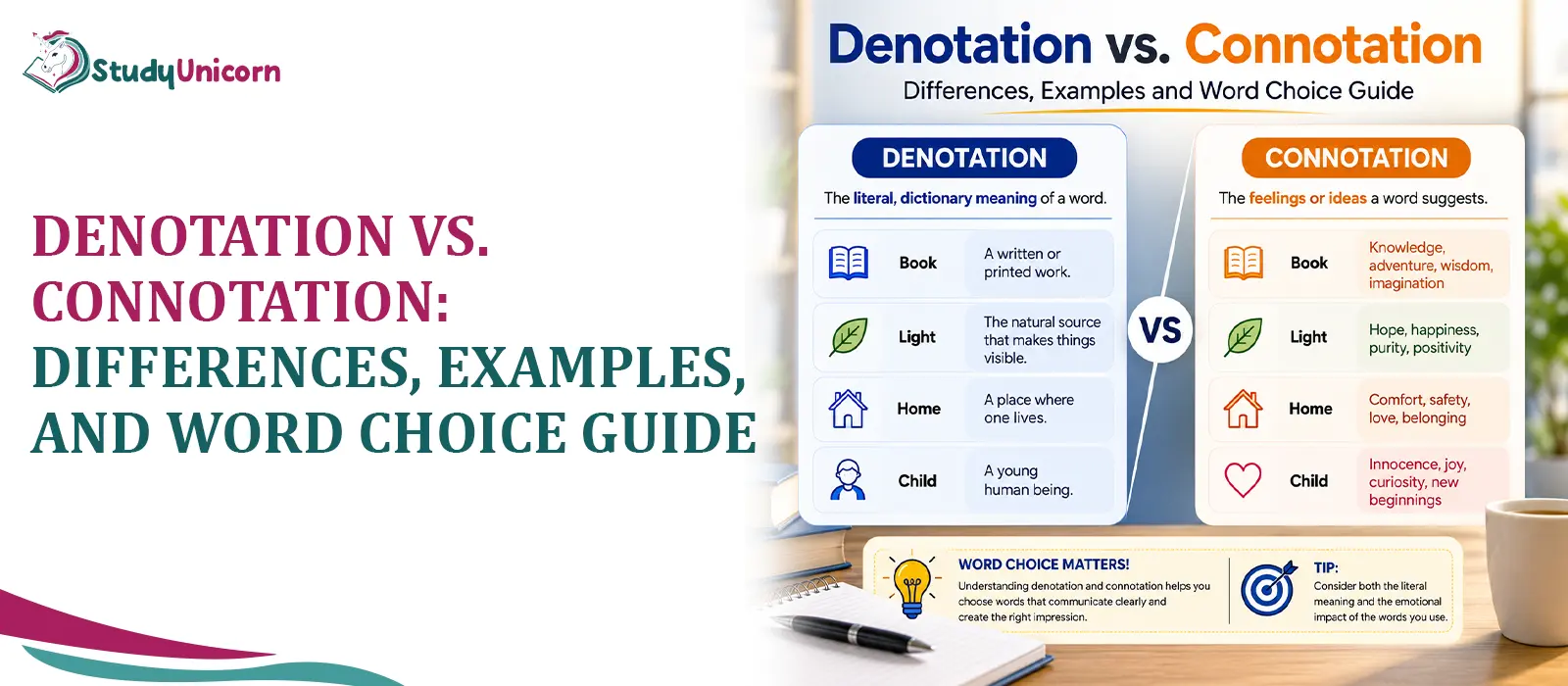
Do you know a single word can have two jobs at the same time, and the chances are high that you have not noticed it. But what definitely comes to your attention are these two terms: Denotation and Connotation, which are related to the two jobs that a word can do. And being in a situation where you confuse the two and have no idea the second one exists entirely, end up writing sentences that are technically correct and somehow still land wrong.
So knowing the difference between Denotation and Connotation becomes an integral part of your academic achievement. Hence, this guide exists and breaks down definitions with real-world examples and comparative tables. And in the end, you will get practical exercises so you can see how much you have understood about these two terms.
Denotation vs.Connotation: The Fast Answer
To really know what sets apart connotation and denotation at its core is actually a very simple distinction. And that is defined clearly below;
Denotation: It refers to the unvarnished, factual, and plain meaning of a word without any added emotional flavoring. For example, "home" is the term that is denoted for the physical place or dwelling of a person.
Connotation: The meaning of words goes beyond their dictionary definitions by the association of some feelings, or the social meaning that accompanies them. For example, the word "home" brings to mind warm feelings - safety, family, a sense of being home, comfort, and love.
Denotation Examples in Everyday Language
Seeing how denotation works in plain sentences shows how it sticks to bare facts, with no lean toward good or bad:
Connotation Examples in Everyday Language
Understanding how connotations can change the tone and reader understanding of a sentence:
Positive example: She showed a thrifty way of managing her household finances. (Suggests wisdom, self-control, and thoughtful arrangement.)
Negative example: She had a really cheap way of handling her household money. (Means to be cheap, giving poor-quality goods, and being reluctant to spend even though it's necessary.)
Positive example: The politician was very self-confident at the debate. (Suggests grace, self-confidence, and leadership.)
Negative example: The politician was very conceited during the debate. (Suggests one's great importance, being very proud, and being disrespectful toward others.)
Note: The main differences in the action descriptions between these pairs are negligible, while the feelings expressed are totally altered only by the usage of words.
Denotation vs. Connotation: Comparison of Pairs of Words
Comparing words with one another helps identify literally definitions differences from emotional associations. The table below reveals the connotative layers of everyday words that remain hidden but actually are connected to simple dictionary meanings.
| Word | Denotation (Literal Meaning) | Connotation (Implied Meaning) | Resulting Tone |
| Home | A physical place where an individual resides | Warmth, safety, comfort, family, and security | Welcoming and affectionate |
| Hollywood | A neighborhood located in Los Angeles, California | Fame, glamour, movie industry, celebrity culture, or superficiality | Glamorous or critical |
| Vintage | Originating from a previous era or past time period | High quality, classic elegance, valuable, and stylish | Favorable and appreciative |
| Gaze | To look steadily at something or someone | Admiration, wonder, deep affection, or thoughtfulness | Gentle and romantic |
| Stare | To look steadily at something or someone | Intrusion, intensity, shock, or rudeness | Uncomfortable or aggressive |
| Pushy | Assertive in pursuing goals or outcomes | Domineering, obnoxious, rude, and overly aggressive | Unfavorable and critical |
| Dynamic | Characterized by constant change, activity, or progress | Energetic, innovative, capable, and forward-thinking | Inspiring and positive |
It is a very effective method to look at the words side by side to determine which terms would best match the specific tone or style of your text.
Advanced Literary Theory: Semiotics and Orders of Signification
To get a grasp of how connotation works at the academic level, you first need to get to know semiotics - the study of signs and how language operates in different ways in society.
Saussure, a linguist, laid the foundations for modern sign theory, whereas cultural theorist Barthes took the ideas even further.
The Signifier: The actual spoken word, written letters, or the visual image (like the letters C-A-T).
The Signified: The mental image or thought tied to that word (a four-legged cats).
Being aware of these structures and layers of meaning helps critical analysts and highly skilled readers detect that language or better yet ,a combination of various layers of meaning - is what is employed in politics, media ,and literature to subtly control public perception.
Why The Choice Of Words Is Significant For Writers
Becoming aware of and using really words that have not only dictionary meanings but also emotional associations allows you to change your writing style quite drastically. Successful copywriters, authors, and journalists know the exact words to choose, so they can determine the tone of the text, create the impression of expertise, or, in a figurative sense, put on the readers' emotions in such a way to have a desired effect for them.
These are the reasons a meticulous picking of words can raise your writing:
Guiding Tone and Atmosphere of the Piece: Calling a room lit by a soft light cozy evokes the feeling of comfort, but calling it by a gloomy light description would probably make the reader feel either sad or at least very apprehensive.
Creating Living Characters: In works of imagination, the language characters speak reflects their thoughts and feelings at that time in a very condensed form. Through a dialogue, the reader gets a quick insight into the character's nature. A character who considers a peer shrewd is probably a great admirer of intelligence, while if someone calls a person crafty, he likely means that he cannot trust the mentioned person.
Convince through Rhetoric: In essays or persuasive speaking, you create an understanding of your position with the use of favorably connoted words. In contrast, using words that carry negative connotations makes people lose their confidence in the opposing idea without being confrontational at all.
Being careful of the shades of meaning you choose will make not only your writing more colorful but also more concise and convincing.
Common Mistakes: Confusing Denotation with Connotation
Even very proficient scribes can, on rare occasions, miss that the use of a certain word has more than one meaning - and the second meaning may actually be the right one to understand and respond to.
Being A Little Wary About The Synonyms: Not thinking they mean literally the same as each other: just because the dictionary says that the definition is the same as the other word doesn't mean that it is the right word for the sentence. Using scrawny instead of thin for praise in a formal situation may actually upset the person being praised.
Dismissing Cultural and Contextual Changes: The connotations shift as time goes by and according to the geography or the age group. What may be a purely descriptive term several decades ago may have become a word loaded with negative meanings or even offensive.
Absent-Minded Tone Incompatibility: Employing very negative or very informal language in a business letter is very likely going to make the whole text appear very unprofessional or even very one-sided, whereas a balanced tone is the one expected of official documents.
Too Much Use of Strong Emotional Words: Loading your text with emotionally strong vocabulary words can leave the writer very exhausted or the reader overwhelmed or very tired to read it. That means intersperse the emotionally intense terms with plain factual explanations.
By looking up not only the definition of unfamiliar words but also their emotional implications, one can avoid tone errors inadvertently.
Choosing the right word is not only about meaning and tone; grammar also matters. If you often confuse similar-looking words, our guide on its vs. it's explains the difference with simple examples and an easy substitution test.
Denotation vs. Connotation Test to Evaluate Your Knowledge
Collection information is not knowledge, especially when you learn something that demands daily use. Hence, we have given you this free PDF for the Denotation and Connotation Test. Try it and find out how many questions you got correct.
Conclusion
The difference between Denotation and Connotation gives you the ability to decide exactly, to your satisfaction, how you make the point by both jobs - getting the message and giving the mood - right. Go to your written text two times: first, make sure everything is factually correct, at least as far as it can be. Then, go through the words for the atmosphere they bring to the scene. With these two steps, you'll gradually be able to single out the lines that are technically inoffensive yet, for some reason, fail emotionally (in the same fashion "skinny" failed years ago at the dinner table). It's the very idea of Denotation vs. Connotation; getting to the core of the concept - that will ultimately enable you to be precise in expression and yet retain full control of its emotional impact (by a skillfully picked word) - this is precisely the purpose of understanding both of these concepts very deeply.