A weak opening can instantly ruin your hard work that you have put into your essay. And your main point, arguments, and research remain untouched as the opening sounds totally out of place.
So, it is clear that the hook for an essay matters a lot, and the double-down question is how to write it. And before you answer that in the form of: a hook that sounds good should be the right choice, then you are completely wrong.
Instead of focusing on using flowery language, heavy vocabulary, or fancy words, you would try to write something that grabs the reader's attention. You can do it by addressing the reader by using surprising facts, putting a question, stating a fact, or providing some data that will amaze readers.
But to know which type of essay a hook works for, you need proper guidance, and that is why this guide covers hooks for essays with eight proven styles that you can adapt for any type of essay.
Apart from that, you will get a five-step method to write a hook for an essay. And by the end, you will be able to open any paper with confidence rather than panic.
What This Blog Covers
- What Is a Hook in an Essay?
- Different Types of Hooks for Essays
- What Are Good Hooks for Essays? Five Quality Checks
- Examples of Hooks for Essays by Assignment Type
- How to Write a Hook: A Five-Step Method
- Common Mistakes When Writing Hooks for Essays
- The Modern Trap: How to Avoid AI-Generated Clichés
- Final Thoughts on Hooks for Essays
- Frequently Asked Questions About Hooks for Essays
What Is a Hook in an Essay?
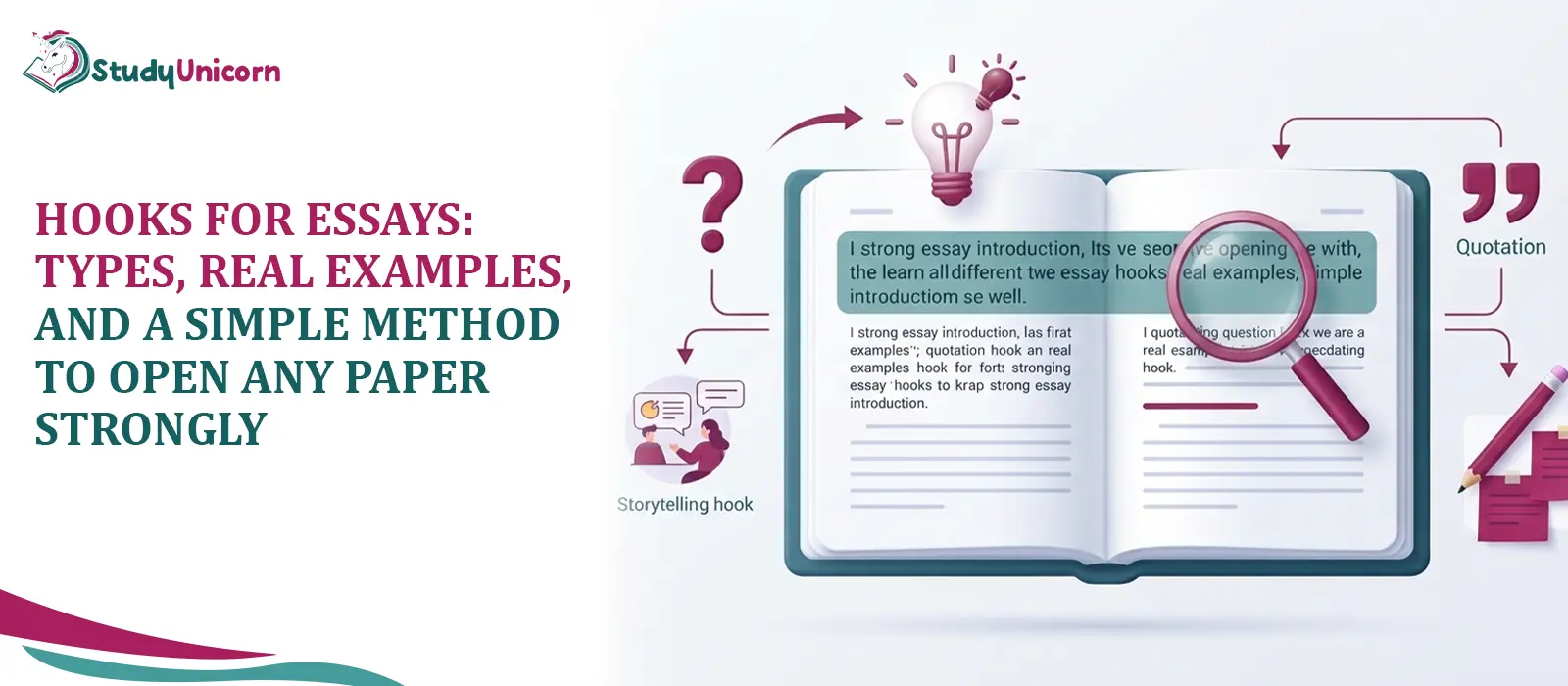
Newcomers often ask what is a hook, and the short answer is the opening sentence or two of an essay. It grabs the reader’s attention, ties to your topic, sets the tone, and steers toward your thesis statement.
Many teachers picture an introduction as an inverted triangle, wide at the top and narrow at the bottom. The shape shows how to write a hook that starts with a broad idea and narrows to a specific claim in three connected parts.
- The Wide Top (Hook): Your first sentence or two speak to a big, general idea that any reader can grasp and care about.
- The Narrowing Middle (Context): Next comes a little background, such as key definitions, a short history, or the debate surrounding your topic.
- The Pointed Bottom (Thesis): Last, you state your main argument in one clear sentence that tells the reader exactly where the paper is headed.
Core Rule: Every hook must connect to your thesis, because an attention-grabbing line that leads nowhere only confuses the reader.
Keep the triangle in mind, and the question of what is a hook in an essay gets a practical answer. A hook is not decoration, and it is not a trick. It is the first step on a path that ends at your main point.
Different Types of Hooks for Essays
Many types of hooks for essays exist, and the right pick depends on your assignment, your audience, and the tone you want to set. Below are eight different types of hooks for essays, each with a short explanation, an example, and the situations where it works best.
The Surprising Statistic Hook: Best for Research Papers and Expository Essays.
Explanation: A startling number shows readers the size of a problem within seconds, which makes the topic feel urgent and real. These hook examples only work when you choose a figure from a trusted source and name that source clearly.
Example: “According to the World Health Organization, roughly 280 million people around the world live with depression, so almost every school community feels its effects.”
Best for: Research papers and expository essays.
The Thought-Provoking Question Hook: Best for argumentative and reflective essays.
Explanation: A well-built question invites the reader to think, but it should never have a simple yes or no answer. Anyone writing argumentative papers can start with a challenging question, one of the safest places to begin.
Example: “If a machine can write a flawless poem in seconds, what is left that only a human writer can offer?”
Best for: Argumentative and reflective essays.
The Short Anecdote Hook: Best for personal and narrative essays.
Explanation: When writing a hook for a personal essay, a tiny story can make an abstract topic feel more human and closer to the reader. Keep the story short, and make sure it points toward the central idea of your paper.
Example: “My grandmother counted every grain of rice before cooking, even on the days when we had more than enough. It took me years to understand that she was not counting rice at all, but the memories of hunger.”
Best for: Personal and narrative essays.
The Powerful Quotation Hook: Best for literature and humanities essays.
Explanation: Of all the hook types, a quotation borrows authority from someone else, so choose it carefully and explain it clearly. Always confirm the speaker and the exact words in a reliable source.
Example: “It is a truth universally acknowledged, that a single man in possession of a good fortune, must be in want of a wife.” (Jane Austen, Pride and Prejudice)
Required explanation: Austen’s line is full of irony, since her novel shows that it is really the women searching for a secure future.
Best for: Literature and humanities essays.
The Bold Statement Hook: Best for argumentative and persuasive essays.
Explanation: This is one of the most direct types of hooks, since it challenges a common belief and invites the reader to disagree. The claim must be strong, but your essay has to prove it with real evidence.
Example: “Homework, as it is currently assigned in most schools, does more harm than good.”
Best for: Argumentative and persuasive essays.
The Vivid Scene Hook: Best for narrative and descriptive essays.
Explanation: A scene pulls the reader into one physical moment by using sight, sound, smell, and touch. This kind of hook works best when every detail has a purpose, and none is added only to sound fancy.
Example: “The kitchen smelled of burnt toast and cold coffee, and my father’s boots still sat by the door. He had left for the oil rigs three weeks earlier.”
Best for: Narrative and descriptive essays.
The Common Misconception Hook: Best for expository and science essays.
Explanation: A misconception makes a good hook for an essay because readers enjoy learning that something they believed was wrong. Start with the popular belief, then show your reader quickly why it fails.
Example: “Most people believe we use only ten percent of our brains, yet brain scans show that we use nearly all of it every day.”
Best for: Expository and science essays.
The Definition or Fact Hook: Best for beginners and short essays.
Explanation: To write a good hook with a definition, pick a word your reader has probably never heard and skip the tired dictionary opening. A surprising fact about that word makes the whole idea easy to remember.
Example: “Petrichor is the name for the earthy smell that rises when rain falls on dry ground, a word coined by two Australian scientists in 1964.”
Best for: Beginners and short essays.
Quick Comparison of Hook Types
| Hook Type | Best Essay Type | Risk to Avoid |
| Surprising Statistic | Research and expository | Using a number without a source |
| Thought-Provoking Question | Argumentative and reflective | Asking a simple yes or no question |
| Short Anecdote | Personal and narrative | Telling a story that runs too long |
| Powerful Quotation | Literature and humanities | Quoting someone incorrectly |
| Bold Statement | Argumentative and persuasive | Making a claim you cannot support |
| Vivid Scene | Narrative and descriptive | Adding details that do not matter |
| Common Misconception | Expository and science | Attacking a belief nobody holds |
| Definition or Fact | Beginners and short essays | Copying a dull dictionary entry |
What Are Good Hooks for Essays? Five Quality Checks
Still in doubt about what are good hooks for essays? Check all five of the following checks for any opening line. In either style, strong ones have the same basic qualities. If your draft doesn't make it through all of the checks, it doesn't make it through all of the checks, rewrite before putting it in the good hooks for essays.
- Relevance: Your hook should not lead into a clever idea or thought that has nothing to do with your topic and thesis, but lead directly to your topic and thesis.
- Accuracy: All numbers, names, dates, and quotes must be accurate and cite a reliable source that you could provide to your teacher upon request.
- Conciseness: Remove any words that do not contribute to the reader's understanding or emotional response to the idea.
- Tone Match: A joke is appropriate for a casual blog post but not a serious research paper on public health.
- Flow: The final sentence of your hook should transition smoothly into the following background sentence, and should not jump to a new topic.
Before and After: Rewriting a Weak Hook
- Before (weak cliché): “Sleep is very important for students, and many people do not get enough of it.”
- After (strong and data-backed): “The American Academy of Pediatrics recommends that middle and high schools start no earlier than 8:30 a.m., yet many begin much sooner.”
This version can be the beginning of thousands of essays. Its replacement provides the reader with a particular source, a particular number, and a specific problem to consider.
Examples of Hooks for Essays by Assignment Type
The best way to learn how each style will appear on the page is to see examples of them in action. This section provides you with several models of essay hooks for different types of essays that are commonly assigned in both high school and college, so you can modify each one to match your essay.
What Are Good Hooks for Argumentative Essays?
The quick answer to what makes a good hook for argumentative essays is conflict: make sure to establish what is at stake as soon as possible. These four examples of hooks are for popular topics, and each has a brief note about why it is effective.
- Social media: “Few teens can say what they actually get from their phone, but they check it out dozens of times a day.”
Why it works: it identifies a habit each reader can relate to and then reveals a hole in the logic of that habit.
- School start times: “What if raising grades was the easiest thing to do was to allow students to sleep an extra hour?”
Why it works: It's a shocking solution that leaves the reader wanting the proof.
- Tuition-free college: “College is marketed as the pathway to opportunity, but the cost of the pathway prevents many talented students from getting in.
Why it works: the image of a gate demonstrates a lack of fairness without using insulting words. - Climate policy: “The price of inaction on climate policy will be paid by our children, but not by us.”
Why this works: it translates a massive scientific problem into a personal responsibility question.
However, after the tuition hook, you might then go on to say, “Higher education is good for society, and public universities should be tuition-free for all people who are qualified for it.” The problem is introduced with the hook, and the answer is provided in one simple move with the intention of the thesis.
What Are Good Hooks for College Essays?
So if you're wondering what makes for good hooks for college essays, it's small, honest details instead of dramatic events. A special moment that you could only experience stands out more than a big achievement, as admissions readers go through thousands of applications. The examples below are typical of strong essay hooks that will likely be used in admission essays.
“My little brother believes our old rice cooker is magic, and I have never had the heart to explain the electronics inside it.”
Note: A funny family detail shows warmth and curiosity without any bragging.
“On Saturday mornings, I fold dumplings with my neighbor, who speaks little English and teaches me more than my textbooks do.”
Note: It reveals values and relationships through one ordinary habit.
“The first thing I ever repaired was a broken bicycle chain, and the grease under my fingernails felt like a small victory.”
Note: a physical detail makes the reader trust the writer.
Avoid this: “Since I was a very young kid, I wanted to be a doctor, and save the world.”
Note: Thousands of applicants write almost the same sentence; it does not say anything special to the reader.
Hook Examples for Research, Narrative and Compare-and-Contrast Essays
Specialized assignments need openings that match their purpose, so the examples below use mental health and climate change to show the difference between each format.
- Research essay: “The World Health Organization estimates that one in every eight people worldwide lives with a mental disorder.”
- Research essay: “According to NASA, Earth’s average temperature has risen about 1.1 degrees Celsius since the late 1800s.”
- Narrative essay: “The waiting room was silent except for the ticking clock and the soft crinkle of a magazine I was not reading.”
- Narrative essay: “By July, the pavement outside my school was so hot that the soles of my sneakers began to soften.”
- Compare-and-contrast essay: “Therapy and medication both treat anxiety, but they ask very different things from the patient.”
- Compare-and-contrast essay: “Solar panels and wind turbines both promise clean power, yet they differ sharply in cost, space, and reliability.”
How to Write a Hook: A Five-Step Method
Learning how to write hooks for essays gets much easier when you follow the same order every time. This five-step routine works without guessing or waiting for inspiration.
- Decide Your Thesis First: You cannot pick a strong opening until you know exactly where the essay is going, so draft a rough thesis sentence before anything else.
- Study Your Audience: A teacher grading a science report expects different language than an admissions officer reading a personal story, so decide who will read the paper.
- Draft Three Different Versions: Try a question, a fact, and a short scene for the same topic, because the best choice is often not the first idea.
- Test the Bridge: Read each hook followed by your thesis, and keep only the version that connects to it without an awkward jump.
- Trim and Polish: Cut extra words, check every fact, and read the final line aloud to hear whether it sounds natural.
Worked example (raw to final):
- Thesis: Schools should teach digital literacy as a required subject.
- Raw hook: “Technology is everywhere in our lives today.”
- Final hook: “The average teenager spends hours on a screen each day, but few can name a single skill those hours have taught them.”
The raw version is vague and could belong to any paper. By contrast, the final version shows how to write a hook that points straight toward digital literacy lessons.
Overcoming blank-page syndrome
- Begin with the word “Imagine” and finish the sentence freely, then delete that first word once a useful idea appears.
- Write the introduction last, because by then you will know your argument and your best evidence.
- Draft a deliberately bad hook first to drain the pressure, and then improve it line by line until you write a good hook.
- Say your main idea aloud to a friend, then borrow the most interesting sentence you hear yourself say.
Common Mistakes When Writing Hooks for Essays
Even strong writers fall into a few familiar traps, and most of them appear in high school papers. Avoiding these six mistakes will make your hooks for essays feel more mature and more trustworthy. It will also help you choose a better opening every time.
- Warning: Dictionary definitions. Opening a hook for an essay with “Webster’s Dictionary defines” is one of the most overused starts, and readers stop paying attention at once.
- Warning: “Since the dawn of time” lines. Sweeping claims about all of human history sound grand, but they say nothing specific about your topic.
- Warning: Unsourced statistics. A number without a source looks invented, and teachers will often ask you where it came from.
- Warning: False advertising. Promising a shocking story that the essay never delivers makes the reader feel tricked.
- Warning: Over-dramatization. Treating a small topic as a matter of life and death makes your tone feel forced and weakens your credibility.
- Warning: Unverified quotes. Many famous quotations online are credited to the wrong person, so always confirm the speaker in a reliable source.
The Modern Trap: How to Avoid AI-Generated Clichés
AI-generated formulaic openings can be easily identified by teachers. A line such as ‘Embarking on the multifaceted journey of modern education' appears to be catchy, but it doesn't actually mean much. Thousands of essays exhibit the same patterns. Now compare it with this example: “My chemistry teacher once failed my whole class because I had one safety goggle missing.” That line is specific, human, and can't be confused for a template. If you're deciding on the type of hook, do it based on your experiences and use AI to spark ideas. The good hook for an essay will sound natural. It is common for AI detectors to miss it, so the best defence is to write something that is obviously your own work.
Final Thoughts on Hooks for Essays
Hooks for essays are not something that people can only do if they are talented. They are the result of selecting a style that will best suit a particular assignment, engaging it with the thesis, and verifying all details for accuracy. Use the 8 types mentioned in this guide and practice 3 versions of each opening, and stick with the one that sounds most like you. The first line is not a threat; it's an invitation with a little practice. If you want to continue to learn, be sure to check out StudyUnicorn's thesis statement guide and essay introduction guide.
 $10/page :