Got an assignment on a discursive essay and are scared? You're not alone. A discursive essay is not a simple scholarly exercise; it is an exercise of your capability to think critically, assess evidence fairly, and bring forth the arguments fairly and cohesively under control. Whether you are an IGCSE student, a National 5 student, an A-Level student or a university student, knowing how to write a discursive essay can change the state of confusion to confidence.
The ultimate 2026 guide is a discursive system of the essay. Instead of scattered tips, there are step-by-step frameworks, straightforward descriptions, examples, and ready-to-use discursive essay template, which are compatible with education systems in the UK, the Commonwealth, and other global educational systems.
Understanding the Discursive Essay: More Than Just Opinion
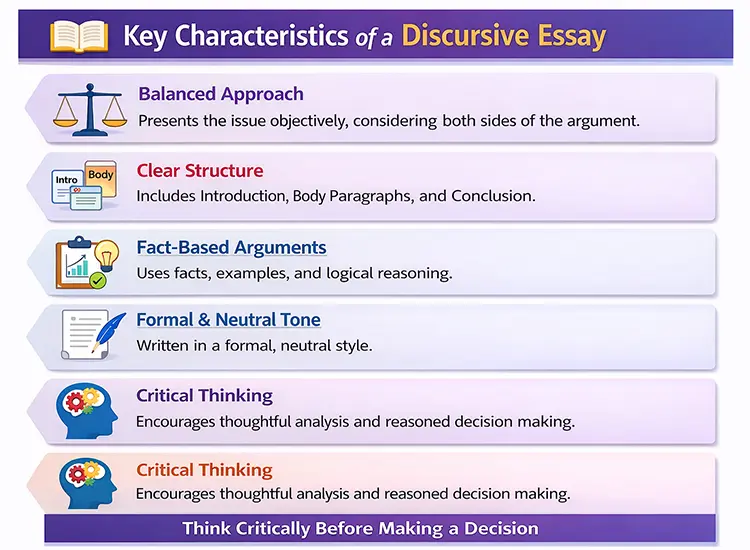
A discursive essay is a balanced argument essay that gives different perspectives on a subject matter, which makes people think. It does not involve the simple expression of opinions, as it involves the balance of argumentation, evidence, and logical reasoning to get the reader interested and promote further insight.
What Exactly Is a Discursive Essay?
A discursive essay is an academic paper that involves one trying to analyze an issue at length and with as many angles as possible before coming to a sound, moderated decision. On the contrary, discursive writing is less opinionated and relies on objectivity, evidence, and reasonable treatment of opposing opinions as opposed to opinion pieces.
Common misconceptions clarified
Some of the myths regarding a discursive essay are that one has to argue on one side or have strong personal feelings. The truth is in the fact that it is a balanced argument essay that examines several points of view in an objective manner. The second myth is that it is not structured, and a discursive essay has a clear and logical structure with arguments and discussion that is based on evidence.
How it differs from argumentative, persuasive, and expository essays
A discursive essay is different and a more balanced argument essay as it addresses various perspectives in an objective manner, whereas the argumentative, persuasive and expository essays have their own purpose, tone and structure.
Comparison of Discursive, Argumentative, Persuasive, and Expository Essays | Essay Type | Purpose | Tone | Key Focus |
| Discursive | Discuss multiple views | Neutral | Balanced analysis |
| Argumentative | Defend one position | Formal, logical | Evidence-based debate |
| Persuasive | Convince the reader | Emotional, assertive | Influencing opinions |
| Expository | Explain a topic | Informative | Facts and clarity |
This distinction is critical to students who want to achieve the best grades.
Why Discursive Essays Matter in Education
The wide use of discursive essays in IGCSE, National 5, Higher English, A-Levels, IB, and even university courses is due to the fact that discursive essays are setting the foundation of the basic academic skills:
- Thinking critically to arrive at good judgments and conclusions.
- Evaluating arguments and ideas reasonably to find flaws or strengths.
- Carrying out effective research to collect and examine appropriate facts.
- Distributing justice and taking into account various opinions and facts.
In addition to exams, discursive writing equips students with the real-life academic and professional situations, like policy analysis, reports, academic debates, and decision-making, in which subtlety is more important than point of view.
The Discursive Essay Framework: A Step-by-Step System
This framework subdivides how to write a discursive essay into manageable steps and assists the students in their thoughtful essay planning techniques and systematic arrangement. It focuses on moderate exploration, rational development, and scholarly clarity, whereby arguments should be thoroughly researched, logically structured, and in line with the formal discursive essay guidelines in educational systems.
Phase 1: The Pre-Writing Blueprint
Before you even write a single sentence, it is worthwhile to plan out how to write a discursive essay and organize your thoughts before you come up with a flow and a convincing piece of academic essay writing help that can pass across what you have to say.
- Analyze the topic and command words: Find out the type of question to be: to discuss, evaluate or examine. These signs are depth and balance.
- Research strategically: Only use credible sources: academic journals, textbooks, government reports, and reputable news outlets.
- Brainstorm arguments for and against: Create two clear columns to create a for and against essay structure:
- Arguments in favor of the subject.
- Anti-arguments against the topic.
- Develop a balanced thesis statement: A discursive thesis statement fosters fair analysis of issues; it will invite trust and discourse over a subject and not propagate one extreme perspective.
Example:
Example of a Balanced Discursive Essay Statement | “Although regulating social media can help preserve democratic integrity, it also creates some questions concerning the freedom of expression and the independence of the platform.” |
Download Template : Discursive Essay Planner Template (Free Download)
Phase 2: The Structural Architecture
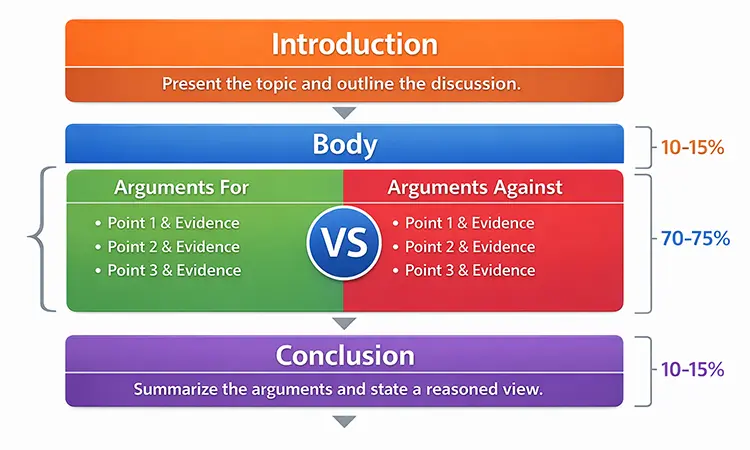
Phase 2 is concerned with structuring ideas, making them clear and logical, in a manner that brings a balanced argument essay in discussion, flow, and competent presentation of arguments in a discursive essay. The typical discursive essay format will contain:
- Introduction
- Body paragraphs (For and against essay structure arguments)
- Conclusion
All the paragraphs must have one clear idea, evidence or examples, relevance and must be logically connected with the next point to be coherent.
More advanced authors can use a discursive essay format where supporting and opposing points in the body paragraphs and, therefore, compare more deeply and transition more easily between opposing points of view.
Typical word distribution:
- Introduction: 10-15% A very short introduction of the topic and the key points to be discussed.
- Body paragraphs: 70-75% Explaining in much detail, evidence, and a discursive essay example to back up thesis.
- Conclusion: 10-15% Overview major points and repeat the importance of the subject.
Crafting Each Section: Formula and Freedom
The discursive essay structure and creativity need to be balanced. Form is guided by a clear formula and freedom by the subtle argument for how to write a discursive essay that makes the relationship between form and expression dynamic and interesting.
Discursive Essay Structure: Balancing Form and Critical Discussion | Section | Main Components | Purpose |
| Introduction | Hook, background, thesis | Introduce topic and position |
| Body Paragraph 1 | Perspective 1, evidence, analysis | Present first viewpoint |
| Body Paragraph 2 | Perspective 2, evidence, analysis | Present second viewpoint |
| Body Paragraph 3 (Optional) | Perspective 3, evidence, analysis | Expand discussion |
| Counterarguments | Opposing view, refutation, support | Address and counter objections |
| Conclusion | Summary, restated thesis, closing thought | Conclude effectively |
The Discursive Essay Introduction Formula
A good discursive essay introduction provides a contextual setting without discrimination.
Effective introduction structure:
- Hook: This is to start with a captivating or interesting fact or a question that provokes the reader to listen and to begin the discussion.
- Background: Give a brief overview of the problem under examination, and show its importance as well as any background that makes the reader aware of it.
- Thesis Statement: Have a clear but brief, without prejudice and bias discursive thesis statement, which clarifies the general argument or perspective of the essay.
- Outline: Is a short summary of the main points or sections of the essay, what will be discussed, and how each point will support the entire argument.
Example introduction:
Sample Discursive Essay Introduction | Political advertising control on social media has been an international issue over the past few years. Even though online platforms present the ability to get information in a form never experienced before, it also brings a dark cloud to the truth and democratic fairness. To come up with a balanced conclusion, this essay will present both the arguments in favor and against the regulation of political advertising on social media. |
The Body: Building Balanced Arguments
Each body paragraph should be organized in a very clear and logical manner. The discursive writing should be accomplished in a modified PEEL method.
Paragraph structure:
- Point: It should be obvious that the central argument or idea that a paragraph is going to address is to be introduced.
- Evidence: Be able to use facts, statistics, actual examples or even expert opinions to prove the point.
- Explanation: How does the evidence support the point, what does it mean and imply?
- Connection: The information about the paragraph has to be connected with the general topic, and the transition words should help to lead on.
Presenting arguments for: It is essential to underline the advantages of the primary side, using evidence to support each argument, a logical argument, and appropriate discursive essay examples to convince readers and reinforce the argument as a whole.
Presenting arguments against: You need to state the argument in a balanced and just manner, without any prejudice to its better points, so as to show balance, a critical approach, and an objective comprehension of the opposing views.
Transitions matter
Use phrases like:
- "On the other hand..."
- "Conversely..."
- "However, critics argue..."
This is an indication of a good discursive essay since it has balance and control as some of its defining features.
Body Paragraph Example
Sample Discursive Essay Body Paragraph | Argument: Flexibility of online education is one good statement that can be made when one is considering online education. Evidence: Research indicates that online learners are more capable of balancing work, family, and education as opposed to traditional classroom learners. Explanation: It means it offers a learner the advantage to study at a personal pace thus avoiding stress and enhancing the course completion rates, particularly among the adult and working students. Connection: Accordingly, flexibility renders online education a successful form of learning and contributes to the general discourse about education system modernization. |
The Conclusion: Synthesizing Without Bias
The discursive essay conclusion is not presented with new arguments and emotional opinion.
Conclusion framework:
- Restate the thesis in light of evidence: Reframe the thesis with information learned during the evidence and demonstrate how the discussion has either justified or narrowed the initial standpoint.
- Summarize key points concisely: In short, recap the main points, this is a brief but clear and effective manner of restating the main points and ideas of the essay.
- Reflect on the complexity of the issue: It must be acknowledged that the issue has numerous sides and dimensions, and moderate level of cognition should be demonstrated rather than demonstrating the problem as a one-dimensional and single-sided one.
- Provide a judicious conclusion: Sum up with a critical rather than a general observation that leaves the reader guessing and possibly arousing the reader to further contemplation.
Conclusion Example:
Sample Discursive Essay Conclusion | In conclusion, one can note that the advantages of political advertisement regulation on social media are dramatic, as well as its disadvantages. On the one hand, regulation may enhance transparency and provide safety into the process of democracy; on the other hand, regulation will tend to curtail free expression. In this way, a compromise that is to be made appears to be the most appropriate. |
Advanced Techniques for Higher Grades
Enhanced discursive writing needs more than structure; it needs to have precision in tone manipulation, positioning of evidence strategically, and complex counterargument management. Learning these tricks will enable the students to exhibit critical depth, academic maturity, and high-level assessment capabilities required in the essays at top grades.
In order to get better grades, the writer has to perfect tone and style, weave evidence into the text and counterarguments, and do them with depth, balance, and critical judgment instead of mere comparison.
Tone and Style Mastery
- Academic objectivity provides the opportunity to keep the arguments neutral, balanced and evidence-based without using emotional and biased language, which discredits a person.
- The proper application of hedging language (may, suggests, or appears to) enables writers to make claims cautiously, which is indicative of academic uncertainty and subtlety.
- Discursive writing uses transition words and phrases that allow the reader to move easily between views, enhancing coherence and logical development.
- The main ingredient of clarity and maintenance of the academic tone of the article is not to fall into the pitfalls of descriptive style, such as repetitions, colloquialisms, and unquestionable statements.
Evidence and Source Integration
- The choice of credible sources is an important issue where academic journals, books, and other reputable publications are taken into consideration to become credible and authoritative.
- To incorporate quotes and paraphrasing is seamless, and it is only through the incorporation of evidence into analysis that one can break the quotation and place it without explanation.
- It should be done in proper citation discursive essay format such as APA, MLA, and Harvard so that academic integrity is upheld and plagiarism is avoided.
- Combining quantitative with qualitative evidence makes the arguments stronger as statistical evidence can be supported by the contextual explanations of the situation and practical examples.
Counterargument Sophistication
- Going beyond for and against essay structure incurs the comparison of the strength, relevance, and implications of conflicting opinions, and does not mean writing them down in the same order.
- Arguments having weight should be weighted according to their strength as evidence, and therefore, more weight should be given to the greater-evidence-based claim in the discussion.
- Strategic presentation of weaker counterarguments demonstrates awareness without exaggerating the points that do not have strong backing.
- The demonstration of critical engagement is showing depth and an assessment of assumptions, limitations, and consequences and indicates thoughtful and independent academic reasoning.
Download PDF: Free Discursive Essay Transition Words Cheat Sheet
Education System–Specific Guidance
Discursive essay requirements differ between different education systems and so it is paramount that the students modify discursive essay structure, tone and argumentation to meet the marking standards. Knowledge of the system-specific priorities can assist writers to achieve the assessment requirements, showcase the relevant skills, and score the maximum number of marks by using the particular academic essay writing strategies.
UK & Commonwealth Systems
UK and Commonwealth models have a focus on balance, transparency, and restrained assessment. Essays are supposed to discuss various points of view without being biased, using language carefully and giving arguments properly organized in accordance with published marking rubrics.
- GCSE / A-Level: GCSE and A-Level essays must have a good structure of paragraphs, equal opinion, and logical flow with appropriate examples to prove points before coming up with an argument that is justified and well-grounded.
- Scottish National 5 / Higher specific guidelines: At this stage, it is expected of the students to be critical in the assessment of the ideas and be strongly aware of the formal language, sentence structure and vocabulary when evaluating the evidence instead of describing the perspectives.
- Australian curriculum standards: Australian assessment is appreciative of well-developed analysis, articulate explanation of ideas, and logical links between arguments in a way that it is deep and does not become shallow or incoherent in any part of the essay.
- South African: South African essays are characterised by the emphasis on structured argumentation and proper integration of evidence, which means that students have to prove their arguments using appropriate discursive essay examples and show their critical analysis of the matter.
International Systems
The international systems usually require flexibility, a mix of structure and critical thinking in essays. The key to success is proper tone, the inclusion of evidence, and answering all the assessment targets according to the global examination frameworks.
- IGCSE: Discursive essays IGCSE must be written in a neutral academic style, a logically structured essay, and good, well-supported discursive essay examples are used to prove the discussion of different sides in a balanced manner.
- IB Diploma: The IB essays require critical analysis in the form of comparison of views, synthesising, and critical evaluation of evidence, which is a test of independent thinking and understanding of a complex topic.
- US vs UK styles: the former (US essays) allows authorial positioning and acknowledgment of arguments in a more open, the latter (UK essays) gives a lot of caution to the use of words, and balances rhetoric and takes a reserved stance in terms of asserting a personal position.
- University-specific variations: Each university and department has its own expectations and therefore, the essay has to follow the course requirements, marking rubrics, and other conventions related to structure, evidence, and argumentation closely.
The Revision and Editing System
Revision will make a discursive essay competent and high-scoring. The alphabetical method assists authors in balancing, testing evidence, improving structure, and perfecting language. The combination of focused checklists with an understanding of the typical errors can help the students to become clearer, more coherent, and closer to the assessment criteria.
The Discursive Essay Checklist
The checklist will be structured in order to see that the key components of discursive writing are in place. It assists students to review balance, evidence quality, organisation and accuracy in language prior to submission, eliminating mistakes and enhancing the overall academic achievements.
- Balance and objectivity audit: It is important to ensure that all the views are presented without emotional and partial words to ensure that the essay is written in a tone of neutrality and presents an objective evaluation rather than a one-sided argument.
- Evidence and source verification: It is important to ensure that all the evidence is plausible and relevant, and it is properly referenced, and that the references supplement the statements made in the analysis, rather than put in a list without comment.
- Flow and structure evaluation: Examine the order of paragraphs, topic sentences, and transitions to ensure that there is a flow of ideas and continuity as the reader can track the argument; otherwise the reader may be lost in the same argument and bored.
- Language and style polish: Expand vocabulary, sentence and grammar structure, and use in order to retain formal academic style, eliminate ambiguous phrases, and, keep the essay precise, concise and consistent all through.
Click to get checklist: Complete Editing Checklist – Discursive Essay
Common Mistakes and How to Fix Them
Knowledge of common discursive essay errors will enable students to avoid the wastage of marks. Writers can also enhance arguments, make them clearer, and more acceptable to the examiners, by identifying common mistakes and knowing how to address them.
8 most frequent discursive essay errors
Common errors include:
- Weak discursive thesis statement
- Asymmetry of opinions.
- lack of analysis
- poor evidence integration
- informal tone
- Repetition
- unclear structure
- unsupported conclusions
Before/after examples of corrections
A contrast of bad sentences with better ones will show the students how clearer wording, better analysis, and structure will greatly improve the quality of the argument and academic tone.
Tips from examiners and teachers
Recommendations of examiners and teachers are more inclined to clarity, pertinence, and balance, relying on students answering the question directly, demonstrating their thoughts, and not spending time on irrelevant and descriptive text.
Practical Application: From Topic to Finished Essay
Practical application can assist the students in shifting from preliminary ideas to a refined discursive paper. Through a systematic example and the templates, learners are able to observe how such things as discursive essay planning and drafting, as well as editing, are used in practical essay subjects.
Complete Worked Example
A worked out example of the process of writing an essay step-by-step is provided. It starts with a brainstorming session, then comes up with a clear outline, and then goes on to write the introduction, body, and conclusion. The completed polished essay is annotated in order to demonstrate the inclusion of arguments, evidence and counterarguments. Students have the chance to repeat such methods on their own topics.
Template Library
The template library is a useful resource for discursive essay planning and writing. It also comes with easy and complex discursive essay templates, an outline of the timeline in the management of the stages of writing, and a template of organizing sources to keep a track of evidence and sources with great efficiency. Such templates assist students to write structured, coherent, and academically rigorous essays.
Tools and Resources for Success
In 2026, students has access to multiple tools and services to boost their academic journey and learning to perform well and achieve academic success.
Digital Tools
Digital tools facilitate the writing of discursive essays, assist in making research more efficient, organising the sources, writing more accurately, and citing the sources properly to ensure that students will be able to meet the academic standards and do it consistently and confidently.
Reference Managers
- Zotero: Manages research materials, archives references and automatically creates citations.
Academic Databases
- Google Scholar: Identifies peer-reviewed articles, dissertations, and scholarly sources of research.
Writing and Editing Software.
- Grammatically: Enhances grammar, clarity, tone and the quality of academic writing in general.
Citation Generators
- CiteThisForMe: Generates formatted citations and reference lists too fast and correctly.
Additional Learning Materials
Additional learning materials enable students to build up academic essay writing skills with the help of guidance, practice, and feedback, which assists future enhancement of structure, assessment, and critical thinking in essays.
University Writing Centers
Style Guides (APA, MLA, Chicago)
- Official Style Manuals: Discuss the rules of formatting, citing, and scholarly writing in comprehensible terms.
Online Academic Writing Courses
Academic Writing Centers and Services
Conclusion
It is learning to write a discursive essay that is all about balance, structure, and critical thinking in essays. The systems, templates, and methods presented in this 2026 guide have you not preparing your assignment once, but creating transferable academic skills that can be used in all subjects, all exams, and all professional writing to come.
Consider any discursive essay as an opportunity to demonstrate intellectual acuity, objectivity of assumptions and ability to convey scholarly articulateness.