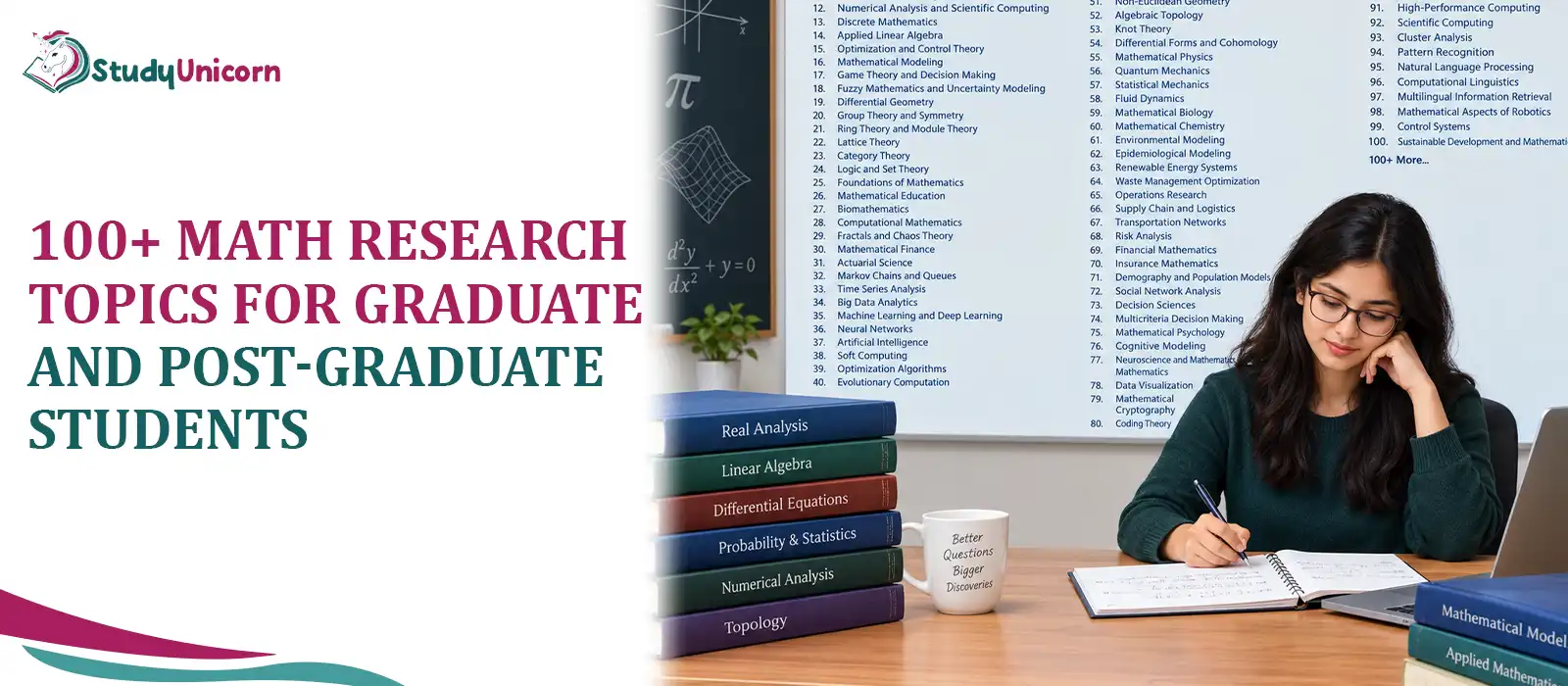
Choosing a graduate mathematics project topic may seem daunting since you should choose something new, narrow, researchable, and in line with your specialization. This 2026 guide provides more than one hundred math research topics for master’s degree, PhD, and postgraduate students, not high school students looking for basic topics. The topics cover pure mathematics, applied modeling, statistics, biostatistics, geometry, topology, financial mathematics, computational mathematics, machine learning, discrete mathematics, and differential equations. In each category, you will find connections between suggested topics, modern trends in academia, applications of mathematical knowledge, and open questions for research.
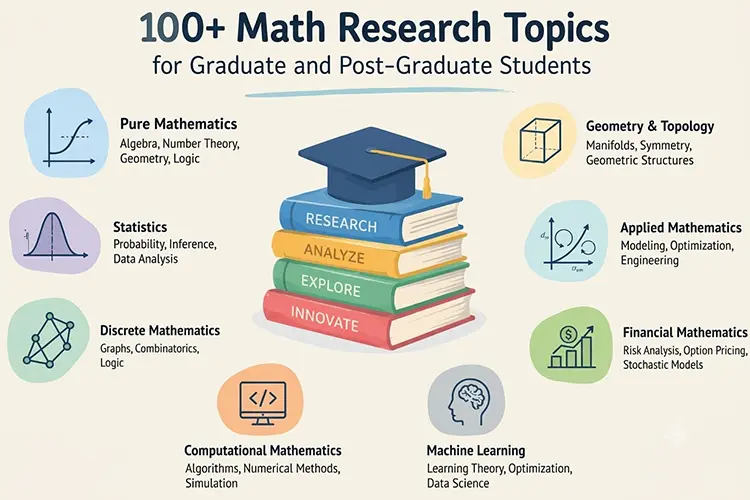
Make sure you consider the interests of your supervisor, available literature, data/software, research timeframe, and career prospects before you decide on the topic. Above, you can see some important takeaways from this guide that will help you to choose the category you need.
How to Choose the Right Math Research Topic?
It is important that your research question be narrow enough for the amount of time you have but wide enough to support analysis. Before deciding which math topic to choose, consider the following factors.
- Alignment with advisor: Choose a topic related to the research and teaching interests of your advisor.
- Availability of the literature: Ensure the availability of the journals, datasets, software packages, proofs, and methods before you narrow down to a research question.
- Originality of the contribution: Decide whether your work is based on extending some theorem, comparing various models, refining algorithms, or applying mathematics in an innovative way.
- Feasible range: Choose the right topic based on your semester duration, computational power, access to data sets, and math background.
- Applicability: An applied topic might lead to working in technology, finance, engineering, healthcare, or data science industry, whereas a theoretical topic might serve as a basis for academic research.
Research pages at MIT, Stanford, and Cornell can help find active fields of study, faculty specialties, and literature search keywords. Therefore, MIT's research is divided into pure and applied mathematics, such as algebra, geometry, analysis, probability, statistics, and computational science.
100+ Math Research Topics by Category
The following is the list of math research topics categorized into specializations that will allow readers to get straight into research areas of interest. There are several topics that may be converted to undergraduate math research topics after shrinking down their theoretical background.
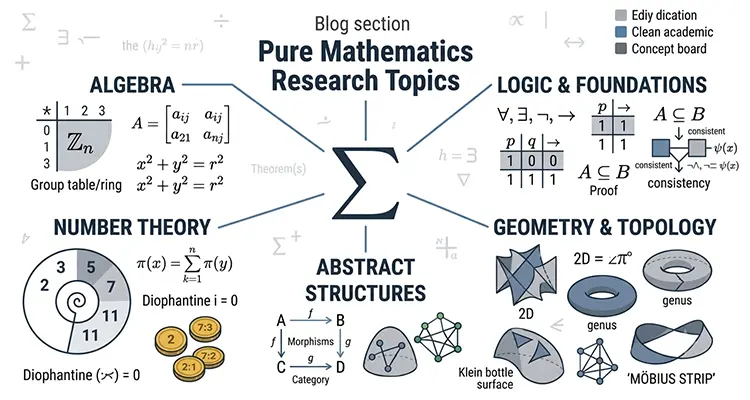
Pure Mathematics Research Topics (Algebra, Number Theory & Category Theory)
Pure mathematics research studies mathematical abstractions, relations, and proof processes independent of practical application. The following research topic list includes algebra, number theory, logic, and higher category theory research topics.
- Applications of Galois Theory to the Solvability of Polynomials.
- Distribution of Prime Numbers in Arithmetic Progression.
- Elliptic Curves and Their Role in Cryptography.
- Representation Theory of Finite Groups.
- The Structure of Noetherian Rings.
- Homological Techniques in Algebraic Geometry.
- Category Theory in Contemporary Algebra.
- Derived Categories and Geometrical Applications.
- Spectra of Algebraic Operators.
- Diophantine Equations and Rational Points.
- Model Theory of Algebraic Structures.
- Algebraic Invariants of Polynomial Rings.
Algebra, algebraic geometry, number theory, logic, foundations, and representation theory are some of the pure mathematics research areas of MIT.
Applied Mathematics Research Topics
Applied math deals with the relationship between mathematical concepts and engineering, physics, biology, economics, and environmental studies. There are many areas where applied math projects may involve differential equations, optimization, simulation, probability, and numerical modeling for Mastering Academic research & formatting.
- Infectious Disease Spread Mathematical Model
- Microchannel Systems Fluid Dynamics
- Supply Chain Logistics Optimization Models
- Traffic Flow Mathematical Analysis
- Autonomous Vehicles Control Theory
- Chaos Theory in Ecological Populations
- Climate Systems Differential Equations
- Tumor Growth Mathematical Models
- Renewable Energy Distribution Optimization
- Coastal Erosion Numerical Model
- Structural Stability Mathematical Analysis
- Manufacturing Systems Stochastic Models
Applied math project ideas gain significance once the variables, assumptions, boundary conditions, and measurable results are clearly defined.
Statistics & Biostatistics Research Topics
Statistics is becoming more integrated with public health, data science, computer science, and machine learning. Possible graduate project topics include statistical models, uncertainty, clinical trials, and population-level effects.
- Bayesian Inference for Making Clinical Decisions
- Survival Analysis for Longitudinal Health Studies
- Statistical Techniques for Designing Clinical Trials
- Models for Emerging Diseases in Epidemiology
- Analysis of Missing Data for Medicine
- Machine Learning to Predict Disease Risk
- Causal Inference for Observational Health Care Studies
- Statistical Analysis of Genetic Association Studies
- Hierarchical Models for Hospital Outcomes
- Robust Statistical Methods in the Presence of Measurement Error
- Time Series Models for Public Health Surveillance
- Assessing Fairness in Health Care Predictions
Probability, statistics, applied probability, numerical analysis, and scientific computing are some research areas mentioned by Cornell.
Geometry & Topology Research Topics
They concern themselves with shapes, space, curvature, manifolds, and transformations that preserve the properties of shapes under continuous changes. Contemporary studies frequently integrate geometry with physics, data science, algebra, and dynamics.
- Differential Geometry of Curved Manifolds.
- Topological Data Analysis for High-Dimensional Data Sets.
- Knot Invariants and Three-Manifolds.
- Non-Euclidean Geometry in Physics Modeling.
- Symplectic Geometry and Hamiltonian Systems.
- Geometric Flows on Riemannian Manifolds.
- Persistent Homology of Biological Networks.
- Fibonacci Sequences in Nature's Geometry.
- Algebraic Geometry of Singular Spaces.
- Topological Approaches to Materials Science.
- Curvature and Geometric Optimization.
- Homotopy Theory in Computational Topology.
The Stanford website characterizes the study of geometry as involving geometric topology, algebraic geometry, symplectic geometry, and geometric analysis.
Financial & Actuarial Mathematics Research Topics
The use of probability, optimization, statistics, and stochastic modeling in markets, insurance, and risks is called financial mathematics. This kind of work can be used in such areas as banking, actuarial science, investment analysis, and financial technology.
- Option Pricing Under Stochastic Volatility.
- Portfolio Optimization With Transaction Costs.
- Survival Analysis for Actuarial Mortality Modeling.
- Market Risk Measures for Extreme Events.
- Default Probabilities of Credit Through Stochastic Models.
- Interest Rate Models for Bond Evaluation.
- Systemic Risks in Financial Networks.
- Forecasting of Pension Fund Liabilities.
- Optimal Portfolio Allocation Through Reinforcement Learning.
- Insurance Catastrophe Modeling.
According to Stanford, financial mathematics is one of the current fields that include financial data and mathematics.
Computational Mathematics & Machine Learning Research Topics
This is the field that blends the study of mathematics, algorithm, numerical analysis, and computer science. It is an ideal track for those students who are interested in machine learning, scientific computation, optimization, or mathematical basis of AI.
- Nonlinear Partial Differential Equations Numerical Methods
- Neural Networks Approximation Mathematical Basis
- Algorithmic Complexity of Optimization Algorithms
- Stability of Numerical Algorithms
- Designing Cryptographic Algorithms and their Security
- Numerical Methods for Solving Inverse Problems
- Mathematical Aspects of Reinforcement Learning
- Optimization Algorithms in Machine Learning
- Error Analysis in Scientific Computing
- Computational Algebra of Symbolic Systems
- Quantum Models' Numerical Simulations
MIT encompasses scientific computing, numerical analysis, theoretical computer science, computational biology, and mathematics of data under its applied research initiatives.
Discrete Mathematics & Combinatorics Research Topics
Discrete math focuses on finite structures, configurations, relations, algorithms, and counting schemes. The topics covered by discrete math homework help range from networks to security, scheduling, coding, computer science, and operations research.
- Graph Theory in the Design of Communication Networks.
- Ramsey Theory and Extremal Graphs.
- Combinatorial Optimization for Scheduling.
- Coding Theory for Reliable Communication.
- Graph Coloring for Resource Allocation.
- Enumerative Combinatorics for Restricted Permutations.
- Design Theory for Experimentation.
- Discrete Geometry for Sensor Networks.
- Combinatorial Models for Social Networks.
Cornell University defines combinatorics as the study of finite structures that often appear in science, engineering, and various branches of mathematics.
Calculus & Differential Equations Research Topics
Calculus and differential equations remain central to mathematical modeling, physics, engineering, biology, economics, and dynamical systems. Projects at the graduate level must include a precise definition of an equation, domain, boundary conditions, or stability problem.
- Nonlinear Differential Equations in Population Dynamics.
- Fractional Calculus in Viscoelastic Media.
- Stability of Dynamical Systems.
- Boundary Problem for Heat Conduction.
- Partial Differential Equations in Fluid Dynamics.
- Numerical Solution to Reaction-Diffusion Equation.
- Integral Equations in Inverse Problems.
- Bifurcations of Nonlinear Dynamical Systems.
- Delay Differential Equations in Ecology.
- Variational Approaches to Boundary Problems.
Trending & Emerging Math Research Topics (2026)
Modern math research tends to be more oriented towards practical applications in AI, networks, climate studies, and quantum computing. These areas can offer relevant questions, but it is necessary to check the existing literature on the matter first.
- AI-Based Theorem Proving and Verification.
- Mathematical Models for Quantum Computing.
- Climate Modeling With Uncertainty.
- Network Theory and Disinformation Propagation.
- Mathematical Aspects of Generative Models.
- Optimization of Sustainable Energy Sources.
- Post-Quantum Cryptography.
- Mathematics for Explainable AI.
- Differential Equations for Forecasting Extreme Weather Conditions.
- Graph Neural Networks for Combinatorial Optimization.
- Mathematics behind Carbon Capture Technology.
- Quantum Information and Quantum Error Correction.
- Privacy Preserving Mathematics for Federated Learning.
Emerging math research topics demand strict scope control due to fast-growing terminology and methodology.
Tips For Writing A Strong Math Research Paper
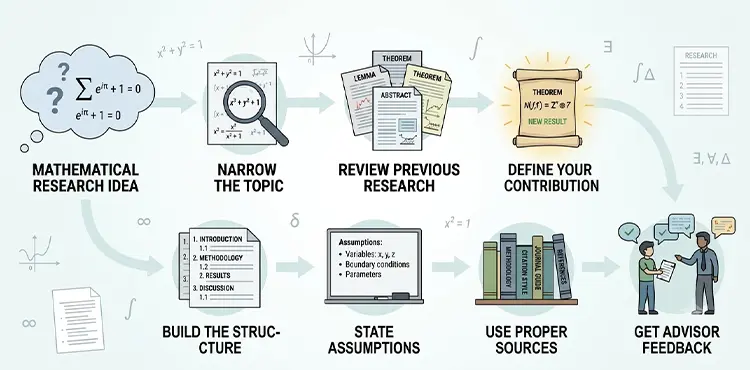
A well-formulated topic requires a good research question, coherent organization of ideas, credible sources, and correct mathematical notation. Apply the following sequence of steps in developing your topic to the research paper.
- Narrow: Instead of broad terms, use a particular theorem, model, dataset, population, algorithm, or comparison.
- Survey: Find out what results are already proven, controversial issues, limitations, and methods used in other projects.
- Specify your contribution: Describe whether you prove, test, compare, improve, model, or apply something.
- Design the structure: Include an abstract, introduction, literature review, methodology, results, discussion, conclusion, and references.
- Specify assumptions: Define boundary conditions, sample restrictions, assumptions of the model, computational settings, and limitations.
- Use sources: Follow your faculty guidelines for formatting according to APA, MLA, Chicago styles, etc.
- Seek feedback: Present your research question and initial outline to your advisor prior to writing the paper.
Conclusion
There are over a hundred research areas within mathematics that can provide good bases for your work at both graduate and post-graduate levels. Yet the topic that is going to suit you most will depend on the area of expertise of your advisor, available literature, the time that you have to conduct research, your education level, and personal interests. The focused question will stay easy to explore, describe, and analyze during your thesis or dissertation writing process, which is going to take several months. Thus, try to focus on particular models, theorems, sets, or other mathematical concepts before conducting your research.
Explore StudyUnicorn’s related academic research and formatting guides for additional support as you develop your proposal and final paper.