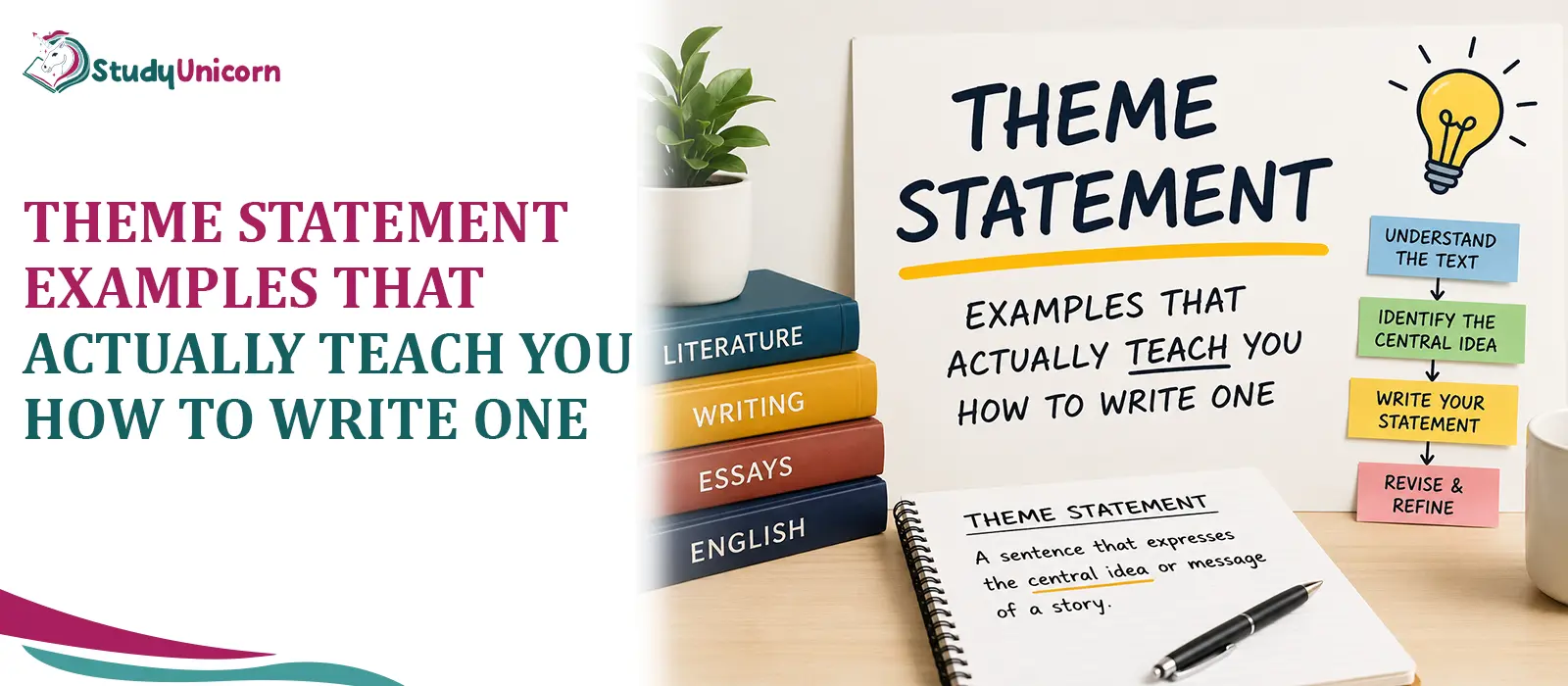
When you are looking for theme statement examples, what you likely have in mind is that you have read a definition, nodded along, and still don't have some actual one-sentence claim that captures the subject. Most students - and even experienced writers - stall when scrambling to find the words to put into sentences that communicate the idea. A theme statement is not a topic, a one-word message, a moral, a general ethical proposition, or a somewhat unclear narrative idea. It is instead a specific statement (an argument) about what the story says about human experience.
This guide includes dozens of samples of theme statements related to universal human themes, writing about classics, and other common types of writing from a friendship essay to a proposal. At the end of it all you will not only recognize a good theme-statement, you will know how to create a theme-statement from scratch.
What Is a Theme Statement and How Is It Different from a Topic?
A Theme statement is a full sentence that presents the message a writer is making or the message the writer is uncovering in the writing about a greater concept, such as love, power, identity, justice. This is distinguishing from pointing at a thing and making a statement about that thing. When someone asks for an example of a theme statement, they're asking you to create a sentence that performs two functions: it identifies a universal concept and it makes something specific, controversial, and provoking statement about the workings of that concept in the world.
This is where most of the writers get caught up, where a topic and a theme statement seem to be similar, on the surface. A topic consists of a word or short phrase: "war," "ambition," "family. Taking that same word, the theme statement becomes an insight; an argument, a support, a claim, a statement that another careful reader can argue, support with evidence, and even disagree with. Topics are neutral. Theme statements make a statement.
The table below makes this distinction concrete:
| Element | Topic (Just a Word) | Theme Statement (A Claim) |
| Love | Love | Love based on control of another person is sure to destroy itself the very thing it was supposed to secure. |
| Ambition | Ambition | Unchecked ambition would seclude somebody from the relations that are to him or her the motivating power. |
| Memory | Memory | Memory is not faulty because people forget; because they create their own memory or reshape it to fit their image of themselves. |
| Justice | Justice | Justice without compassion is a cruel and unloving dispensation. |
Be aware that each label presented in the left column is actually a topic. Every theme statement in the right-hand column is a sentence that makes a statement: either one might argue against the statement or could be challenged by a reader against the text; either it could be the topic of a whole essay. When you do not remember anything keep this thing in mind a topic is a subject, and a theme statement is an argument about it.
20 Universal Theme Statement Examples Across the Biggest Human Themes
Some themes and ideas appear in almost every story that has ever been written, that's why they're universal. The difficulty is less about finding a subject and more about saying something succinct, original about the topic. The following are some universal theme statement examples; each theme statement comes with a brief explanation before it in order to help you understand the thinking behind each statement.
Identity & Self-Discovery
This category shows the slow self realization of the characters. It shows that what they apper to be is complete different from the one who they are in real life. In this category, the best theme statements convey the process of that discovery, rather than simply the discovery itself.
- “Identity is not born in you, it is created by your own choice when no one is watching.”
- “It takes loss of the “self” that people know and expect to discover.”
- “People's true identity is only developed when they stop performing in order to gain acceptance.”
Power & Corruption
It's rare to see power-themed stories that claim that power is “evil”. The one that is neater and more captivating is typically the insights or forces it reveals or hastens in somebody who already had the seeds of evil within him.
- “Power discovers character, not makes it; corruption was always in the wings, looking for a chance.”
- “Without accountability, authority quickly malfunctions and becomes corrupt.”
- “When the need for power is at the chase, mankind often sacrifices what is most valued in its relationships.”
Loss & Grief
Grief stories don't always end in neat conclusions, so the best statements of theme in these stories will not imply that grief is something that must be overcome. Instead, they examine ways in which the loss of someone fundamentally changes a person.
- “Grief sweeps away love and leaves only the memory of it, yet never takes away the love.”
- “Loss makes those who are left without a person who essentially means a lot to them redefine themselves in some ways..”
- “Even though healing from grief involves the process of not forgetting, it is also about learning to live with not having it.”
Belonging & Isolation
Often the theme of these stories is the disconnect between someone being physically at a community and actually feeling a part of that community. Most of the strongest statements are driven by wanting connection and fear of rejection.
- “Belonging is not a place, but the presence of other real people who truly see one.”
- “Self-isolation may be a strategy 'as protection from the threat of rejection.”
- “Often, a sense of belonging needs to be built from the ground up and takes a certain amount of courage to show your authentic self.”
Courage & fear
Courage-based themes do best without the all-too-familiar "fearless" word. The most helpful statements are that of recognizing the presence of fear and courage, not that they are opposite.
- “Courage means 'not to be afraid, but to act.'”
- “Fear will often shelter people from their growth even as it keeps them safe from danger.”
- “Real bravery is what you reveal in everyday life, in less-than-glorious moments.”
Justice & Morality
Justice themes become more layered and nuanced when a story makes the entity of who determines right and wrong more complicated. The below statements applaud that complexity, rather than delivering a pithy judgment.
- “Justices systems created by flawed individuals will always be shaped by their shortcomings.”
- “When it comes to conviction and a moral commitment, it hurts most when you have to pay a personal price.”
- “Justice sometimes means violating laws which are from the beginning unjust.””
Change & growth
Growth stories are also a story about sacrifice—what the character must give up to allow him or her to become something new. That trade-off is captured by these two statements.
- “To grow, you must give up your old ways of knowing and your comfort with them, and go into the unknown, into the experience.”
- “People can only change, if they take responsibility for the change not blaming circumstances.”
These various topics can make you understand the story-telling process better, and allow you to develop more interesting stories.
Extracting Theme Statements from Classic Literature: A Guided Breakdown
Taking the time to read examples of theme statements in literature is among the quickest ways to build up this skill, since classic novels have been crafted from hundreds of pages of discussion around the theme. As a reader or student, you should condense all that development to one very succinct sentence. The table below progresses through 5 popular works that progress from a topic statement to a fully developed theme statement.
| Work | Topic | Theme Statement |
| To Kill a Mockingbird | Racism and moral courage | During times of prejudice, one must have moral courage to stand in opposition against a community, even if it may endanger their own lives. |
| The Great Gatsby | Wealth and the American Dream | When American Dream is defined by materialism and replaces real identity with money, the dream fails. |
| 1984 | Totalitarianism and truth | There are no limits on the power of totalitarianism when they rule over people's minds and even the way they think. |
| Romeo and Juliet | Love and family conflict | Inherited hatred destroys the very love it claims to protect when it goes unexamined. |
| The Alchemist | Destiny and self-discovery | Life has a lot to teach if you follow your calling and not the destination. |
Pay close attention to the pattern in each row. The “Topic” column never goes anywhere, it's right there just tucked into a word! What alterations is the incorporation of a statement concerning how that subject works in the tale. The word "racism" becomes a plea for the price of moral justice. The word “wealth” comes to signify the things that are lost in materialism. The same compression process that we used for a text - topic plus claim is used in any text.
Friendship Theme Statement Examples: Beyond Loyalty to Something More Complex
One theme that is highly current, even more common than others, is friendship and one word that's heard more than any other for this essay is loyalty. If one thinks of loyalty as a theme statement, this is a topic with a positive spin. Good friendship theme statement examples explore questions beyond loyalty to explain the circumstances in which it can flourish, grow thin, or fail completely. Here are some of the examples:
- “Real friendship is not friendship without disagreement; it is friendship marked by virtue of honesty, which values the comfort of its opposites.”
- “Loyalty alone is not a value of friendship, but it is a value of enabling.”
- “Failure is not the best test of friendship, but success is.”
- “Showing up is the foundation of Friendship, particularly when it's not convenient.”
- “Real friends do not settle for affirming the existence of another's errors, but they will seek to address them head on.”
- “The kind of friendship that requires a lot of effort but doesn't pay off leaves only resentment after a while.”
Tip: If you want the statement of "friendship requires honesty" to be a little more forceful, crop it to include a why or what if. An example of "friendship endures hardship" would be: "Trust must be given in an unpleasant manner-when both friends are willing to be honest in an unpleasant manner, which, of course, creates distance for the time being. The addition of only, when, which, which is frequently the difference between a forgettable theme statement and a true, effective statement.
How to Write a Theme Statement in 3 Deliberate Steps
After examining a few examples, the obvious next thing you'd have to ask yourself is how to write a theme statement for your own, rather than mimicking one of the examples. It is more mechanical than subconsciously it may feel, but it definitely will stop in three clear movements.
Step 1: Identify the Thematic Concept
Begin by identifying the one human thing the text is continually coming back to: love, ambition, betrayal, isolation. Do not yet be concerned with any fancy speech, just pick out the word. Look for repeated symbols, reoccurring conflicts, or a question that is continually being faced and wrestled with by the characters. If the main issue in a story is a character's loyalty or duty-even when this is never clearly written in the text of the story, then it is likely loyalty or duty.
Step 2: Ask What the Text Claims About That Concept
This is the part that most people overlook; and this is the part that forms the theme statement. What does this story appear to say is true about loyalty, love, ambition? Does it imply that loyalty is good, bad, not to be taken for granted, or something else? Consider the resolution of the plot; is the most faithful character rewarded, punished or left morally "straightjacketed"? The conclusion typically indicates the implicit claim of the author.
Step 3: Strip Out All Story-Specific Details
One error that is usually made is writing "Atticus proves that doing the right thing is important. That's still one plot and one character. The last step is to construct the sentence in a way that it would be possible to extend its applicability to other stories beyond this one, but still leave it as yet specific as possible without becoming absurd. Eliminating specific plot events and proper nouns leads to the rest of the sentence being universalized - this is what is truly meant by a theme.
Statement of Theme Examples: From Flat to Sophisticated - A Direct Comparison
Even after writers grasp the process, often the sentences that they come up with when starting out are “nice,” but they're not really an insight. Analysing an example of weak and strong statement of theme examples side by side helps to identify the difference easily when compared with any abstract description.
| Weak | Strong Version | Why It Works Better |
| The book is a story of love. | An possessive love is the most destructive type of love in the world. | The strong version makes an argument, one that can be disputed, rather than the naming of a topic. |
| Friendship is good. | With true and real vulnerability, friendship becomes deeper. | The strong version is identifying a condition, not saying what is obviously true. |
| War is bad. | War strips away the moral certainty soldiers carried into it. | The strong version is identifying a condition, not saying what is obviously true. |
| Family matters. | When family loyalty requires that wrong doing is not reported, the family loyalty is destructive. | The strong version adds strain and complexity of moral issues. |
| Growing up is hard. | Losing illusions that you thought were protective is the path to growth. | The Strong Version provides a mechanism for growth, rather than a mere label that it is "difficult. |
Every line in the grid follows the same pattern: Weak statements indicate a sentiment towards the topic; Strong statements describe the functions of the topic in the story. The shift from feeling to mechanism is what is the difference between a flat sentence and a really sophisticated sentence.
Theme Statement vs. Moral of the Story: A Distinction That Changes How You Write
Sometimes, writers blur a theme statement with a moral, but it's not difficult to make this mistake: The theme statement and moral are situated around the same length, time, and place in an essay. But they have different work to do, and often when they are mixed then you end up creating a example theme statements that are not correct.
| Aspect | Theme Statement | Moral of the Story |
| Purpose | Researches or discovers a common concept | Prescribes correct behavior |
| Tone | Observational and analytical | Instructive and directive |
| Complexity | Permits for some ambiguity and nuance | In most cases: clear-cut and simplified. |
| Audience Takeaway | This is the case with regard to X (in this story). | “Here is what you need to do” |
| Example | Those who are not ready for the power it bestows are corrupted by it. | Don't abuse power. |
The moral is intended to instruct the reader in the proper conduct. A theme statement tells the reader what the story is opening, which is what the story will say; the reader may differ from the writer in some aspect, whether by complicating it or by using it in another way. Academic essays, almost always, require a theme statement, not a moral, since a moral "closes off" discussion and an essay is about evidences of analysis.
Why Mastering Theme Statements Sharpens Every Type of Academic Writing
The ability to convey a complex concept in a single correct and debatable sentence doesn't just remain a classroom tactic. It's the same muscle that is employed in writing a thesis notion, a research question, or an argumentative essay claim. Too broad of a theme statement ("love is complicated") will allow your essay to wander, just as a paper does if a thesis statement is too general to support. To read how precision can be used in argumentative writing, check out our guide on Crafting a Perfect Thesis Statement which systematically shows the parallel process.
This relationship is also important in the context of, not only the analytical essay, but also for creative writing. For writers composing short stories or personal narratives, it is helpful to narrow down to a theme statement before writing, as it will help every scene to have a through line to carry out which will avoid wandering from one idea to another. Or when you look down at an essay and see that it's due and the central claim hasn't been developed yet, you can use our Essay Writing Help service to spark some ideas and create a strong, standout argument.
Proposal Theme Statement Examples and Other Niche Contexts
Theme statements don't only belong in the literature classroom. The one sentence of business writing, grant application, academic proposal, is the unique binder which holds the whole thing together. The same principle applies to a strong proposal theme statement example as it does to a literary: it identifies a concept and draws a close-cut judgment on the topic. The only difference is that, instead of a narrative, you are dealing with a practical situation.
- For a research proposal: “The models of 'reactive treatment' are more readily watered down when shift to 'early intervention', producing long-term savings with better results.”
- For a business proposal: “A sustainable package offers a more reliable boost to brand loyalty than any price competition can.”
- For a grant application: “People trust community-led programmes more than top-down ones because they engender trust before infrastructure is built.”
The formula remains the same in all cases: specify the concept, and then make a specific, defendable statement about the way it works. In the case of a longer academic written proposal, then if you wish to develop that central thesis into the entire argument, our Thesis Writing Service could be the one to help you structure the entire proposal.
Conclusion
A powerful theme statement is not just a summary of a story, it is a valuable life lesson that readers can examine and debate and provide details from the text to substantiate. You can easily write a compelling and strong theme statement when you clearly understand the difference between topic, theme, moral and by taking help from the examples. Facing difficulty in creating a theme statement? Contact us today and our experts will handle the rest!