Did you know that regular spellcheckers can easily miss the difference between "whose" and "who's"? And it is because both find their place in the dictionary. This seems like a small mistake
that can cost you heavily in your grades.
Now, let's check the ground reality, and you know both terms indicate two different meanings. But what you don't know is where to use which one, and the guessing game that starts playing in your head can lead you to lose marks.
And since you have landed here, the confusion will not be part of your writing and editing, as this guide gives you a better picture of it. What you will cover is a simple two-second trick that fixes the confusion forever and an exercise that would be proof that you have learnt it.
So, scroll down and don’t lose your hard-earned points over a small grammar mistake; learn the easy rule right now and submit your paper with total confidence.
Quick Summary: Clear Your Confusion Between Whose and Who’s
Here is the insight about this confusion that gives you better clarity on a superficial level.
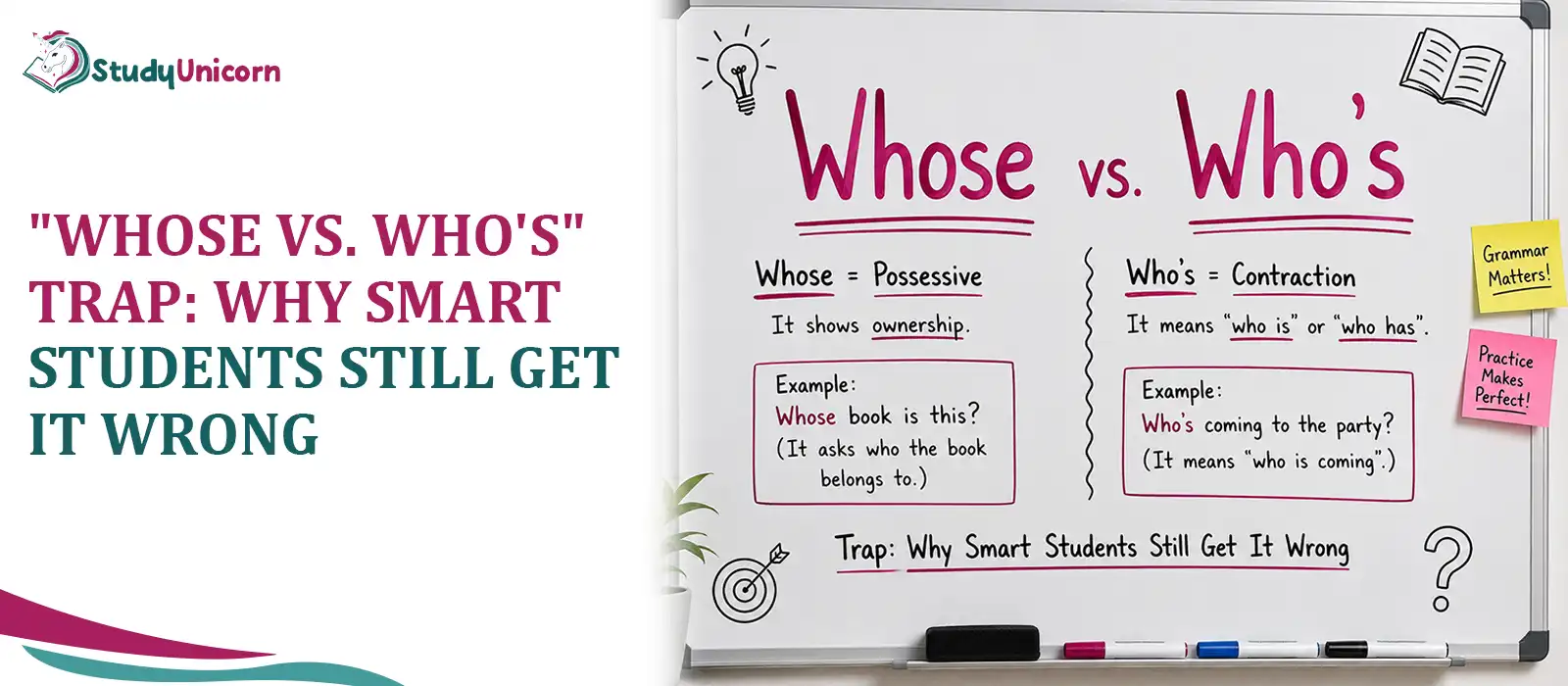
| Word | Function | Simple Definition | Example Sentence |
| Whose | Possessive pronoun / determiner | Shows ownership or belonging | Whose jacket is hanging in the closet? |
| Who's | Contraction | Short for "who is" or "who has" | Who's going to lead the meeting today? |
What Does "Whose" Mean?
In sentence construction, your must be in the correct "the right" version when talking about a possessive relationships. In reference to a person, animal, thing, or idea that owns something, a possessive pronoun should be used if the possessed object is found within the sentence. The proper word in this case is whose, which is a form of possessive of who.
The one significant exception to this is when you are showing possessive adjectives. They are used to avoid the use of an apostrophe and s, for instance; the student's book would not be a possessive adjective, neither would the teacher's desk but it does include whose. The possessive pronouns in English never include and apostrophe and s and this is a rule;
- For example, whose is on the same footing as his, hers, its, ours, yours, and theirs.
Using Whose to Ask About Ownership
Whose is an interrogative pronoun or determiner in direct as well as indirect questions asking (or related to asking) which person or persons owns or has something; pertains.
- Whose car is it in the reserved area in front of the main entrance?
- Whose turn is it to put forward research to the board?
- Whose coffee is on the top of the copy machine?
- Are you aware of whose keys are hanging in the corridor after class?
Here, want to know the owner or owner. Observe that; with the possession inquired about; holds the same meaning as; using a personal possessive pronoun such as his her their etc; .instead.
Using Whose in a Relative Clause
Whose is a relative pronoun, which can be used in a complex sentence to refer to a noun and follow it. The relative clause giving more information about the noun follows after. Student writers most often make the error that whose can only be used with people.
Pre-existing style guides including those by Merriam-Webster, The Chicago Manual of Style and the MLA Style Center generally concur that "whose" can be used for residents of character animals, spatial places, institutions, and ideas. Though, for all inanimate items, which prevents the awkward wordy phrase.
Examples with Human Subjects:
- The researcher whose paper got a tag of international recognition was awarded a grant.
- An author whose books found their place on the top bestseller list met with college students
- Patients whose medical records need a touch of updating must head towards the reservation desk.
Examples with Animals and Natural Entities:
- A dog whose leash broke ran through the grassy park near the lake.
- This is one of the jewels of history in the form of an ancient tree whose branches shaded the courtyard and survived the severe storm.
- Migratory birds whose habitats face environmental risks immediately need protection in the form of shelter and better management.
Examples with Inanimate Objects, Places, and Concepts:
- We explored a European city whose central architecture has a connection with the Middle Ages.
- The corporation whose stock value is projected to expand can see a better workforce this quarter.
- A software program whose code has bugs can lead to performance issues.
- This is a policy whose long-term consequences remain uncertain for local communities.
What Does "Who's" Mean?
In English syntax, some apostrophes are used to show possession or the relationship between words. In other cases, it is used for words made up of two others, such as they're. It's can only ever be a contraction, never meaning for example, belonging to.
Who's identifying where in the clause it substitutes for two words. What it is formed when the pronoun who joins with two particular forms of the auxiliary verbs..
Who's = Who Is
The most common use of who's is as a contraction of two words, who is, in present tense statements, in relative clauses, and in direct questions.
- Who is showing up for tonight's library study group?
- She is the appointed project leader who is handling our team assignments.
- Do you know who is in charge of posting for the department calendar each week?
- Who is committed to getting their finished manuscript in on time?
- I have the front desk clerk who is requesting to speak with the manager.
In each of the examples above, if one were to reinflate the parenthesis to be who is one keeps the grammar intact without altering the meaning.
Who's = Who Has
The contraction who's is a shortened variant of who has in the present perfect use of verbs in the English language. And this auxiliary verb has, when followed by a past participle verb form, will be contracted to who's or who has.
Who has completed the readings from the textbook chapters assigned for tomorrow's seminar?
- He is the only job applicant who has passed all required background investigations.
- Who's been at the office printer the whole lunchtime?
- Discover who’s the keys out of the main security drawer.
- She is the experienced instructor who’s published dozens of articles in various academic journals.
Uncontracting these sentences gives "who has finished, " "who has completed, " and "who has been using, " illustrating the contraction's usefulness in the present perfect tense.
The Simple Trick to Never Mix Them Up Again
For those kinds of papers (for example, an elaborate research report or an urgent email that's due immediately and quickly), fast and reliable methods for word removal will be required. All that is needed is doing a mental substitution test, and you will never struggle with the right words.
The Step-by-Step Two-Word Swap Test
Handle this quickly in four easy steps, always during your final proofing passes:
- Back up to the sentence in which the word or phrase in question appears.
- Mentally expand the phrase "who is" or "who has" to read.
- Reading through the entire sentence, including the replacement, does it sound natural?
- Evaluate the result:
- If you've understood each part of that sentence correctly, write Who's.
- For the study if there is an awkward, ungrammatical, or sounding wrong sentence, write whose.
| Decision Step | Action / Question | Outcome A | Outcome B |
| Step 1 | Spot the word choice in your sentence | Word is whose or who's | Word is whose or who's |
| Step 2 | Perform the replacement test | Swap with "who is" or "who has" | Swap with "who is" or "who has" |
| Step 3 | Read the sentence aloud | Sentence makes complete sense | Sentence sounds awkward or incorrect |
| Step 4 | Select the correct word | Use Who's | Use Whose |
| Example | Testing: "Who is at the door?" | Correct Who's at the door? | Testing: "Who is coat is this?" Incorrect Whose coat is this? |
Whose vs. Who's vs. Whom
Authors, however, may decide which two to use when referring to clauses: whose, who's, and whom. Many authors: making sure of any certainty. Jumpstarts the clause's relative pronoun structure. Blends of relative phrase roles you will have to order.
To see how the three dimensions behave in the distinct ways, it is necessary to consider the morphological set to which they refer.
- Whose is a possessive pronoun (denoting ownership).
- Who's functions as a contraction (combining subject + verb).
- Whom functions as an objective pronoun (receiving an action or following a preposition).
| Term | Grammatical Category | Primary Function | Quick Swap Test | Correct Sentence Example |
| Whose | Possessive pronoun | Shows ownership or belonging | Replace with "his," "her," or "their" | The teacher whose class we took was brilliant. |
| Who's | Contraction | Short for "who is" or "who has" | Replace with "who is" or "who has" | Who's attending the writing workshop tomorrow? |
| Whom | Objective pronoun | Receives verb action or preposition | Replace with "him," "her," or "them" | To whom should I direct this official request? |
How to Distinguish Between Who, Whom, and Whose
It sometimes becomes a little confusing about the correct usage of whom, who, and whose when building a sentence with a relative pronoun. The substitution with a personal pronoun rule should be applied:
Subjective case (who): If the position for the sentence you will use: he, she, or they
- Example: Who is the mastermind behind writing this research paper? (He wrote this paper with all his expertise with hardwork.)
- Objective Case (Whom): If the sentence position revolves around him, her, or them, it is always in the correct position to use whom.
- Example: With whom did you complete the review task and make notes (I reviewed and crafted the notes with her.)
- Possessive Case (Whose): If your sentence is harmonized to his, her, or their, you will prefer to choose whose.
- Example: Whose manuscript was selected for publication in the latest assembly section? (Their manuscript was selected as they have done brilliant work.)
Through your knowledge of the relative pronoun, you can instantly solve the most complex sentence structure by directly substituting the personal pronoun (he/him/his):
Common Mistakes with Whose and Who's
English punctuation and grammar is one of the many things that common, place-based automated spelling checks and proofreaders are uncharitable in catching. Automated software algorithms tend to plow right past the substitution errors as both words are entries in the dictionary.
Once you master these common error kinds, your writing will always be crisp, professional, and never have that too-silly-to-be-believed error.
1. Adding an Apostrophe to Show Possession
The most common mistake occurs when writers put an apostrophe after whose ("whose's") or who indicates possession on purpose; on the other hand, they believe that "apostrophes = possession".
An apostrophe is used with common English nouns to show a possessive/ownership(eg. Sarah's jacket, or the company's policy). Possessive pronouns follow an entirely different rule to this by default, and will NEVER take apostrophes.
Just recall this parallel grouping: his, hers, its, ours, yours, theirs, and whose — all of them (all the possessive pronouns) convey ownership without apostrophes.
2. Writing "Whos" Without Any Punctuation
A further common error is writing punctuation out of context and, for instance, framers.
Whos with no apostrophe is not a word in proper English grammar, in academic dictionaries, or style guides. If you wish to merge who and is, you would need to have an apostrophe in who (who's). If you wish to show possession, you would need to remove the apostrophe and use who's (whose).
3. Overusing Contractions in Formal or Academic Writing
That's you know what, who's is entirely suitable in familiar (not to mention, I suppose colloquial?) speech. But in conventional styles of guidelines for academic writing, they usually recommend avoiding contractions when writing formal research papers, dissertations, and reports.
When we are writing as professionals/academics, we write out the whole two-word phrase instead of the contraction.
Once you learns this skill of keeping this distinction it will improve your tone of your academic work and at the same time also prevent you from having accidental premature comma.
Is There a Difference in British vs. American English?
The grammatical rules of WHOSE and WHO'S are exactly the same in all dialects spoken all around the world in English. American writers, writers from England, all British countries, Australian writers, and writers on the international Scholarship market all abide by the same grammatical rules.
The usage of whose and who's does not alter given the place; this is not true when referring to the spelling (e.g. color/colour, analyze/analyse) or where a punctuation mark is placed (e.g. colon/quotation).
| Region | Rule for "Whose" | Rule for "Who's" | Regional Variance? |
| American English | Possessive pronoun (no apostrophe) | Contraction for "who is / who has" | None |
| British English | Possessive pronoun (no apostrophe) | Contraction for "who is / who has" | None |
| Canadian English | Possessive pronoun (no apostrophe) | Contraction for "who is / who has" | None |
| Australian English | Possessive pronoun (no apostrophe) | Contraction for "who is / who has" | None |
The only kind of faint regional difference is that there is a general preference for formality. It is proven that the relatively more conservative British publishing and the relatively more formal writing style of academic texts can be less forgiving of contractions like who's (i.e. more in line with "rules") than the more lax American writing styles. But, this has not been shown to be true of the grammatical definitions.
Whose vs. Who's: Quick Reference Examples
Contrastive sentence pairs Left your brain in the lurch about the right usage? Practice comparing and contrasting pairs of sentences the next time you proofread and you soon will become not only a master at their differences but also a skilled at avoiding them! Grab these handy comparison charts below the next time you proofread and use the table for quick reference.
| Incorrect Usage | Correct Usage | Underlying Rule & Explanation |
| Who's laptop was left in the lecture hall? | Whose laptop was left in the lecture hall? | Shows ownership of the laptop; requires possessive pronoun. |
| I spoke to the manager whose in charge. | I spoke to the manager who's in charge. | Short for "who is in charge"; requires contraction. |
| Whose coming to the library study session? | Who's coming to the library study session? | Short for "who is coming"; requires contraction. |
| The country who's borders were closed reopened. | The country whose borders were closed reopened. | Shows possession relating to a country; requires possessive pronoun. |
| Do you know whose completed the assignment? | Do you know who's completed the assignment? | Short for "who has completed"; requires contraction. |
| The artist who's work is on display spoke today. | The artist whose work is on display spoke today. | Shows ownership of the artwork; requires possessive pronoun. |
| Find out whose calling from the main office. | Find out who's calling from the main office. | Short for "who is calling"; requires contraction. |
| An organization who's values align with yours. | An organization whose values align with yours. | Shows possession for an organization; requires possessive pronoun. |
Test Yourself: Whose or Who's?
Test your understanding by filling in the blanks in the following ten practice sentences. Choose the correct word for each scenario using the substitution rule learned above.
- ______ signature is required on this legal document?
- The candidate ______ running for student council spoke at the rally.
- ______ been sitting in my assigned seat during lecture?
- That is the scientist ______ breakthrough research won the Nobel Prize.
- Do you know ______ planning the end-of-year campus ceremony?
- A house ______ roof is leaking requires immediate structural repairs.
- The professor ______ syllabus was distributed yesterday is on leave.
- ______ responsible for locking the laboratory doors at night?
- We interviewed an applicant ______ qualifications matched our needs.
- Find out ______ taken the reference books from the department desk.
| Question Number | Correct Answer | Detailed Explanation |
| 1 | Whose | Possessive: asking about ownership of the signature |
| 2 | Who's | Contraction: short for "who is running" |
| 3 | Who's | Contraction: short for "who has been sitting" |
| 4 | Whose | Possessive: referring to the research belonging to the scientist |
| 5 | Who's | Contraction: short for "who is planning" |
| 6 | Whose | Possessive: referring to the roof belonging to the house |
| 7 | Whose | Possessive: referring to the syllabus belonging to the professor |
| 8 | Who's | Contraction: short for "who is responsible" |
| 9 | Whose | Possessive: referring to qualifications belonging to the applicant |
| 10 | Who's | Contraction: short for "who has taken" |
Deep-Dive: Possessive Pronouns vs. Contractions
Getting a grip on permanent versus new contractions of word pairs like whose and who's is far easier if you understand the system of English pronouns and contractions in general. Mistakes and mix-ups between the possessive form and the apostrophe-containing contraction are far more widespread than this one pair of words!
Actually, the reason so many words are confused in English is the same for every one of several sets of synonimes, where the only factor is the assumption that an apostrophe continually quotes whatever is before it:
The Parallel Homophone Pairs
Examine how these four common word pairs share identical structural patterns:
- Whose vs. Who's
- Possessive: Whose notebook is this? (No apostrophe)
- Contraction: Who's going to class? (Short for who is)
- Its vs. It's
- Possessive: The cat licked its paw. (No apostrophe)
- Contraction: It's raining outside. (Short for it is)
- Your vs. You're
- Possessive: Is this your backpack? (No apostrophe)
- Contraction: You're welcome to join us. (Short for you are)
- Their vs. They're
- Possessive: Their team won the tournament. (No apostrophe)
- Contraction: They're studying in the library. (Short for they are)
Recognizing that possessive pronouns never require apostrophes provides an all-in-one rule that fixes multiple grammar errors simultaneously across your writing.