What Can You Do with a Criminal Justice Degree?
Explore 50+ criminal justice degree career paths and salaries for 2026. Find the best jobs in law enforcement, law, corrections, and more
Jun 06, 2026
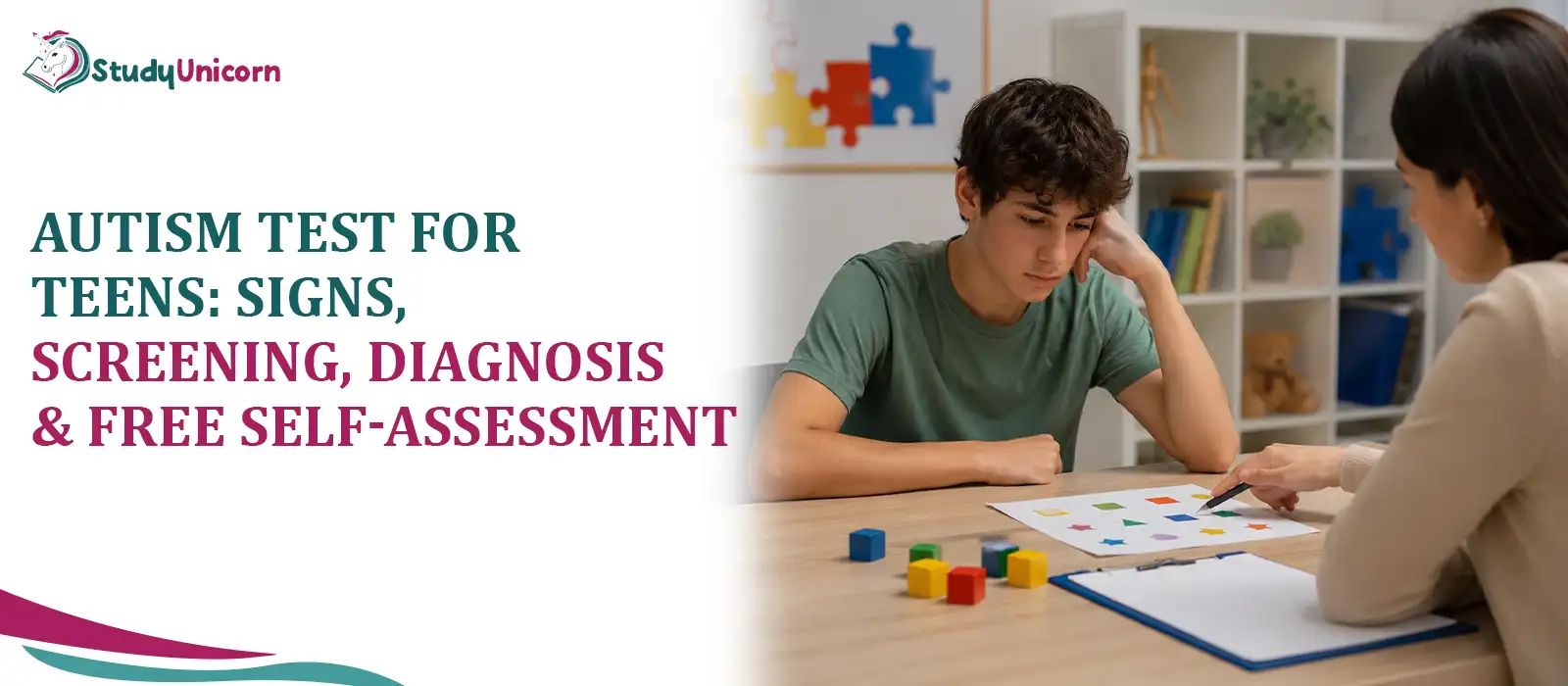
"Is my teen showing signs of autism?" It is very common question that keeps coming on parent’s mind when they see their child suffering socially or when they find that their child has intense interests that do not fit in with society. Continue reading this guide to know about the signs of Autism, about the working of autism test for teens, what is included in a formal diagnosis and also to get a free self-assessment test to have a better understanding. Important thing to remember: this guide just acts as a screening tool it is not a diagnosis only a experinced licensed professional can confirm about this disorder.
People who look for an "autism test" are typically imagining a clinical blood test, brain scan, or a yes/no answer. There is no laboratory test for autism for any age, in reality. There is no such thing as a diagnostic test but rather a screening questionnaire a series of questions about behavior, communication and sensory experiences that can be used to determine if a teenager's characteristics fit those of an autistic spectrum disorder.
An autism spectrum test for teens is intended to help identify potential symptoms early, helping a family to determine if it is worth a comprehensive assessment. It is not a scale of intelligence, personality or “how autistic” a person is. It merely correlates reported behaviors with an established set of criteria and provides a response that basically translates to "these behaviors raise the possibility of autism" or "these behaviors are not strongly indicative of autism. Screening is not the end of the process, but the beginning.
Many teens and older children learn to "mask" or conceal their characteristics to fit in with others and that's part of the reason why it may look different in teens than it does in younger children. Commonly examined categories are listed below.
Autistic teens may struggle to conversate and connect with their peers, even when they are sincerely interested and want to do so.
These patterns can cause socializing to come across as performance instead of natural, and can be fatiguing to maintain for day in and day out.
Structure, predictability and intense fascinations are comforting for many teens with autism and can provide focus.Structure, predictability and intense interests are comforting for many autistic teens, and can provide focus for them that others may not be aware of.
These behaviors may vary from teen to teen but are frequently ways to cope with stress and to stay grounded.
The sensory world of everyday life can be a lot more overpowering for autistic adolescents and certain settings might actually be quite hard to endure for extended durations.
A teen with sensory sensitivities can be exhausted, angry, or simply wanting to get away from the situation even after only a brief period of over-stimulation.
None of these signs alone is a sure sign of autism; many teens will have one or two of these sometimes. The key is a consistent pattern in a few categories that is very noticeable and impacts daily life, school or relationships. If the scenario seems familiar, then a free autism test for teens may be a good first step before deciding to seek a professional opinion because it helps a person take an abstract concern and make it more concrete to discuss with a physician.
There's a typical progression from "I'm concerned" to diagnosis when things start to fall into place. That process will typically involve the following steps:
This can be a very dramatic process for the teen. Nerves, self-consciousness and uncertainty about what the "right" answers are are all normal and expected when going into an interview. A competent physician will discuss the procedure and ensure that it is carried out without pressure and that there is no such thing as a "failed" assessment. Support can take the form of helping to understand that it is a means of finding out, not a test of character, for parents.
The only way to get a formal diagnosis of autism is to seek help from a qualified professional who has been trained in developmental and behavioral assessment. This typically includes:
| Professional | Can Diagnose Autism? | Role in the Process |
| Developmental Pediatrician | Yes | Medical doctor specializing in child development; conducts full evaluations |
| Child/Clinical Psychologist | Yes | Trained in administering diagnostic tools like the ADOS-2 |
| Psychiatrist | Yes | Evaluates ASD alongside co-occurring conditions like anxiety or ADHD |
| School Counselor | No | Can flag concerns and support the student but cannot formally diagnose |
| General Practitioner (GP) | No | Can refer families onward to a specialist, but cannot formally diagnose |
| Online Screening Tool | No | Useful for raising awareness, not a substitute for clinical diagnosis |
The ability to give a diagnosis is a skill that isn't reserved for the medical profession. A school counsellor can identify concerns and advocate for a student and a GP can signpost a family to the next steps, but neither can make a formal diagnosis of autism. The same is true of any online questionnaire, even the one below that's good for raising awareness, it's not a diagnostic instrument.
Take this autism test for teen to learn about behaviors and traits that are often associated with Autism Spectrum Disorder (ASD) and are addressed in this free, online autism test for teens. This is a self-assessment check list that may be helpful for identifying and deciding if a further evaluation by a professional might be the next right step.
Free Autism Test for Teens: Self-Assessment Checklist
If a screening indicates the possibility of autism traits, the following steps are crucial. Calmly and without alarm, talk with your teen about the findings, pointing out that you are seeking understanding, but not labelling them. From there:
These steps early in the process don't only result in a diagnosis, but often provide relief and support for the teen, regardless of the diagnosis.
The first step to understanding autism in teens is to be aware of patterns and not make assumptions. While it may be helpful to have a screening tool, it is just a first step to clarity and support. Knowing about the results and being open-minded is a big difference for your teen's well-being, whether it indicates further evaluation or not. If you are seeing regular signs, please do not delay taking the free autism self-assessment today and take the time to seek advice from a qualified individual.
Clinicians use structured interviews, behavioral observation instruments (such as the ADOS-2), and parents, teachers and the teen's feedback. There is no single test, but rather information is collected from various settings to determine if the patterns of behavior consistently meet the diagnostic criteria of ASD.
A teen's voice is important and generally heard through a teen self-report instrument or through direct interaction when evaluating. This is taken into account, along with the input from parents and teachers, because teenagers may be aware of social or sensory difficulties that may not be seen by anyone else.
A screening is a short questionnaire that helps to identify potential traits, while a diagnosis is a detailed assessment performed by a trained professional to make a formal diagnosis. Only a diagnosis, not a screening result even from an autism test free for teens online confirms ASD.
Testing begins with a screening questionnaire, which is usually done online, or at a child's pediatric checkup. A referral to a developmental pediatrician or psychologist for a comprehensive evaluation with standardized instruments and interviews is made if results indicate concern.
An online autism test for teens free of charge can highlight traits worth discussing with a doctor, but it isn't diagnostically accurate on its own. These tools are screeners, not clinical instruments so results should always be followed up with a professional evaluation if concerns persist.

Sources

Struggling With Assignments?
Get expert-written, plagiarism-free assignments delivered on time.
Place Your Order
Related Posts

What Can You Do with a Criminal Justice Degree?
Explore 50+ criminal justice degree career paths and salaries for 2026. Find the best jobs in law enforcement, law, corrections, and more

What Are Vape Detectors and How Do They Work in Schools?
Learn what vape detectors are, how they work in schools, their key features, benefits, and why they're becoming essential for student safety in 2026.

Longest Harry Potter Book: Ranking, Word Counts & Times
The longest Harry Potter book is Order of the Phoenix (257,045 words)! See where all of the 7 books rank in length, total page counts and read time.

Which Zodiac Sign Is Truly the Most Powerful? Know Yours!
Find out which zodiac signs dominate in love, career, and intelligence. See where your sign ranks using cosmic history paired with real psychological ...
Subscribe now!
To our newsletter for latest and best offers

Need Writing Help?
Our expert writers are ready yo assist you with any academic assignment.
Get Started
Join our 10K of happy users
Get original papers written according to your instructions and save time for what matters most.
Order Now