Writing without plagiarism is one of the key elements of credibility and integrity in writing, regardless of whether you are a student, researcher or a blogger or content creator. We live in the digital era where information can be accessed easily, and it is quite simple to accidentally recycle the work of another person without giving him/her the credit due. Here is where plagiarism checkers and the originality scores come in as very necessary tools. They assist writers to recognize the duplicated material, bring out the areas where they need to reference or rephrase, and to make sure that the completed work is genuine.
How these tools operate can make a lot of difference regarding the quality of writing as well as safeguard intellectual honesty. Instead of treating plagiarism checkers as a last resort before submitting an assignment, a writer may consider them as tools of learning to improve paraphrasing, reinforce citation and enhance originality. This guide will discuss the functioning of plagiarism detectors and the way to interpret the originality scores to create a real original and reliable work.
What is Plagiarism? Beyond Copy-Paste
Before delving into how to avoid plagiarism let’s have a look at what actually does it means. Most individuals think that plagiarism normally occurs when one literally copies and pastes a piece of work produced by another party. Nevertheless, plagiarism is far more extensive and intricate than that. It is the violation of intellectual work of another person either purposefully or unintentionally. In scholarship writing, blogging, research and professional writing, the knowledge of what really qualifies as plagiarism is vital to the preservation of credibility and originality. Knowing the different forms in which plagiarism may take place, authors are able to avoid the most frequent mistakes and enhance the research and citation process.
The Full Definition
Plagiarism is an act where an individual uses the idea, words, or any other creative work of an individual without crediting the original source. It is not just related to the word-to-word copying, but there are various forms that are also subtle. As an example, quoteless and uncited direct copying is a vivid example of plagiarism. The other frequent variant is ineffective paraphrasing, when only some words are changed, and the rest of the sentence remains the same.
The plagiarism may also be involved in cases where the writers present the ideas of other people, their research findings, statistics, picture, and data without citing the sources. The act of even using your own, already published work without asking or referencing it, also called self-plagiarism, can be described as unethical in most academic and professional circles.
So, to avoid such issue it is important to understand proper citation practices. Read our guide on Mastering Academic Research & Formatting if you want deeper understanding of citation and formatting rules.
The Root Cause
Many cases of plagiarism are due to the inability, lack of preparations or knowledge and not deliberate cheating. Unintended plagiarism may happen when a student is pressured to achieve good results, meets deadlines, and is confused about citing. Being aware of these reasons enables writers to make no mistakes. Plagiarism also tends to occur due to some of the following most common reasons:
- Poor time management: It is a common habit to finish the assignment or article in the very last minute and in a rush, the writer is likely to copy information and fail to cite or paraphrase it.
- Weak note taking habits: Since the sources are not noted with care, the writer at the research point is prone to forget the origin of some of the ideas and phrases at later stages.
- Poor knowledge of citation guidelines: A lot of authors do not know how to reference a source in a correct way or what style of referencing is to be used.
- Problem with paraphrasing: It is also possible to consider plagiarism even when a few words have been substituted into a sentence and the structure is still the same.
Writers can significantly minimize the risk of unintentional plagiarism by enhancing the organization of the research, learning acceptable referencing styles, and allocating sufficient time to write and revise papers.
How Plagiarism Checkers Actually Work: The Tech Behind the Score
The plagiarism checker have now become a necessity to students, researchers and content writers who wish to be sure that their work is original. Nevertheless, the majority of the population does not understand the actual work of such tools. These systems do not find out if a document is plagiarism; instead, they scan the text and find similarities between the work submitted and what is available in the internet and the academic databases. Knowledge about the mechanism of this technology can be considered as more precise interpretation of the results and more efficient use of the tools by writers.
The Algorithm
Most plagiarism checkers consist at their core of a text-matching algorithm as opposed to a genuine plagiarism detector. The software searches through the document that was uploaded and divides it into small segments of text or word groups. These are then matched in a huge database which could contain published web pages, online articles and academic journals, books and even already submitted student papers.
In the case of the system detecting the same or closely related phrases, it will treat them to be similar and be attached to the texts that contain similarities. The higher the number of matches it makes, the more similarity percentage can be. This is done within a few seconds using sophisticated indexing mechanisms and huge content databases which are updated regularly with new content.
What It Flags
The plagiarism checkers identify the text that looks like the database contents and the writers are able to identify and make amends about the similarities. Nevertheless, they are able to detect patterns, but not to verify plagiarism. Usually, the following are identified by the plagiarism checkers:
- Matching strings of words: The program highlights words or sentences that are similar to the online sources, journals, or previous papers.
- Same sentence construction: Despite the modifications of several wordings, text having a very similar structure to a given source can still be indicated.
- Common phrases or technical terms: Generalized phrases or definitions or terminologies which are common words can seem as matches even in cases where no plagiarism is aimed.
- Quoted content or cited content: A duly quoted content can yet be highlighted due to the fact that the system identifies similarity rather than whether the citation is right.
These limitations have led plagiarism checkers to be similarity detectors rather than intent and honesty judging tools. It is the author duty once again to go over the report, verify source references and also make sure that the work is original.
Decoding the Originality Report: Your Step-by-Step Guide
Once you have used a plagiarism checker, go over the report other than the percentage of similarity. It displays duplicated chapters, materials and duplication of content which offers essential information. After learning to read this report, one can distinguish between real issues and harmless matches. Rereading of flagged parts enhances references, revision of paraphrasing and preservation of authenticity.
Step 1: Don't Panic Over the Percentage
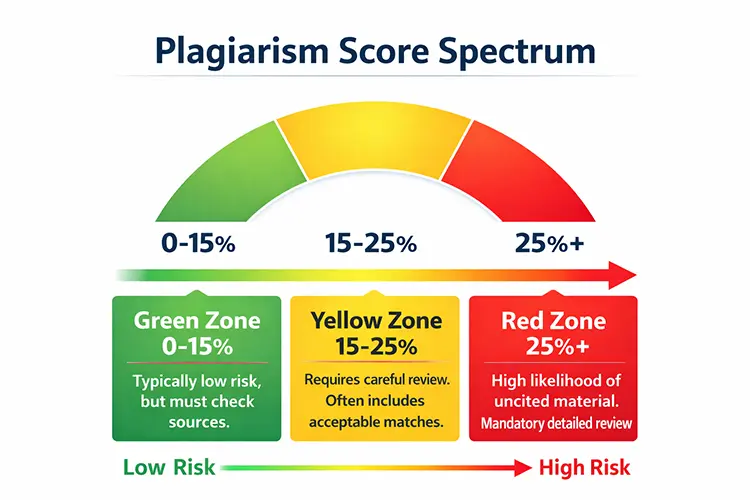
Among such errors is the belief that the percent of similarity is the sole measure of plagiarism. It merely reveals the degree of matching of text with sources but not the context of matches.
As an illustration, a 5 per cent similarity rating may still be an issue when that whole match was carried out by a single source that was reproduced without reference. Conversely, a similarity score of 30 percent would be fully acceptable provided that the matches are made in the harmless parts like:
- The manner of the cover page or the title.
- Properly quoted material
- The bibliography or the reference list.
- Common standard expressions of academic writing.
For those who are wondering what is a good plagiarism score, needs to keep in mind that, just do not assess your work by the mere number, but start with the percentage and compare where you can find a match.
Step 2: Analyze the "Match Breakdown" or "Source Overview"
Majority of plagiarism detectors have a section known as Match Breakdown, Source Overview or something like that. This section of the report demonstrates what sources your text was similar to and what percent of your content is similar to the source. The report displays and indicates the sources with percentages or color indicates text matches. Going through this will assist you to determine whether they are similar due to numerous little matches or due to a big source of similarity.
For instance:
- In case numerous sources record 1-2 per cent matches, it can be common phrases or standard scholarly wordings.
- When the percentage from one source is big, it can be an indicator that your writing is too similar to that source and requires some changes.
This summary lets you know which parts of your paper require the greatest focus.
Step 3: Investigate Each Highlighted Match
The identification of the sources is followed by a close look at each of the highlighted parts in the report. The majority of plagiarism tools allow you to use the high-lighted texts to get the original source and view your text in comparison to the source materials.
In watching every match ask yourself:
- Is this text properly quoted?
- Did I include a citation?
- Am I being too close to the original structure by paraphrasing it?
- Is it just a cliché that can hardly be paraphrased?
Such measure will help to avoid the case of accidental plagiarism and be able to improve before submission or publication.
The 4 Types of Matches & How to Handle Them
Not all the sections pointed out in an originality report are issues. The majority of them contain non-harmful matches and sections which might require revision. Learning the type of matches is good to determine what to do.
1. Properly Quoted & Cited Material
The highlighted text will be okay when it is within quotes, and there is an appropriate reference provided there. Plagiarism checkers mark these areas as the text is identical to sources yet a reference to the source is duly given. There is also no significant revisions required that will be needed in this scenario; simple ensure the quotation marks and reference are formatted properly.
Read our guide on APA Headings & Subheadings if you are working with APA style formatting and want to structure your sections properly.
2. Common Phrases or “Bibliographic Material”
Popular expressions on academic work such as “The purpose of this study was to do this,” “The results of this research indicate,” etc. are regularly detected by plagiarism checkers since they are regularly recurrent in documents. These matches are normally inevitable and justifiable provided that they are not overused all through the text.
3. Your Reference List / Bibliography
Reference lists are often listed as a duplication in the originality reports since they hold the same titles, authors, and publication information as that of other academic papers. This is completely normal. As reference entries have to be presented in particular formats, they have to correspond to other sources and typically do not need to be taken care of.
4. Uncited Paraphrase or Direct Text
Such a match is the one that has to be addressed urgently. In case a section highlighted contains very similar wording or structure in comparison to a source, but no quotation marks or citation are present, then it can be considered plagiarism.
To address this problem you should either:
- Re-phrase the part with the words of your own choice and sentence structure, or
- Place quotation marks and reference in case you include the exact words of the source.
The most important step to transform a similarity report into an originality-enhancing tool, instead of a signifier of a similarity, is to deal with these problematic matches.
The Ethical Paraphrasing Checklist: How to Fix Problematic Matches
Despite an originality report pointing out problematic matches to the text, do not simply delete the text. Rather, reword it in your own light with reference to the source. Ethical paraphrasing allows you to take the ideas of a research without copying word-by-word or even structure.
The paraphrasing is a challenge to many writers since they make minor alterations replacing a few words but retain the same sentence structure. For those who are wondering how to paraphrase, needs to remember that to paraphrase well, one has to comprehend the concept, and give an explanation in a different manner. Check this checklist to find out weak paraphrasing and correct it.
Have a look at our guide on Literature Review Essentials to synthesize the sources of your dissertation properly.
Bad Paraphrasing
The Synonym Swap is one of the typical mistakes in which authors change the words with synonyms but maintain the same sentence construction and pattern.
A writer may, as an example, replace such words in a sentence as important with significant or shows with demonstrates in one of the sources. Despite its appearance, plagiarism checkers are capable of detecting the similarity in case of the identical structure and wording.
Such paraphrasing is offensive in two ways:
- The sentence is written in close reflection of the original source.
- The fundamentals of the wording structure are similar and the match is easy to detect by plagiarism detection tools.
Consequently, the similarity report will probably draw attention, and the writing can still be regarded as being too similar to the source.
Good Paraphrasing
Strong paraphrasing is concerned with re-phrasing the thought, not simply substituting the single words. The first trick is the Read, Understand, Restate, which allows making sure that the final sentence sounds like your thoughts and not the language of the primary author.
Here’s how the process works:
- Read the original source carefully: Take time to get acquainted with the idea that is being expressed and not just the wording.
- Close the source or turn it over: When you are familiar with the concept, remove the source temporarily so that you are not tempted to repeat what it said.
- Explain the idea aloud in your own words: Pretend that you are explaining the concept to your friend or classmate. This then makes you automatically word the thought in another manner.
- Write down your explanation: You are to put your verbal explanation on paper, however, emphasizing conciseness and clarity.
- Compare your version to the original: Ensuring that the meaning is correct, make sure that the wording and the structure are obviously different.
- Always add a citation for the idea: Even in cases where you manage the paraphrasing of ideas, the thought remains the property of the source and has to be referenced.
Example: Bad vs. Good Paraphrasing
It is a lot easier to understand the concept with the view of the distinction between weak and strong paraphrasing.
Example of Bad vs Good Paraphrasing in Academic Writing | Original Source: “Effective time management assists students to reduce stress and increase academic performance.” Bad Paraphrasing (Synonym Swap): “Efficient time management helps students to reduce stress and improve academic performance.” Good Paraphrasing (Read–Understand–Restate): “According to the source, students who schedule and organize their study time do not tend to be stressed and are likely to perform better in their course work (Source).” |
This method ensures that Turnitin similarity score are always minimized and your writing is made more robust and complete through incorporation of ideas into your own voice.
The Limits of Technology: When Checkers Fail & Human Judgment is Key
Plagiarism checkers are effective tools which are still not absolutely perfect. They are capable of fairly quickly determining similarities between texts, as well as pointing out possible ones, but they are not able to interpret, read between the lines, and grasp the meaning underlying the text. Due to this shortcoming, originality report is always subject to human judgment.
The use of software alone to check originality is not enough to give an understanding. It may overlook genuine plagiarism and designate innocent material. The awareness of their limits will enable writers to apply these tools prudently as tools of help, rather than as judges.
What Checkers CANNOT Detect
The plagiarism detection software operates mostly through text comparison with the available databases. This implies that they can do very well in defining the same or very close wording, but they fail to notice more advanced types of plagiarism. There are also forms of plagiarism that may not necessarily be picked by the checkers, which include:
- Idea plagiarism: A plagiarist may take the main point or argument of another writer and then reword it without giving a mention. Software will not be detected by a different wording, though a borrowed idea might be used.
- Deep paraphrasing: In the case that one paraphrases a passage, but keeps the original idea and does not give the source, the checker might not mark it as such since the sentence structure and words have been altered.
- Content from limited databases: Plagiarism checkers make comparisons with text only to their database content. The software may not match the original, which may be of non-indexed sources, such as personal documents, non-internet books, or databases that are closed.
- Translated plagiarism: A translation of text without reference is likely to pass through any checker that is not a cross-language tool.
Due to these shortcomings, the lack of similarity in one of the similarity reports does not necessarily imply that the material is totally original.
The Danger of Over-Reliance
Excessive dependence on plagiarism tools is dangerous because it may lead to neglecting the actual purpose of ethical writing, which is to provide the necessary credit and present the ideas in their own words, rather than basing on low percentages of similarity.
Excess use of plagiarism checkers may cause a number of issues:
- Authors can concentrate on beating the checker instead of acquiring the correct way of doing research and citing.
- A lot of context might be disregarded, as the software is unable to determine how meaningful or correct citation is.
- False confidence may occur when there is low similarity degree in a document although the borrowed ideas were not cited appropriately.
Finally, plagiarism checkers are to be considered as a supplementary tool as opposed to an ultimate authority. Ethical writing is a responsibility of the author. Originality and credibility are achieved by doing good research, proper referencing and re-phrasing.
Your Proactive Writing Workflow to Avoid Plagiarism
When originality is incorporated in the writing process, it will be easier to avoid plagiarism. Rather than doing an end-of-the-line verification, authors need to adhere to a process of doing quality research work, drafting and revision.
Breaking down your work into distinct stages minimizes the chances of being caught duplicating, having lost sources or poor paraphrasing. An upstream workflow aids in monitoring information, building knowledge and ensuring originality before being submitted.
Phase 1: Research & Note-Taking
Plagiarism prevention begins at the first stage through effective research. In order to prevent confusion, cultivate good note taking habits. You should always note the entire source information such as author, title, date of publication, and link or page number down. This facilitates its subsequent referencing.
It is important to distinguish between direct quotes and personal notes; copying is to be explained with quotation marks to be able to remember that it is not your own wording. Also, paraphrase as you do your research. Writing short overviews of the important issues in them will boost your knowledge and make sure that you will not end up copying something accidentally when you write.
Read our guide on Thesis Proposal Structure if you are planning a research project or thesis and want to organize your research effectively.
Phase 2: Drafting
In the drafting stage, move away to getting the information and take your own words to articulate your thoughts. Pay attention to paraphrasing and doing the references correctly. Elaborate on ideas using your own knowledge and do not rely on references so that creativity can be promoted. Direct quotes should always be placed in quotation marks and citations and ideas that are paraphrased ought to be referenced as they are still the property of the authors. Make an effort to give your work the balance between your analysis and the sourced material, use sources to justify your thoughts whilst keeping your own in mind.
Phase 3: Pre-Submission Check
Always do a last originality check before handing in your work so that you can make sure that you have credited all your sources and also that you have understood your work. Go through a plagiarism-checker, scan the report and make amends on the corresponding passages. Finally, go through your reference list to make sure that you have cited all the sources and in the proper format. Last but not least, proofread the paper to ensure flow and cohesion, bringing clarity and creating awareness of possible plagiarism.
The three-part workflow of research, drafting and the review assists in making plagiarism prevention not a final exam but an ordinary aspect of the writing procedure.
Have a look at our guide on How to write an APA Abstract (7th Edition) if your writing in APA style and want to ensure your research paper includes a properly formatted abstract section.
Conclusion
Plagiarism detectors and originality reports are useful but in the real sense academic honesty lies in knowing how to utilize sources in responsible manner. To prevent plagiarism by accident, writers can not only study the principles of similarity reports and use such a method to report, but also practice ethical paraphrasing and adhere to a well-designed writing process. The bottom line is that originality has nothing to do with the reduction of a similarity score, but rather having your ideas made clearly, truthfully, and with due credit to the sources that informed you.