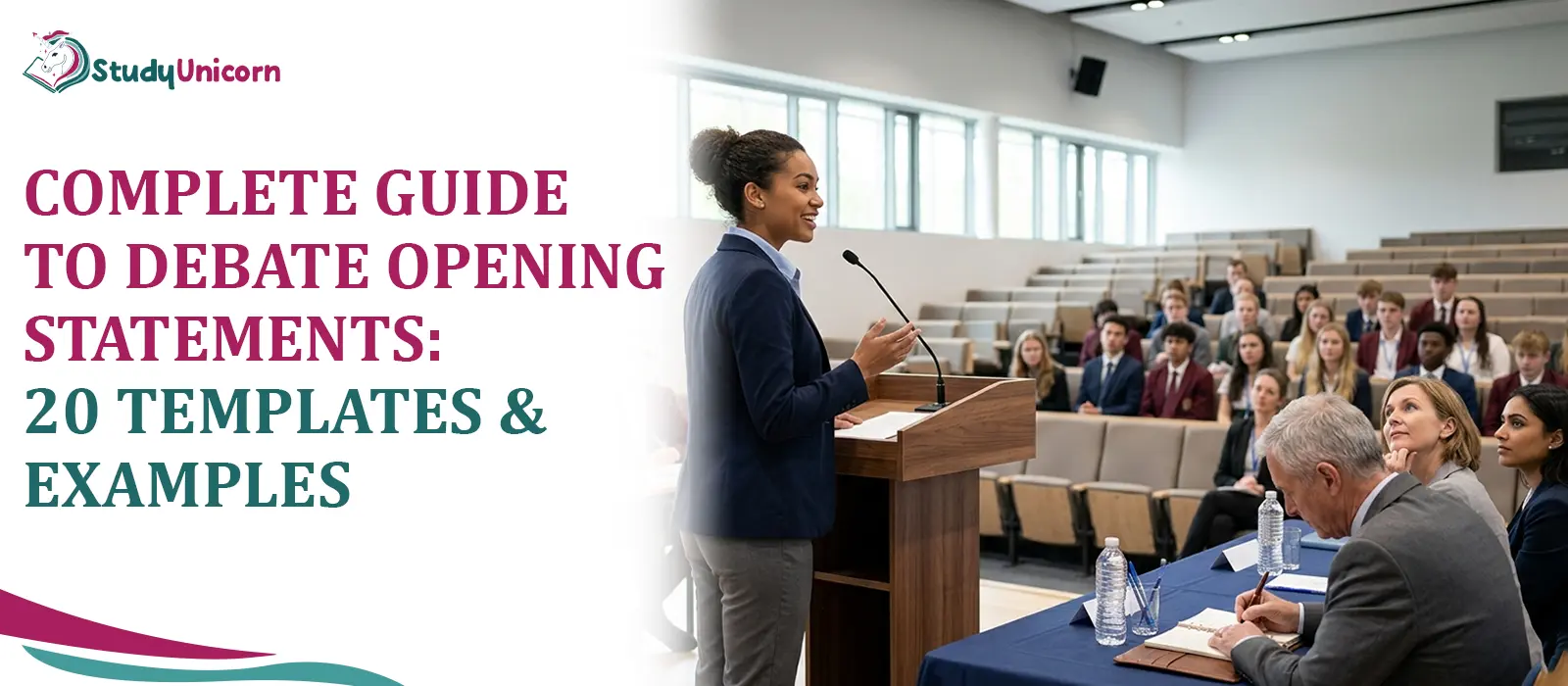
The first thirty seconds of a debate decide more than most competitors realize. Judges form an impression before your first argument even lands, and that impression is built almost entirely on your opening statement. A strong opening tells the room you know exactly what you're arguing and why you're going to win. A weak one - rambling, generic, or forgettable - puts you on the back foot before you've made a single point.
This guide teaches you the elements that make an opening work, and provides you with 20 template examples of all of the major debate styles, plus helpful tips for customizing and effectively presenting them. Below you will find some good debate opening statement examples to practice before the next tournament, as well as the structure and tips in delivering each statement.
The Anatomy of a Debate Opening Statement
Before crafting a good opening it is very important for one to have a clear understanding about what it is really made up of. A similar logic and flow is followed by each and every successful opening regardless of the format followed, the topic selected and the speaker. Grabs people's attention, states an opinion, previews the argument, moves into the body of the speech. If you remove the "topic" words, the same "skeleton" can be found in almost any successful round.
The 4 Essential Components
The general debate opening speech structure is based on four components. When you miss any of the below mentioned four components your opening sounds thin, directionless, even in the situations where your arguments are strong enough.
| Component | Purpose | Example |
| Hook | Gets attention and conveys the need for listening to this speech | It is estimated that every 11 seconds, a person dies as a result of a medical error that could have been prevented. |
| Thesis | States your main position in one succinct sentence | We are strongly committed to the error reporting systems in hospitals. |
| Roadmap | Gives a judge a preview of one's case to follow although the case has not yet started | I will explain why this is important, how it works, and why concerns of opposition do not block this. |
| Framing | Establishes critical criteria that will be considered by the judge in judging the round | This discussion is not the debate of the best system — it's the debate on the system that saves the greatest number of lives. |
Listeners will not be in the position of thinking what you are talking about and what will be the next move when all of the above mentioned core elements are presented in clear and order form. This is what good signposting is all about in the rest of the speech – not just the introduction.
Quick Formula
If you don't have time and simply need a working structure, you can use this formula, as it applies to most cases:
Hook → Thesis → Roadmap (2-3 points) → Transition into Argument 1
Follow this quick formula when wondering how to start a debate opening statement, and you do not have enough time to think about it. Capture attention with some opening in the opening, clearly define your opinion, preview your thoughts, and jump to your first point without a beat.
The following templates all take this formula, and present it in different ways.
Template Library by Debate Type
Here are 20 templates to suit most any topic or form. Each focuses on a different strategic objective – some are constructed to be emotionally charged, some for pure logic, others for specific modes such as Lincoln-Douglas or policy debate.
Think of the below shown templates as the debate first speaker template library. Select the template that best suits with your strong points and with the topic that you are going to talk about. But if you're still debating what you want to argue in the first place, our guide to debate topics will help get you started before you write any of these out.
Template 1: The Classic Proposition Opening
| “Honorable judges, for the next few minutes, we, the proposition, will set to prove to you that asserting such a resolution is not only defendable but necessary: that is, that [reason 1] makes it a necessary resolution, that [reason 2] makes it a necessary resolution and that [reason 3] makes it a necessary resolution.” |
Best for: Standard one-on-one or team debate with without conflict, that support the resolution and is looking for a clean formal opening.
Template 2: The Classic Opposition Opening
| “As my opposing side maintains they have a nice plan, I'm at the opposite side where I can demonstrate the weaknesses of [resolution] by [reason 1] and [reason 2] by the end of this round, you will see that the proposition's case is not sound.” |
Best for: Opposition to a resolution in contexts where the space is structured with a clear proposition / opposition division, such as in most parliamentary and Oxford divided-debates.
Template 3: The Story-Driven Opening
| “It's not something that [name] did differently that makes her story special — it's what made it happen again, that's what's making us have this conversation right now. Today I'll argue that [thesis] because stories like hers don't have to continue happening.” |
Best for: Any issue or topic where human or emotional considerations are involved, such as healthcare, justice, or social policy issues.
Template 4: The Fact-First Opening
| “Here's a number worth sitting with: [striking statistic]. That single figure is why we stand in support of [thesis]. The evidence on this issue isn't ambiguous, and over the next few minutes, I'll walk you through exactly why.” |
Best for: Resolutions with lots of data included; Credibility relies mainly on data and not emotions.
Template 5: The Frame-the-Debate Opening
| “Before we go further however, let's establish what this debate is not about – this isn't about the false framing – this is about the framing we agree on. Once you've been able to agree on that, the answer to [thesis] is clear.” |
Best for: Used best in a round in which the other player is trying to distract the judge's attention to a weak version of the topic.
Template 6: The Contrarian Opening
| “Common belief is wrong; the evidence points to this (your thesis); when you hear the evidence you will wonder how you ever believed otherwise.” |
Best for: Passion for a contested conventional wisdom that exists in the minds of many people that you can directly challenge.
Template 7: The Urgency Opening
| “We don't have the opportunity to debate this slowly; whatever urgency consequence, now it is, will make it worse every day until we do something to counteract it. And that's why — because waiting is a choice in its own right — we're here today arguing in favor of [Thesis]” |
Best for: Policy and current events where failure to act itself has a cost.
Template 8: The Refutation-First Opening
| “My opponent will likely argue [anticipated point]. Here's why that argument fails before we even begin: [brief rebuttal]. With that cleared away, let's turn to why [thesis] is the stronger position.” |
Best for: 2nd speaking role or round where you have researched your opponent beforehand.
Template 9: The Historical Context Opening
| “This is not the first time that [topic] has come to the attention of the populace, because [brief historical example] has revealed to us that [lesson was learned], and if we do not draw that lesson from that history, then we will make the same mistake again today.” |
Best for: Constructing an argument that builds in historical context or reinforces your belief and your parallel argument.
Template 10: The Simple and Direct Opening
| “This is going to be a very quick one," I will say, “[Thesis statement] and here's why: [reason 1] [reason 2] [reason 3]” |
Best for: Time-limited rounds, impromptu speeches, or judges that prefer pointed speeches to showers of words.
Template 11: Lincoln-Douglas Style Opening
| “In the field of [value, such as justice, liberty], the issue we face is [resolution]–I say that stands before us–I stand in full support of the value of [core value] which I will show to be best achieved by [thesis]. Under this criterion [criterion] the resolution clearly stands.” |
Best for: Ideal for use in Lincoln-Douglas rounds where the crux is value based framing and having a clear criterion more important than policy specifics. If this is a format you're unfamiliar with, we've got a thorough explanation of Lincoln-Douglas debate on value premises and criteria.
Template 12: Policy Debate Opening (1AC Style)
| “Resolved: [resolution]. We affirm. Our plan is [one-sentence plan summary]. The harms to be overcome from the status quo are [harm 1] and [harm 2]. The solvency mechanisms of our plan are [solvency mechanism(s)]. The advantage of adopting our plan outweighs any disadvantage of not changing the status quo.” |
Best for: A formal policy debate opening statement (especially 1AC – first affirmative constructive speech) where plan text and clear solvency is required.
Template 13: Public Forum Debate Opening
| “Resolved: [resolution]. Our case is simple, as the [pro/con] team, we will argue that [thesis]. Our opening case is [contention 1] and our second case is [contention 2] which together demonstrate that [thesis] aligns with [framing standard e.g., greater good, fairness].” |
Best for: A first speaker debate script in Public Forum Debate which encourages contestation and has clear language rather than jargon.
Template 14: The Two-Sentence Thesis Opening
| “[Thesis sentence one, stating the position]. [Thesis sentence two, stating the stakes of getting it wrong]. This is the stakes of this round and this is what I want to demonstrate.” |
Best for: Speakers who wish to get to the point, and who do not want to go through a lot of settings to do so.
Template 15: The Question Opening
| “If [hypothetical scenario, hypothetical question]?” Today's resolution hinges on the question as to whether or not the answer is [thesis]. And we believe that the answer is yes, and here's why the answer is very important, far outside of this room.” |
Best for: Ideal for struggling to capture the attention of a less serious audience or when audience interaction is not the priority, such as during classroom debates or informal exhibition rounds.
Template 16: The Contrast Opening
| “The purpose of this debate is that you have to pick between two futures: 'on one side you have [opposing outcome]' and 'on the other, you have [your proposed outcome]'. We believe that [thesis] is the road to the better one.” |
Best for: Two distinct visions or outcomes, as often occurs in politics or ethics.
Template 17: The Burden of Proof Opening
| “As we are making this resolution, we bear the primary burden of proof and we accept that challenge and take it upon ourselves to show [standard] — and we'll do just that first with [reason 1].” |
Best for: Formats with clear rules regarding the burden of proof like Oxford style, competitive parliamentary speaking or emulation.
Template 18: The Definition Opening
| “Let's begin by clarifying what we are talking about by defined terms (definition), once our term is correctly understood, then we are declaring ourselves to be at a certain point (position) and that is our [thesis].” |
Best for: Resolutions that will contain any vague wording which may create a disagreement later on.
Template 19: The Impact Opening
| “If we lose this debate, here's what's actually at stake: [real-world impact]. That's not an exaggeration; it's the direct consequence of getting this resolution wrong. That's why we stand in support of [thesis].” |
Best for: Ideal for topics in policy or ethics where substantive consequences outweigh doctrinal arguments.
Template 20: The Hybrid Opening
| “[Hook or statistic]. This is what we're talking about today: [Thesis] based on [value/criterion] supported by [evidence type]: first [point 1], then [point 2] then [point 3].” |
Best for: Advanced debaters looking to combine hook, framing and roadmap into a single, efficient, format flexible opener.
Complete Example: Opening Statement in Action
Scroll down for a full debate introduction example made with Template 7 (The Urgency Opening) in a policy resolution about emergency housing funding.
| “Tonight, somewhere in this city, a family is sleeping in their car. That's not a hypothetical — it's the reality for over twelve thousand households in our region right now, and that number is climbing. We don't have the luxury of debating this slowly, because every month of delay means more families pushed further from stability. That's why we, the proposition, stand firmly in support of expanding emergency housing funding by twenty percent over the next fiscal year. We'll show you three things tonight: first, that the current system is failing by its own measured outcomes; second, that this funding increase directly targets the root causes of that failure; and third, that the cost of inaction is far higher than the cost of this proposal. Waiting on this issue isn't neutral — it's a decision with consequences, and tonight we'll show you exactly what those consequences look like if we choose to wait any longer.” |
Within the boundaries of less than 200 words, notice that elements of the hook are present (the family in the car), thesis (the arguments that support the funding increase), roadmap (three different numbers or points), framing (inaction as a choice). This is where an argumentative debate opening is different from a plain statement of a position.
How to Adapt Templates for Your Debate
No template is perfect — it requires your topic, your evidence, and your voice. The adaptation of a good template is not a creative process, it is a 3 step disciplined process that takes most debaters under 15 minutes after a few rehearsals.
Step 1: Identify Your Debate Type
Some structures are rewarded in different formats. Lincoln-Douglas—value framing and a criterion, policy debate—plan text and solvency, public forum—clear and accessible (contention based), parliamentary and Oxford style—sharply framed and rhetorical. Choose your template to match your format before you start working on your content because each of the twenty templates that are above will not work with every content format.
Step 2: Fill in Your Arguments
After you've identified your format, replace your thesis, evidence and framing with your own. This is where knowing how to write a debate speech really comes in handy: It provides you with structure, however, it is your reasons, statistics and examples that make the opening your own, not the speech's structure. Make all the roadmap items in the same format as each other (e.g., all beginning with "first," "second," "third") to enable the judge to follow easily.
Step 3: Practice Delivery
An excellent script will not beat a good well-presented script. Prior to the round read your adapted opening aloud five times or more, keeping track of timing and where/when natural pauses or emphasis would occur. By the third read-through (or fourth), you should be able to play it from memory.
Delivery Tips for a Winning Opening
No matter how good your opening statement debate template is, it's not going to be effective without the right presentation. Judges are paying attention to content, but judges are paying attention to presence too — and more so than is anticipated by new debaters..
Tone and Presence
Your body language begins communicating BEFORE you say a word. Your judges read confidence in your presentation BEFORE they do your argument.
- Be sure to pause at your beginning read – pacing is nervous energy, not confidence.
- Begin a little more slowly than normal — most speakers start too fast at the beginning.
- Look the judge in the eye, not at your notes, particularly in the thesis sentence.
- Give the line room for the hook to fall with a brief pause before starting your thesis.
These minute physical addictions will keep you looking calm enough before judge reaches your thesis sentence.
The Voice
The 'how' of your opening is as important as what you say! Be intentional with your voice, otherwise an rushed delivery will lessen even the best of scripts.
- Change speed - deliberately, slow for thesis, speed slightly through support.
- Lower your pitch at the end of the most critical sentence — a lower, more steady pitch provides credence for what you're saying compared to a higher pitch.
- Project sets in back of room, not solely at judge directly in front of room.
- Try not to put an ascending intonation at the end of statements as it can render even firm statements as questions.
Authorities are established by a controlled, intended voice, before you can present a solitary piece of evidence.
Common Mistakes to Avoid
There are some habits that repeatedly occur in poor openings. Beware of these prior to delving into speaking!
- Placing the thesis in needless prolaim, so the judge fails to see what you are arguing about.
- Reading the roadmap in a monotone — even a strong structure sounds like an afterthought.
- Apologizing for being nervous publicly makes it appear more noticeable than it really is.
- Shoving so many numbers around that the position isn't visible amongst the numbers.
For almost all of these, there are two steps to take: first, narrow down the opening to what's needed and second, execute what remains with assurance. If you want more info on building confidence round after round, our guide to efficient debates has progressed some tips for effective preparation that can make the experience seem less stressful.
Quick Reference: Template Selector by Situation
In case you don't have a lot of time before a round, simply scroll down until you find the template that applies to your situation without reading through all of the twenty.
| Situation | Recommended Template |
| Need something fast and reliable | Template 10: Simple and Direct |
| Debating Lincoln-Douglas | Template 11: Lincoln-Douglas Style |
| Debating policy / writing a 1AC | Template 12: Policy Debate Opening |
| Speaking first in public forum | Template 13: Public Forum Opening |
| Topic has strong emotional weight | Template 3: Story-Driven Opening |
| Topic is data-heavy | Template 4: Fact-First Opening |
| Opponent likely to misframe the topic | Template 5: Frame-the-Debate Opening |
| You're speaking second and know their case | Template 8: Refutation-First Opening |
| Resolution hinges on definitions | Template 18: Definition Opening |
| You want maximum polish | Template 20: The Hybrid Opening |
This handy reference guide can help you with the right template to make a strong opening statement.
Conclusion
Opening statements in a debate are not about 'fancy' but about 'strategy'. The hook captures the audience's attention, the thesis makes your claim to the judge, the roadmap establishes the Judge's trust, and your first piece of evidence is already bringing the judge to your side. There are 20 templates for the most various debates, from Lincoln-Douglas to public forum, to impromptu argumentative debates, you have got an starting point for almost any debate that you will experience. Choose the template that suits your format and your strengths, tweak it with your evidence, practice it verbatim, and come to your next round fulfilled.