Imagine your teacher says, “It’s raining cats and dogs,” and you look out the window expecting animals to fall from the sky. Such a sentence would sound weird since it doesn’t convey exactly what the words say. This is where the figurative language examples will prove helpful. Examples of figurative language can be found in novels, poems, songs, speeches, and so forth. You may know all of the words in a sentence but not be able to tell because it's not exact. The confusion occurs because it is based on the implied meaning of the words rather than the literal meaning.
This guide explains examples of figurative language for school, college, and university students that include many different types of examples (more than 100) and how you can identify them.
What Is Figurative Language? (Meaning and Examples)
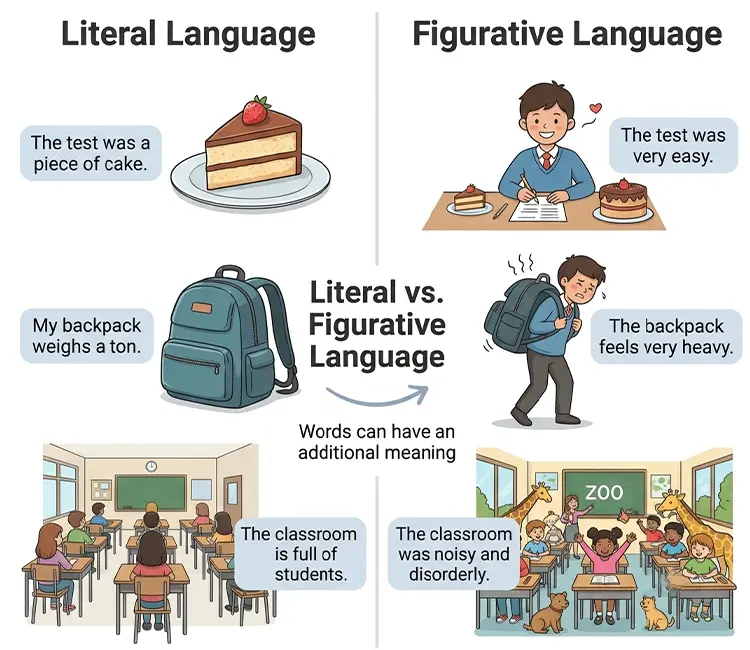
Figurative language uses words in such a manner that they mean more than what is written or spoken. In other words, it uses the additional or the secondary meaning rather than the actual one. Here "figure" is simply a device in language that is used to create a certain effect. Such a comparison is also another way to show similarities between two separate things.
A figure of speech is a phrase whose wording has been used in a nonliteral way. Also, when students seek to understand what is figurative language examples are, they actually want to understand the phrase as well as its meaning. For instance, the phrase "She has a heart of stone" does not mean that her heart is made of stone. Instead, that means she appears to be emotionally unkind and cold.
Here are the three examples of figurative language in action:
- “The test was a piece of cake.” “The test was very easy.”
- “My backpack weighs a ton.” “My backpack is very heavy.”
- “The classroom was a zoo.” “The classroom was very noisy.”
Literal vs Figurative Language: What Is the Difference?
Recognizing the difference allows students to prevent themselves from being too serious about their creations. In other words, it means more than just the words that are being used, whereas literal language states ideas directly. While many examples of figurative language may seem very odd or even impossible.
| Literal Language | Figurative Language |
| The classroom is full of students. | The classroom is a zoo. |
| She runs very fast. | She runs like the wind. |
| The baby slept peacefully. | The baby slept like a log. |
| He is very kind. | He has a heart of gold. |
An easy clue for identification is to see whether the sentence is sensible if read precisely. If it appears ridiculous or exaggeration, it could mean that the speaker is being figurative.
Types of Figurative Language With 100+ Examples
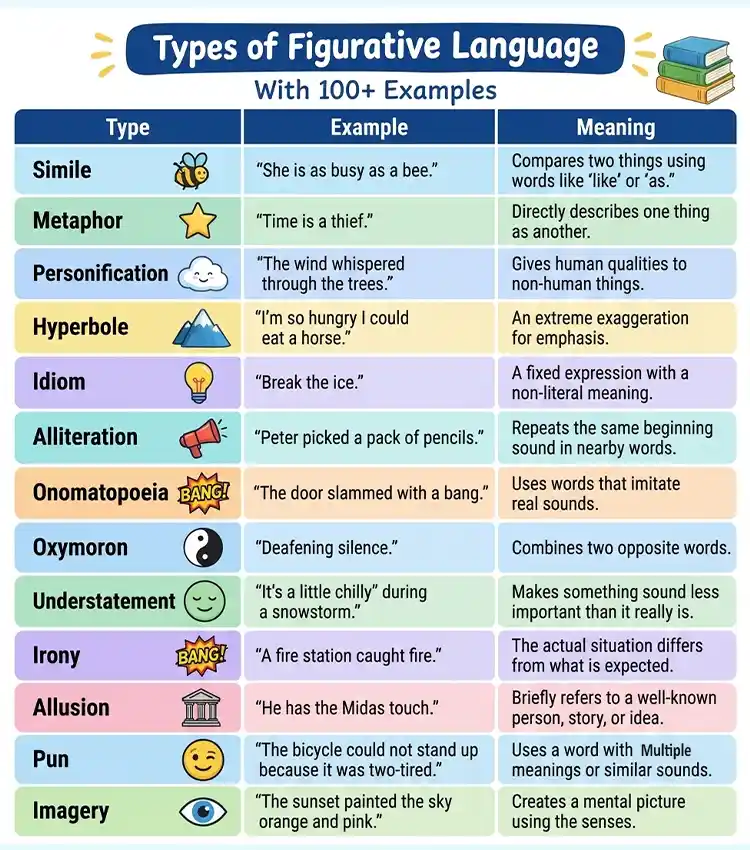
Each figurative language example creates a specific effect, and understanding their pattern makes it easy to identify them. The following figurative language examples sentences are classified according to their types, with brief meanings for each expression. In case you are looking for some examples of figurative language, then this is the right place.
Simile
Similes are comparisons between two different things using terms like “like” and “as.” This comparison makes it easier for the reader to understand the concept being conveyed.
- She is as busy as a bee. She is very busy.
- He runs as fast as the wind. He runs extremely fast.
- The water was as cold as ice. The water was very cold.
- Her smile is as bright as the sun. Her smile is cheerful and warm.
- The classroom was as quiet as a library. The room was very quiet.
- He is as brave as a lion. He is very courageous.
- The blanket was as soft as cotton. The blanket was very soft.
- My brother eats like a horse. My brother eats a large amount.
- The exam was as easy as ABC. The exam was very simple.
- She sings like an angel. She sings beautifully.
- The road was as smooth as glass. The road had no bumps.
- He slept like a baby. He slept deeply and peacefully.
Metaphor
In a metaphor, one object is described to be like another without using the words “like” or “as.” This creates a very powerful comparison between two things.
- Time is a thief. Time flies and robs us of precious time.
- The classroom is a zoo. The classroom is very disorderly.
- Her voice is music. Her voice sounds sweet.
- Life is a journey. Life is all about development.
- He is a shining star. He is a gifted individual.
- The city is a jungle. The city is very hectic.
- Homework is a mountain. Homework is difficult.
- Her words were like arrows. Her words are sharp.
- The library is a treasure box. The library is a storehouse of knowledge.
- His mind is a computer. His brain works very fast and he remembers everything.
- The storm was a monster. The storm was wild.
- Laughter is sunshine. Laughter makes us happy.
Personification
Personification means an attribute by which human qualities or actions are attributed to anything which is not human. This makes nature, animals, or any place come alive in some way or another.
- Wind blew between trees. The wind made whispering sounds.
- The sun smiled on us. It was a bright and pleasant day.
- The old house moaned. The house was making groaning noises.
- The flowers danced in the wind. The flowers danced in the air with the wind.
- The clock was shouting about time. The clock was making a loud sound.
- The rain was kissing the windows. The light rain fell on the glass.
- The car denied starting. The car refused to start.
- The stars were watching over the city. The stars shone above the city.
- The computer was dying. The computer stopped working suddenly.
- The waves were chasing the shore. The waves were reaching the shore again and again.
Hyperbole
Hyperbole is a form of overstatement that means that you purposely exaggerate the truth in order to drive home your point.
- I am so hungry that I can eat a horse. I am extremely hungry.
- I have told you a million times. I have told you many times.
- This backpack is a ton. This backpack is very heavy.
- My phone has died a thousand times. My phone has stopped working many times.
- I waited forever for the bus. I waited a very long time for the bus.
- Her room is a million miles away. Her room is very far away.
- That was the best day ever. That day was extremely good.
- I can sleep for a year. I am very tired.
- The line was a mile long. The line was very long.
- My teacher says everything twice. My teacher repeats the instructions often.
Idiom
Idioms are expressions which have a meaning different from the meaning of the individual words. Students should learn the entire expression and not the individual words.
- Strike up a conversation. Begin talking to someone politely.
- A piece of cake. This is extremely easy.
- Under the weather. Feeling a bit sick.
- Hit the books. Begin to study very seriously.
- Spill the beans. To tell some information.
- Cost an arm and a leg. To be very expensive.
- Once in a blue moon. Rarer than ever.
- Pull yourself together. Try to calm down and collect your thoughts.
- Be on the same page. Agree on something.
- Call it a day. Finish working for the day.
- Get cold feet. Get nervous before a very important occasion.
- Keep an eye on. To watch out.
Alliteration
Alliteration refers to the repetition of the initial sounds of words that are placed side by side. And this is done according to the sounds of the words and not the spellings of the words. This literary device can be used for several reasons.
- Peter selected a pack of pencils. The repeated “p” sound makes rhythm.
- Buzzing bees passed by. The repeated “b” sound makes the effect of buzzing.
- Silly students exchanged stories. The repeated “s” sound creates a smooth rhythm.
- The cat approached silently. The repeated “c” sound creates suspense.
- Big brown bears jumped about. The repeated “b” sound creates energy.
- She sells seashells. The repeated “s” sound creates melody.
- The fair fox found food. The repeated “f” sound creates flow.
- Mike baked many muffins. The repeated “m” sound creates rhythm.
Onomatopoeia
Onomatopoeia refers to a word which imitates the sound of something in reality. Examples include such words as buzz, splash and bang.
- The bees buzzed. It is an imitation of bee sounds.
- The balloon made a pop. It is an imitation of popping.
- The pan sizzled. It is an imitation of something frying in hot oil.
- The door banged shut. It is an imitation of a sudden impact noise.
- It rained pitter-patter. These words are an imitation of light rainfall.
- The clock ticked and tocked. These words are an imitation of the sound a clock makes.
- The dog barked woof. It is an imitation of dog noises.
- The car screeched to a halt. It is an imitation of sudden braking noises.
Oxymoron
Oxymoron combines two contrasting terms in order to shock the reader and make him or her understand an irony in the contradiction.
- Deafening silence. Silence that is so powerful that it becomes sound.
- Bittersweet memory. A memory that is both sweet and bitter.
- Seriously funny. Something is really funny.
- Clearly confused. Someone is really confused.
- Open secret. Something that should be a secret but is known by everyone.
- Act naturally. Act in a natural manner.
Understatement
Understatement is the process by which something is made to look much less important, less serious, or less impressive than what it actually is. The use of it in conversations is mostly to be humorous or sarcastic.
- “It is rather cold,” in the middle of a snow storm. It is exceedingly cold.
- “That examination was slightly difficult,” after a tough exam. That examination was really tough.
- “I did okay,” after winning the first place. The individual performed really well.
- “The traffic was a bit slow,” when there was heavy traffic. The traffic was highly delayed.
- “It is not my favorite,” referring to an unpleasant food. He/she detests the food item.
Irony
Irony happens when the reality of the situation is very different from expectations or statements made. This is not just any kind of coincidence but one with meaning.
- The fire station burned down. The place designed to prevent fires had one.
- The traffic officer was late due to traffic. The person responsible for traffic had the same problem.
- The nutrition teacher ate candies all day long. This situation contradicts the content of the lecture.
- The weather forecast announced sunny weather while it was stormy. This situation contradicted the forecast.
- A student who skipped class was asked to explain attendance. A student who did not attend classes was asked to explain his absence.
Allusion
An allusion is a brief reference to a familiar person, incident, thing, place, or idea. It also adds meaning without extensive description.
- He has the Midas touch. He is very successful in earning money or making success.
- She met her Romeo. She found her romantic lover, referring to Romeo from Shakespeare’s plays.
- This place looks like Wonderland. This place seems to be magical or unique, referring to Alice in Wonderland.
- He is a real Einstein. He is a very intelligent person, referring to Albert Einstein.
- The team encountered its Achilles’ heel. The team had a weakness, referring to Greek mythology.
Pun
The use of a pun in humor relies on the presence of either multiple meanings of a word or a similarity in the sound of words.
- The math book was depressed due to the large number of problems that it contained. “Problems” can refer to mathematical questions as well as difficulties.
- I used to be a banker, but I have lost my interest in the same. “Interest” can mean curiosity as well as profit earned through investments.
- The bicycle was unable to stand upright because it was two-tired. “Two-tired” is a pun for “too tired.”
- The teacher was upset since the students were not willing to be quiet. “Cross” means being angry as well as a crossing point.
- Time flies like an arrow; fruit flies like a banana. This is a pun on the words "flies" and "like."
Imagery
It uses descriptive language to help readers imagine something through their senses. While it also can describe sight, sound, smell, taste, or touch.
- The hall had a smell of fresh paint and old books. Such sentence creates an imagery typical for the school.
- The tray crashed to the table. It makes the readers hear a noise of the cafeteria.
- My hands got warm with hot chocolate on that winter day. Such sentence allows creating an imagery of warmth.
- The gym smelt like rubber shoes and sweat. It is typical for the imagery of the school gym.
- The loud ring was heard through the silent hall. This sentence allows readers to hear the end of classes.
- The taste of pizza was salty, spicy and creamy. This sentence creates the strong taste imagery.
- Snowflakes were quietly falling into my mittens. Such sentence allows creating imagery of a snowy day.
How to Identify Figurative Language in a Sentence
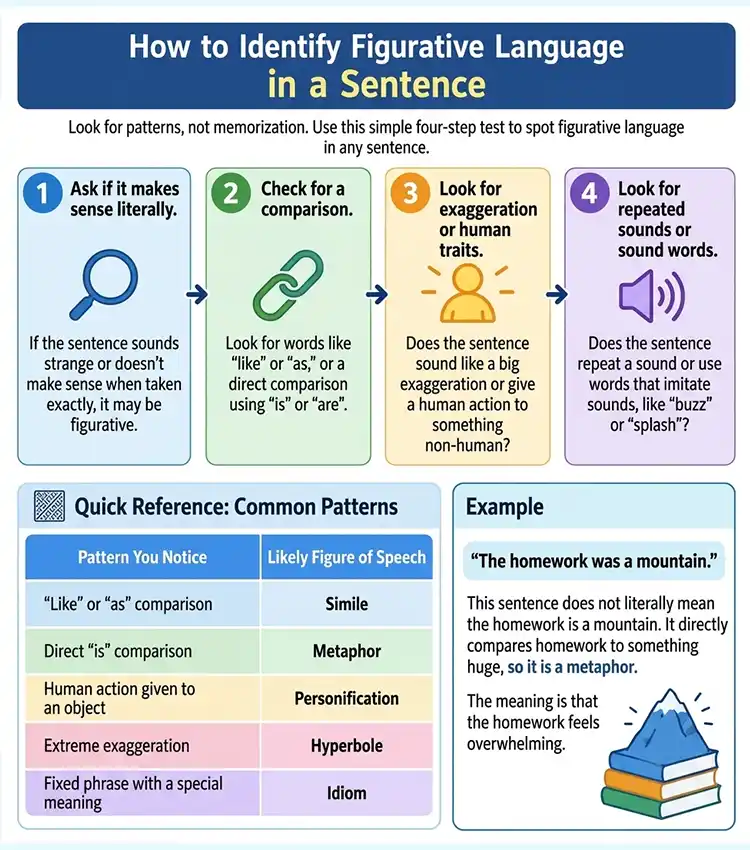
Students often ask, “What figurative language is this sentence?” The best way is to identify the patterns in the sentence rather than memorizing all the possibilities of figurative languages. Some of the examples of sentences are:
Use this four-step test:
- Consider whether the sentence is sensible.
- Determine whether it is comparing two different items.
- Look for an exaggeration or personification.
- Listen for sounds and imitations of sounds.
| Pattern You Notice | Likely Figure of Speech |
| “Like” or “as” comparison | Simile |
| Direct “is” comparison | Metaphor |
| Human action given to an object | Personification |
| Extreme exaggeration | Hyperbole |
| Fixed phrase with a special meaning | Idiom |
For instance, "The homework was a mountain.” The sentence is not stating that the homework is actually a mountain. It is comparing homework to something huge, thus it is a metaphor.
Why Writers Use Figurative Language (Uses and Benefits)
Writers, speakers, students, and average English-language speakers use figurative language for more clarification, too emotional and memorable. Examining various examples will help the learner realize how simple words can result in outstanding pieces of writing. Some good figurative language meaning and examples should not only have an impressive sound but also provide a quick explanation.
In Stories and Poems
Figurative language (core term) makes up pictures in mind, emotions, atmosphere, and memorable descriptions. In poetry, it may appear that "The moon smiled down upon the sleeping town."
In Essays and Speeches
Comparisons can sometimes make complex ideas simpler an d more comprehensible. For instance, “a good thesis is the backbone of an essay example” could be used by a student to demonstrate the importance of the thesis for all paragraphs.
In Everyday English
Expressions and idioms will make your speech sound more native-like. Expressions like “hit the books” or “under the weather” are frequently used in American class, office, or social situations.
ESL tip: Study idioms in categories by theme, such as college essay, weather, work, emotions, or personal relationships.
Quick Practice: Name That Figure of Speech
See whether you can find the figurative language in each sentence below. The five sentences represent the five most used kinds of figurative language. They provide a good test for you to test your knowledge.
- Her laughter was music to my ears.
- He was as quiet as a mouse.
- The alarm clock screamed at me.
- I have a million homework assignments.
- Let us call it a day.
Answers: 1. Metaphor. 2. Simile. 3. Personification. 4. Hyperbole. 5. Idiom.
Conclusion
These examples give ordinary words more emotion and meaning. As a result, if you learn similes, metaphors, idioms, personification, and hyperbole, then you can also understand reading passages in depth and be able to improve your own writing. With that in mind, choose two or three favourite examples from this guide and use them in your next study assignment or writing. Finally, bookmark this page to know more and return back to it whenever you need a quick study reference.