Documentation is important in academic research, not just as a formality, but as part of the scholarly rigor. An annotated bibliography is more than just a list of references; it includes a brief evaluative or descriptive summary of each source, providing critical evaluation of the relevance and credibility of the sources. It is important to know how to write an annotated bibliography in APA style (7th edition), because the APA style changed and welcomed major updates to the standards of citations which are widely used in all disciplines. Each of the formatting requirements is explored in detail below.
What Is an Annotated Bibliography? (Purpose & Components)
An annotated bibliography is a research paper that combines a list of citations for sources cited in the bibliography with substantive analysis written commentary about them. An annotated bibliography differs from a traditional reference list in that it is not just a list of sources a researcher consulted in writing the paper, but it shows a researcher's thinking process in selecting the sources and provides a level of depth and rigor of a researcher's interaction with existing scholarship.
1. Definition and Academic Purpose
In essence, an APA annotated citation format is really what a citation without the annotation can't do: it situates each source in a research context. It conveys the information of the formal citation, but also explains why the reading was chosen, how it relates to the topic being studied, and its ability to be used as a reliable source for scholarly writing. By that, it represents learning to engage in careful and systematic research practice, a key characteristic of any credible academic work.
2. Core Purpose in Research Practice
In addition to documenting, the annotated bibliography is also a useful organizing tool in the research process. They help researchers to trace the intellectual history of a subject, to find points of agreement and disagreement among sources, and to develop soundly supported academic claims. A stringent approach to making thoughtful annotations fosters critical thinking and an evaluative, strategic approach to reading literature.
3. Key Components of an Annotation
There are three interrelated parts that form each annotation:
- a) Summary: A brief summary of the gist of the source's arguments, results, and/or theories, which provides a clear sense of what the content and scope of the source are.
- b) Critical Evaluation: An objective evaluation of the author's credentials, the quality of the method and the author's possible bias and any significant limitations that might compromise the suitability of the source for the intended purpose.
- c) Reflective Relevance: A careful interpretation of the relationship of the source to the research at hand, whether to support, extend or challenges the researcher's position.
APA 7th Edition Formatting Basics for Annotated Bibliography
Knowing how to format APA 7th edition is, like a key part to make sure you end up with a correctly arranged and trustworthy annotated bibliography, because honestly it helps a lot more than people think. The 7th edition made a few changes in the formatting of citations and documents, which it now represents, and is now the standard in many academic fields. If you apply these conventions properly, then an “annotated bibliography APA 7th edition” will be both accurate and consistent with the precision and rigor that scholarly writing requires and the expectations of the institution. However, before you can build individual entries, you kinda have to first figure out how to format a page, along with a few of those other rules for writing annotations, and setting the width of the indent too.
APA Annotated Bibliography Formatting Rules (APA 7th Edition) | Formatting Element | APA 7th Edition Rule | Explanation / Purpose |
| Page Margins | 1 inch on all sides | Ensures uniform presentation and professional document appearance |
| Font & Size | Times New Roman 12 pt, Calibri 11 pt, or Arial 11 pt | APA 7 permits multiple accessible font options |
| Line Spacing | Double-spaced throughout | Applies to both reference entries and annotation text |
| Title Formatting | "Annotated Bibliography" — centered, bold, title case | Follows standard APA heading conventions for document titles |
| Reference Entry Structure | Hanging indent (first line flush left, subsequent lines indented 0.5 inch) | Standard APA citation format applied to each reference entry |
| Annotation Placement | Begins on the next line after the reference entry | Maintains clear visual separation between citation and commentary |
| Annotation Indentation | Entire annotation indented 0.5 inch from the left margin | Visually distinguishes annotation text from the reference entry |
| Annotation Length | Typically 150–200 words per annotation | May vary by institutional guidelines; brevity and precision are prioritized |
| Paragraph Structure | Single paragraph per annotation (unless instructed otherwise) | Encourages concise, integrated commentary rather than fragmented points |
| Alignment | Left-aligned text throughout | Consistent with standard APA document formatting conventions |
| Page Numbers | Top right corner, beginning from page 1 | Included in the running header as per APA 7th edition guidelines |
| Running Head | Not required for student papers; optional for professional manuscripts | A notable change was introduced in the APA 7th edition |
Doing it isnt just a matter of habit or convention, no, it’s the scholarly integrity, and that constant attention to detail that gives an annotated bibliography real academic credibility, and also professional authority.
Step-by-Step Formatting Instructions
Creating a properly formatted annotated bibliography is not just about knowing the citation rules it’s this careful process of how the documents get presented, then the quality of the annotations really matters too, and after that you also need consistency in the way everything is organized. This annotated bibliography APA 7th edition guide will show you how to format your document from start to finish, including tips on setting up your document, formatting it, and reviewing it for accuracy. If applicable, “how to write an annotated bibliography in APA format” is highlighted so as to strengthen the accuracy of the whole process.
Step 1: Set Up Your Document
The document should be formatted to APA 7th edition format before adding any content. The base settings give you a uniform look, which is kind of essential when you’re writing academic papers at a professional level, and make sure all parts of the page are placed correctly from the start, rather than later.
- Set all margins to 1 inch for all sides of the page.
Choose an APA font style:
- Times New Roman (12pt)
- Calibri (11pt)
- Arial (11pt)
- Use double spacing for the whole document.
- Put a page number in the header in the top right corner.
- Please do not insert additional spacing between paragraphs and/or entries
Step 2: Title Your Page
If the document has been set up properly, the page title should be written in APA 7th edition style. This is a basic but essential practice and will make it clear to readers what the document is used for and will meet standard academic presentation requirements.
- Write Annotated Bibliography at the top of the first page.
Style the title as:
- Centred
- Bold
- It's capitalize all major words, a style known as Title Case.
The title should not be in an italic type, underlined, or be in quotation marks.
If institutions' guidelines require it, a separate title page is required.
For standard academic papers, the title should be displayed on the bibliography page.
Step 3: Format Each Citation
Once you have the document and title, each source needs to be cited in the correct APA 7th edition reference (citation) structure. The key to the integrity of an annotated bibliography is accurate citation formatting, even though it sounds small, because each annotation kind of depends on this formal scholarly record.
For each source type use APA 7th edition reference formatting:
- Author: A. A. books. (Year). Title of work. Publisher.
- Journal Articles, A. A. (Author). (Year). Title of article. Journal Name (Volume and issue number), page number.
- A. A. Websites. (Year, Month Day). Title of page. Site Name. URL
Use a hanging indent for each reference entry:
- Left-aligned first line.
- The rest of the lines were indented 0.5"
- Write using correct punctuation, capitalization, and italics, as needed, following APA style guidelines.
- Arrange list in alphabetical order, by the last name of the author.
Step 4: Write the Annotation
The annotations should be written clearly, academically accurately, and analytically, following each properly formatted citation. This is the most intellectual of tasks and demands the researcher to summarise, evaluate and reflect on every source in a coherent, formally written paragraph.
- Start the annotation on the following line following the reference entry
- Indent paragraphs of annotation 0.5 inch from the left.
- Unless otherwise stated, the annotation should be 150-200 words.
- Type formally (academic prose), do not use bullet points or short sentences.
Three elements are essential in each annotation;
- Summary: Give a brief description of the main arguments or findings in the source.
- Evaluation: determine the author's credibility, method and the limits of the author.
The source will be related to or support the research focus in the explanation below:
- Make sure that the annotation is written as a single paragraph.
Step 5: Alphabetize and Review
After all entries and annotations, the final step is to arrange the bibliography properly and do the very thorough review. This step ensures that the document is coherent, correct and meets APA 7th edition formatting requirements prior to submission.
- Sort all the entries by the last name of the first author
- For works by anonymous authors, the entries are arranged alphabetically by first significant word in the work's title.
Once ordered, review carefully by checking:
- Margins, font, and spacing are consistent throughout
- All reference entries have been used correctly with hanging indents.
- Each and every entry has the same indentation.
- Citations are fully and neatly formatted.
- The length and quality of annotations are suitable to the academic level required.
- Double-check all entries in line with APA 7th edition rules before submitting.
By proceeding through this step-by-step style approach, you can kind of make sure that all the pieces of your annotated bibliography really do meet the expectations, in APA 7th edition, and you will end up with a pretty well-organized and credible showing that actually sticks together, sort of.
Visual Example – What It Should Look Like
The annotated bibliography example in APA 7th Edition is like a visual representation that helps you see the structure layout, and formatting rules all at once, so writing an annotated bibliography becomes way easier to get right in the first place.
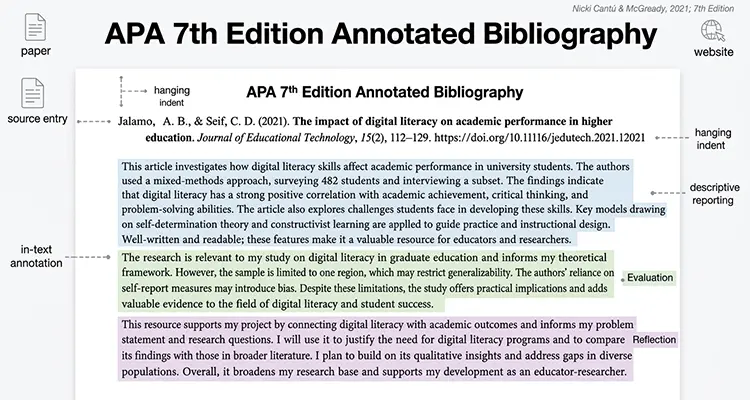
Page Layout & Formatting
- Margins: This document enforces standard 1-inch margins on all sides—top and bottom, left, and right too.
- Spacing: The whole document is double-spaced, no additional spacing between the citation and annotation.
- Typography: Uses a clean and professional academic font e.g. Times New Roman or Calibri.
The Citation (Hanging Indent)
The bibliographic entry at the top is in the proper format for the APA 7th edition (Author, Year of publication, Title, Source, and the DOIs/URLs).
Uses hanging indent: the first line of a citation will not be indented, all subsequent lines of the same citation will be indented 0.5 inches.
The Annotation Paragraph (Indented)
The entire block of annotation is pushed in 0.5 inches from the left edge which matches the hanging indent of the rest of the citation.
A full-length APA 7th edition annotation usually incorporates three main parts.
Key Components of an APA Annotated Bibliography | Element | Purpose Depicted In The Image |
| Summary (Blue) | Condenses the source's core focus, methodology, empirical scope (e.g., studies analyzed between 2015–2021), and key findings regarding the topic. |
| Evaluation (Green) | Critically assesses the source's strengths and limitations, such as the rigor of its statistical modeling or limitations in geographical/demographic generalizability. |
| Reflection (Purple) | Explains how the source directly fits into your own research project, shapes your hypothesis, or supports specific sections like the literature review. |
Complete Examples by Source Type
When you see those nicely arranged APA annotated bibliographies, it becomes a little easier to understand how to format one. In the APA 7th edition there are a couple of different citation formats for different types of sources, like books, journal articles, and websites, for example. Still, each annotation should also have a short summary, an assessment, and a note on why the source matters, like its relevance or usefulness.
Book Example
This example illustrates the proper APA 7th edition book citation and annotation.
Citation
American Psychological Association. (2020). Publication manual of the American Psychological Association (7th ed.). American Psychological Association.
Annotation
This book will explain the official APA 7th edition formatting and citation guidelines used in academic writing. This book will explain the official APA 7th edition formatting and citation guidelines used in academic writing. It includes annotated bibliography guidelines, paper formatting, and in text citations as well as a full reference section. It’s published by the American Psychological Association, so it is seen as reliable and authoritative. Although, it’s a helpful source for getting the correct APA formatting down, without too much fuss.
Journal Article Example
This is an example of the correct APA 7th edition reference and annotation for a scholarly journal article with a Digital Object Identifier (DOI).
Citation
Johnson, R. T., & Keller, S. P. (2021). Academic writing strategies and student research performance in higher education. Journal of Educational Research, 114(3), 245–258. https://doi.org/10.1080/00220671.2021.1871234
Annotation
The purpose of this article is to deal with the improvement of academic writing strategies for better performance in students' research. The study is based on survey and statistical analysis in the study of writing habit and research quality. The source is credible, it is published in a peer-reviewed journal. It is applicable to annotated bibliographies because it emphasizes the need for accurate citation and organization in research papers.
Website Example
The following example explains how to cite and annotate an online webpage source in APA 7th edition formatting guidelines.
Citation
Purdue Online Writing Lab. (2023, July 15). Annotated bibliographies. Purdue University. https://owl.purdue.edu/owl/general_writing/common_writing_assignments/annotated_bibliographies/index.html
Annotation
This page provides information about creation, organization and APA formatting of annotated bibliographies. It contains simple instructions and examples which are easy for students to follow. Purdue OWL is a well-known academic writing site, making it a reliable source. It is useful for practicing proper APA citation and annotation format.
Common Mistakes to Avoid
While students may be familiar with APA formatting, any minor mistakes can diminish the clarity and professionalism of an annotated bibliography. Citation, indentation, spacing and structure of the annotations are common areas of errors. By examining the frequent problems that are encountered, you can help avoid having to run your annotated bibliography by the wayside in regard to APA 7th edition formatting and making it look crisp and professional as a student presentation.
Common APA Annotated Bibliography Mistakes and Fixes | Common mistake | Why is it incorrect | Correct APA practice |
| Incorrect citation format | Missing punctuation, italics, or publication details creates incomplete references | Follow APA 7th edition citation rules carefully for every source type. |
| Forgetting hanging indents | Makes the reference list appear unorganized | Apply a 0.5?inch hanging indent to each citation. |
| Writing overly long annotations | Reduces clarity and includes unnecessary details | Keep annotations concise, usually between 150–200 words. |
| Using bullet points in annotations | APA annotations should be written in paragraph form | Write annotations as a single formal paragraph. |
| Missing evaluation or reflection | An annotation should do more than summarize the source | Include summary, evaluation, and relevance in every annotation. |
| Inconsistent spacing or fonts | Creates an unprofessional appearance | Use double spacing and APA?approved fonts consistently. |
| Not alphabetizing entries | Makes the bibliography difficult to navigate | Arrange all entries alphabetically by the author’s surname. |
| Using unreliable websites | Weakens the credibility of academic research | Choose authoritative and updated academic sources. |
| Incorrect URL or DOI formatting | Can make sources difficult to locate | Copy URLs and DOIs accurately without extra punctuation. |
| Ignoring APA 7th edition updates | Older formatting rules may not meet current standards | Always follow the latest APA 7th edition guidelines. |
Annotated Bibliography vs. Literature Review: What’s the Difference?
An annotated bibliography and literature review are similar in that they analyze academic sources, but they are used for different purposes in research writing. The annotated bibliography emphasizes sources and includes citations and brief critiques of the sources, while the literature review involves bringing several sources together to discuss a research topic. Students understand these differences and select the appropriate format for academic tasks.
Annotated Bibliography vs. Literature Review | Feature | Annotated bibliography | Literature review |
| Main purpose | Summarizes and evaluates individual sources | Analyzes and compares multiple sources together |
| Structure | Separate entries for each source | Organized into thematic or topic-based sections |
| Citation style | Includes full APA citations with annotations | Uses in-text citations within discussion paragraphs |
| Writing focus | Source-by-source explanation | Overall discussion of research findings and trends |
| Tone | Descriptive and evaluative | Analytical and argumentative |
| Organization | Alphabetical order by author surname | Logical flow based on themes, arguments, or chronology |
| Length | Usually shorter entries for each source | Longer and more detailed academic discussion |
| Research goal | Shows source relevance and credibility | Builds understanding of a research topic or gap |
| Common use | Research preparation and source evaluation | Introduction to research papers, theses, and dissertations |
| APA formatting | Uses citation plus annotation format | Uses standard APA paper formatting with headings |
Conlusion
Knowing how to format and write an annotated bibliography in APA format helps you present your research in a way that is clear, organized, and honestly pretty credible. If you learn to do it well on your own, and you keep to the APA 7th edition guidelines with a bit of careful attention, you can craft professional annotations that really lift the overall quality of your writing and research. Just follow the formatting rules, look at the examples and best practices, and you’ll likely feel more confident with your academic writing, while also making a stronger impression on your assignments. For students who need expert assistance, at studyunicorn we help & professional support for APA Paper Writing Service while ensuring your work follows the latest APA guidelines.
Still Need Help? Get Professional APA Formatting Assistance
APA formatting can be kind of confusing, especially when you are drafting a longer research paper, like an annotated bibliography. And then there is that extra confusion, when you’re trying to be consistent across everything. For those moments, Studyunicorn.com can step in with professional APA formatting help so students can become more accurate, clear, and pretty confident. Whether you are formatting citations, arranging the document, or you just want something that supports the writing process, we are here to help you produce writing that looks polished and academic.
Downloadable Resources (PDF Concept)