Key Takeaway:
To conclude before we go into the FAQs section, here is a recap of everything discussed above:
- There are three elements of an introduction paragraph that are a hook, background, and a thesis statement.
- Start with either a question, statistical information, or a brief story to grab the attention of the reader instantly.
- The introduction should be brief, and normally containing three to five sentences.
- It should be conclude with a concrete thesis statement.
- Do not rephrase the essay prompt to use it as a hook.
Have you ever understood the significance of the initial few sentences in anything that you have written and the impact they might have in keeping a person interested or moving on to something else? That is what an introduction paragraph does for any piece of writing. It is that part of the writing which either grabs the attention of the reader or fails to get their interest in the first place.
What Is an Introduction Paragraph?
An introduction paragraph is a beginning section of a paper, which attracts the attention of the reader, introduces the topic and outlines what will be discussed in detail further in a thesis statement. Thus, one may see it as a sort of a preview, not a summary of the whole piece of writing but rather something which will attract attention of the reader and make him or her understand what is going to follow next.
The main characteristic feature of an effective introduction paragraph is its ability to combine three important elements into one. The attention-grabbing element which starts with the first line of the paragraph, some contextual information that would allow the reader to orientate himself or herself and the central idea. Which would be clearly stated so that no vagueness appeared. After the introduction is done, it becomes much easier to continue writing the paper, since one knows exactly what should be written in every other section of the text.
Why the Introduction Paragraph Matters in an Essay
The first paragraph of your paper sets the tone for the rest of the essay. As reported by the writing center at Harvard, a good opening helps readers prepare for your arguments; that's precisely why teachers tend to evaluate essays based on how they start off. Moreover, a good essay statement in the final sentence of your introductory paragraph will function as a map, guiding you and the reader through the paper.
Failing to write a good introduction or simply rushing this part of your essay because you want to write the "actual" parts is the number one reason why many students fail even though their arguments are excellent. After all, the person who reads your essay forms an opinion very quickly, and a bad beginning makes your work look poorly researched and disorganized, even if that's not true. Taking some extra time for this particular paragraph is often much more beneficial than spending the same amount of time improving a body paragraph.
Introduction Paragraph Format: The 3-Part Structure
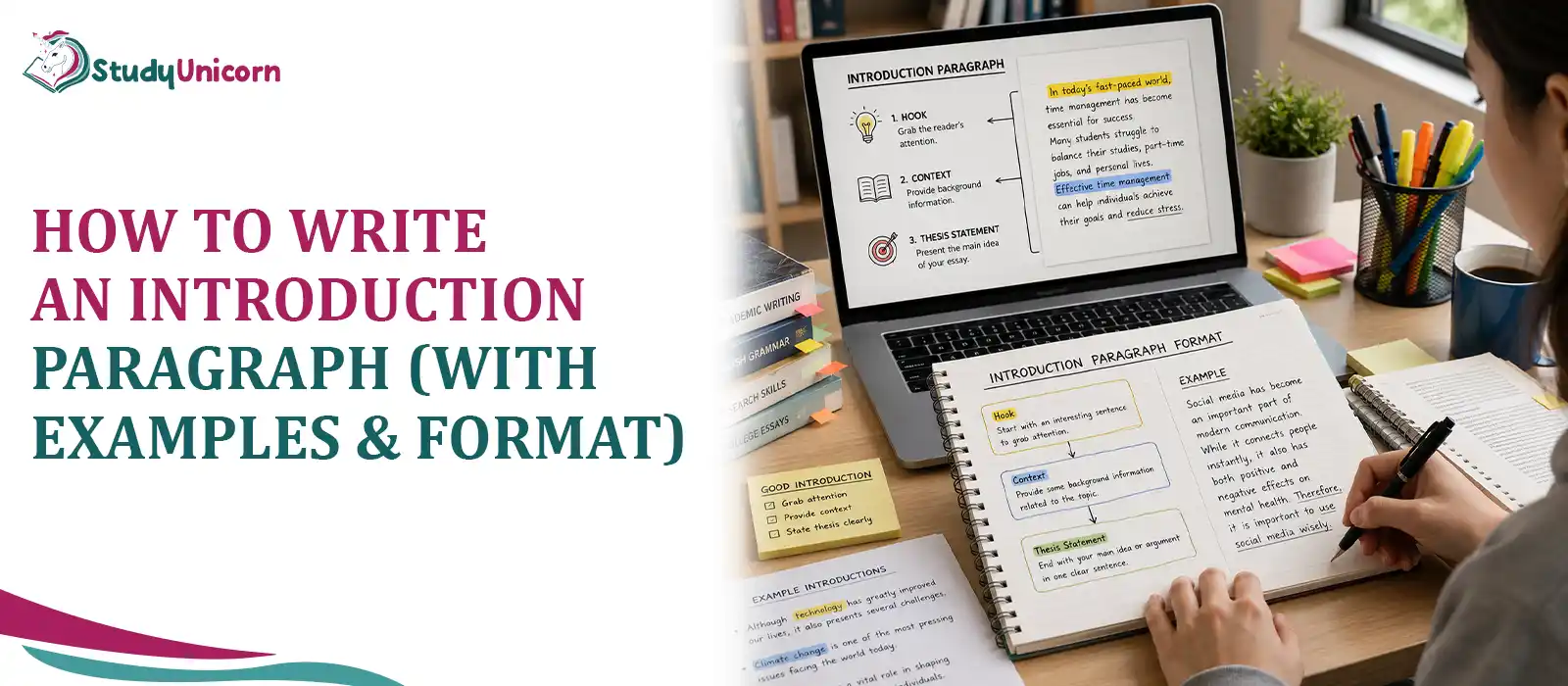
All types of introduction paragraphs contain basically three elements, which include a hook, some background information, and a thesis statement. When understanding the role of each element of the introduction paragraph, writing one becomes much easier because you just have to do three specific tasks instead of staring at a blank paper.
1. The Hook (Opening Sentence)
The hook is the opening sentence that is used in an introduction paragraph. It has no other objective than to attract the attention of the readers so that they keep on reading. In a way to write a good introduction paragraph, the one should choose a perfect hook according to the topic; and it may take the form of a question, fact, or even a story.
2. Background / Bridge Sentences
The hook must be followed by one or two sentences which will provide necessary background. This is where you will give some background information on the topic which the reader might not be familiar with at all. These bridging sentences will help you transition from the interesting hook to the specific point that you intend to bring up.
3. The Thesis Statement
The thesis statement of your essay is its last sentence in the introduction and is considered the most significant one. The reason is that it expresses the central point or argument of your essay in just one sentence. As it is stated by Purdue OWL, a good thesis should be specific and debatable rather than a general fact. If you are looking for more detailed information or guide about how to create it, this step-by-step thesis statement will definitely help you.
How to Write an Introduction Paragraph: Step-by-Step
In case you are confused regarding the exact way to proceed about writing the introduction paragraph, then following are four steps that would help you through the whole process.
Step 1 – Start With a Strong Hook
- Do not start with restating your prompt in a different way. Rather start with something that would capture the reader’s attention instantly, whether it be in the form of a question, statistic or an anecdote.
- In case you are stuck at the idea of what to use as your hook, just jot down a few hooks and select the most appropriate one.
Step 2 – Add Context and Background Information
- It is important to provide your readers with enough background information such that they are able to understand the topic in question without getting confused.
- It should not take you too much time to do this because it only needs one or two sentences.
- The reason is that all you are expected to do here is to give your readers a little bit of context.
Step 3 – Write a Clear, Arguable Thesis Statement
- Your introduction should conclude in your thesis statement where you make your argument about your particular case.
- Be very specific here because it's important that your thesis statement is not overly broad; for example, avoid writing something like "there are many impacts of climate change," which is a very general statement indeed.
Step 4 – Connect the Introduction to the Body Paragraphs
- Thesis statement must establish what will be proved by your body paragraphs.
- After you write an introduction, see how transition words in body paragraphs make sure that the rest of the essay remains coherent.
- So that your reader does not get lost in understanding the link between paragraphs and your main argument.
How to Start an Introduction Paragraph (Hook Ideas & Examples)
The ability to write a good introduction paragraph lies in picking out an appropriate hook for your topic, as there are specific hooks for particular essay types. Here are three ways to do it effectively, which could suit any essay type with minor modifications.
Question Hook
Pose a provocative question on your topic. Example: "What will happen if all students have free college tuition?" It is a particularly good way for writing an argumentative essay, as you make your readers formulate an opinion before stating yours.
Statistic or Fact Hook
Use some surprising statistics or facts, for instance: "About 40 percent of college students claim that they cannot eat proper meals because of their expense." The use of facts and statistics is more appropriate for expository or informative essay types.
Quote or Anecdote Hook
Use an interesting quote or some anecdote, for example: "When Maria entered her first class at college, she had never seen a laptop before." This kind of hook is mostly used when writing narrative essays.
Introduction Paragraph Examples for Different Essay Types
However, different essays would require different styles of writing introduction paragraphs although they all follow the same structure. Below are sample introductions for three popular types of essays which you may be required to write in your classes.
Example: Argumentative Essay Introduction
When dealing with the problem of how to write an argumentative essay intoduction, begin your essay introduction with "Are school uniforms mandatory for students? The supporters say that school uniforms prevent distractions and bullying while those against state that they limit personal freedom. The present paper is intended to reveal why it is beneficial to wear school uniforms in order to create an environment for learning." For further details on writing an argumentative essay, see our article on this topic.
Example: Narrative Essay Introduction
"From the very first time I had been up on the stage, I was holding my note cards hardly because of the tremors in my hands."
Example: Expository/Informative Essay Introduction
"The use of recycling facilities has greatly increased in the past ten years, although there are plenty of individuals who are unaware of what is recyclable. The following essay will address typical recycling errors and how one can avoid them."
Common Mistakes Students Make When Writing an Introduction Paragraph
There are several recurring patterns exist in poor-quality introductory paragraphs and most of them are relatively simple to correct. So, beware of the following pitfalls:
- Repetition of the essay topic question without formulation of a unique introductory hook
- Inclusion of a thesis statement that is not specific enough to support the whole essay
- Excessive length of the introductory paragraph – more than five or six sentences
- Failure to link background information with a thesis statement
- Inclusion of an irrelevant generalizing first sentence such as “From the dawn of time”.
- Including too much into one thesis sentence, which only leads to confusion
Introduction Paragraph Checklist Before You Submit
When you have completed your essay, do not forget to follow the following checklist that is quite simple to complete but will help identify most common errors from the list mentioned above.
- Has your hook attracted attention without paraphrasing the prompt?
- Is your background information concise and relevant?
- Does your thesis statement present your argument clearly?
- Is your introduction made of three to five sentences?
- Is your introduction perfectly connected to your first body paragraph?
- Could anyone who does not know much about your topic can understand what the essay is about?