Most students don't notice their errors until they read the comments on their essay. It's often less about the bad ideas or poorly written paragraphs and more about the parts of the essay placed in the right format.
The ground reality of quality essay writing for novices and seasoned writers alike is no doubt an essay structure. The confusion begins the moment you realize there is not just one general style that you can use everywhere. As a result, multiple lengths and types of essays require different structures, not the same one that you have used in every essay you've written.
But you dont need to worry, as here's the guide that hits all these points regarding essay parts, so you can confidently how to write my essay with correct structure. By the end, you will have a framework, guidelines, the intent of each section, and some common mistakes to avoid. And all these things make you ready to write any level of essay regardless of topics.
What Is an Essay?: Quick Definition
An essay is a piece of writing built around one main idea to convince the reader about it or give insight. And in order to make it high quality and present it in a logical way, several components play a major role.
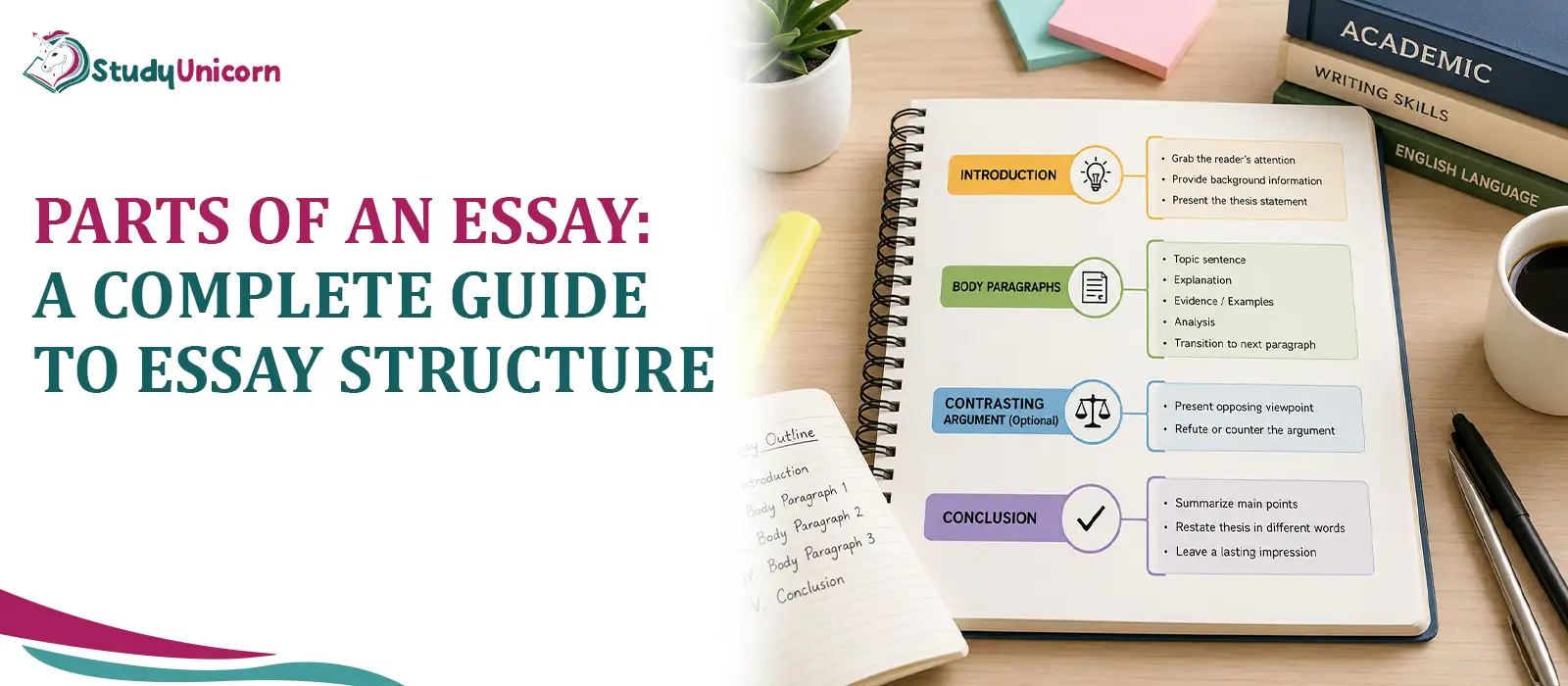
Basically, these components fall into three sections, which are also known as the three main parts of an essay that we have discussed in the segment below.
The 3 Main Parts of an Essay
An introduction, a body, and a conclusion are the major parts of an essay that you can see in every version, whether it is your short essay or a long one. But what about the other types of essays or the long one that includes heavy research? So, the answer still lies in this structure, but this essay structure is stretched a little to fit the assignment with a subcategory.
| Part | Purpose | Typical Length |
| Introduction | Hooks the reader and states the thesis | 1 paragraph |
| Body | Develops and supports the thesis with evidence | 1 to 3+ paragraphs |
| Conclusion | Restates the thesis and closes the argument | 1 paragraph |
To make sure that you get a broader picture of these three components of an essay, take an example like a student who writes an essay on renewable energy.
- The Introduction opens with a fact about solar power growing fast.
- Body Paragraphs each hand over one reason renewable energy actually matters.
- Conclusion pulls those reasons together into one bigger point.
Breaking Down Each Part of an Essay: Mostly Overlooked by Students
On a serious note, knowing the rules with one example is literally not enough for achieving expertise in writing an essay. So, rather than going to cover every part in one take, make sure that you understand what each part plays a role. As a result, no matter what kind of topic you are going to cover, if you understand the depth of every section, then writing an essay in a perfect style is not a daunting task. So let's cover each section in simple terms to streamline everything.
1. The Introduction
An introduction has three main objectives that you need to conclude in a long paragraph or two short paragraphs.
Hook. A line that grabs attention, and it could be a fact, question, or something that easily grabs the eyeballs. For example, "Solar panel use has grown by over 20 percent every year for the past decade."
Background: This section gives the depth of why this topic is important with all the logical reasons and combines with aspects like FOMO(fear of missing out), emergency, urgency, desire, and anything else.
Thesis statement: One sentence stating exactly what the essay is going to prove, and it must contain the assurance along with a bridge that compels readers to read your writing.
This last section has done a good job of telling the reader what's coming next, giving more of the gist, and increasing curiosity.
Now, you will have to find if there are any sentences that sound weak, illogical, or something that has no backup with facts. Moreover, start to write something and target the pain point and give assurance there is no fluff, and only the thing that is relevant to the topic would be described in this essay. Knowing how to write introduction paragraph can help you begin the essay by identifying these points clearly.
2. The Body Paragraphs
This is where an essay actually earns its grade. Every paragraph in the body should hold exactly one idea, and each one tends to move through the same small pattern.
- Topic sentence. Names the single idea this paragraph is about.
- Evidence. A fact, example, or quote backing that idea up.
- Analysis. A quick explanation of why that evidence actually matters.
- Transition. A word or short phrase leading into the next paragraph.
Back to the renewable energy essay. A good introduction to a paragraph should appeal to the reader with that statement, cite a specific example (such as the solar panel, in this instance), and explain the link of that to your main argument. The second paragraph, Renewable energy also protects the environment, takes a new angle, introduces the necessary emissions data, and then connects these back to a different direction - the thesis. Same thesis both times, just a different reason carrying the weight.
Two short names describe this pattern, in case a label sticks better than a description does.
- MEAL. Main idea, Evidence, Analysis, Link.
- PIE. Point, Illustration, Explanation.
Either works fine. The real question underneath both is simple. Does this paragraph make one clear point, back it up, and explain why anyone should care?
Transition words are what keep these paragraphs from feeling like a random pile of facts sitting next to each other. A few, grouped by what they're doing.
- Adding an idea: furthermore, in addition, also, coupled with
- Showing contrast: on the other hand, however, even so, although
- Showing cause and effect: as a result, for this reason, therefore
- Giving an example: for instance, such as, in particular
- Wrapping up a point: overall, in short, all things considered
Match the category to the job at hand. A paragraph adding a new reason needs a word from the first group. A paragraph pushing back on something needs one from the contrast group instead. Mix them up and an essay starts to feel slightly off, even when a reader can't quite say why.
3. The Conclusion
The conclusion has its own short list of jobs. Restate the thesis in fresh wording. Pull the key points together. End on something a little bigger than the essay itself.
Here's what tends to weaken a conclusion fast.
- New evidence showing up out of nowhere. That belongs in a body paragraph, not the ending.
- Copying the introduction with a few words swapped around. That isn't restating; that's repeating.
- A flat ending with no zoom out at all.
One small test works well here. After restating the thesis, ask a simple question. So what? Why should this matter to anyone who isn't grading the paper? Answering that honestly, in one sentence, almost always beats a generic closing line and is an important part of how to write conclusion paragraph effectively.
5 Parts of an Essay (Expanded Structure for Longer Essays)
If an assignment calls for a five paragraph essay, nothing about the actual structure is different. The same three parts just spread out across five paragraphs instead of three.
- Introduction
- Body paragraph one
- Body paragraph two
- Body paragraph three
- Conclusion
This format can be found in schools in the US, UK, Australia, and Canada. It's not a block by itself that needs to be learned separately. The same three part skeleton, but with an extended body.
Parts of an Argumentative Essay
A persuasive essay follows this same backbone but leans more heavily on emotional appeal alongside logic. If you'd rather have a specialist handle that balance, see our persuasive essay writing option. The thesis becomes a statement with which others can disagree. There is one reason given in each body paragraph. Then there is something many students overlook: the counterargument and rebuttal, placed directly before the conclusion.
This is a simple structure of the parts of an argumentative essay.
- Claim (thesis)
- Reason 1 + evidence
- Reason 2 + evidence
- Counterargument
- Rebuttal
- Conclusion
A well-crafted argumentative essay will deal with opposing ideas, a distinguishing aspect from a mediocre one. If the strongest counterclaim is presented and you explain why it will not refute your argument - you indicate to the reader that you have genuinely attempted to "defend" your argument by raising the strongest counter-claim, as opposed to merely repeating it. For the renewable energy essay, the counterargument may acknowledge the initial expense of solar energy. The rebuttal then provides an explanation as to why that cost is still worthwhile in the long run.
Parts of an Informative Essay
When the goal changes, the structure adjusts but doesn't change in shape. An informative essay does not make any claims; it is designed to tell the reader something about a topic. There is one body paragraph for every fact or one part of the topic. There's no point in arguing here; no one is trying to persuade the reader.
Now it's the same topic, different job. The use of renewable energy is on the rise due to decreasing costs, new government policies, and increasing demand from residents. Each body paragraph just accounts for one of those three reasons and does not have to substantiate any of the reasons.
What About Narrative or Application Essays?
Not every essay is built around proving a thesis. A narrative essay tells a story and is structured more like beginning, rising action, climax, and resolution than claim-evidence-conclusion — see our narrative essay writing service if that's the assignment in front of you. Admissions and MBA essays bend the rules further still, since they're built around a personal story or vision rather than an argument - our MBA essay writing service covers that structure specifically.
Essay Structure Template You Can Copy
Hook: ___________________________________
Background: ______________________________
Thesis: __________________________________
Topic sentence 1: ________________________
Evidence: ________________________________
Analysis: ________________________________
Transition: ______________________________
Topic sentence 2: ________________________
Evidence: ________________________________
Analysis: ________________________________
Transition: ______________________________
Topic sentence 3: ________________________
Evidence: ________________________________
Analysis: ________________________________
Restated thesis: _________________________
Summary of key points: ___________________
Closing thought: _________________________
Drop this straight into a blank document and fill in the blanks. The essay outline stays the same no matter the topic. Only the words inside each blank actually change.
Common Mistakes Students Make With Essay Structure
Even strong writers repeat these errors. If you'd like feedback on your own structure before you submit, our essay writing help team can review it with you.
- A weak or missing thesis: A topic isn't a thesis. Write one sentence someone could actually argue against.
- One paragraph holding two ideas at once: Split it into two separate paragraphs instead.
- Paragraphs with no transitions: A simple linking word at the start of each one goes a long way.
- New evidence sneaking into the conclusion: Move it into a body paragraph where it belongs.
- A conclusion that ignores the introduction: Read both together and check they're actually talking about the same thing.
- Copying a template: Start with the template above and resize it to fit the actual assignment.
These errors keep appearing in students' essays, even those of students who are otherwise excellent writers. Rough in one last time before handing anything in, and most of the marks get swallowed up.
Why This Structure Works for Every Assignment
Every student can use this format so they don’t have to start their essay from scratch whenever they get a new prompt. That same reader who used to be given back a paper and "where is your thesis" written in red pen can now detect that hole before a teacher ever sees it. It's that difference, from mere speculating about structure to real knowledge of it that makes the difference between an essay that "reads" and a “finished” essay. Next assignment is to be a little easier than last time, regardless of what shape it is in.
Does Citation Style Change Your Essay Structure?
The paragraphs following the title and introduction are identical for all essay types and irrespective of the type of citation style that a class might employ (such as MLA, APA, Harvard, OSCOLA, etc.). The form of a citation does not affect what information is found in the source. It is not that you don't need a thesis, body, and conclusion in an essay. Pay attention to the formatting on the assignment sheet, and as a guideline, these are the rules that underlie all of them.