The Quick Answer
Use into when something moves inside or changes form. (Example: She walked into the room / The code turned into an error.)
Use “in to” when the word “in” naturally pairs with the verb right before it, leaving to to start a new phrase. (Example: Please log in to your account / Hand in to the manager.)
The 2-Second Test
Here is a foolproof way to check which one you need: try swapping the word out with "toward."
If the sentence still sounds natural, such as saying "She walked toward the room," then you want into.
But when you decide to replace it with the word "toward," it sounds completely broken, like saying Please log toward your account. And it is in that moment you got the wave of realization that words need to stay separate, as in to.
You are right in the middle of writing, and suddenly a confusion hits your mind: into or in to? And now pausing over prepositions can completely derail your train of thought. But relax, mixing these up is not a sign of weak writing because English has plenty of such confusing little traps. So, now this dilemma can be part of anyone, from everyday writers to experienced scholars.
The reality is that you do not need a linguistics lecture, confusing textbook rules, or definitions that you can easily forget over time. But all you need is just a practical approach to look at into vs in to prepositions.
In order to do that, here is the guide to lock this rule into your memory so you never hesitate again. So, start the game of scrolling and get practical insight in the form of quizzes, self-check tips, and examples that will allow you to master this preposition in a few minutes.
What Does "Into" Mean?
In this term, the preposition establishes a link between the noun or pronoun and the other parts of the sentence by showing to which place, to what thing it turns into, or to what thing one has.
We can learn this in this example: (she walked into the kitchen), and here you see that the endpoint is in the kitchen, and into signifies that she walked into it.
Now let’s see another one: "The caterpillar turned into a moth." Here, Into projects a change of form, not a place.
By looking at both examples, what we got is that Into always needs an object right after it. Lock this learning that a repeated routine first makes in to vs into easier to sort out later.
- You walk into a room
- Pour water into a glass
- Crash into a fence
It can also express interest in a hobby, in a person, or in a thing, such as saying 'She is into jazz.' While this phrase carries an informal tone in daily conversation, analyzing the subtle difference between literal meaning and figurative expression comes down to understanding denotation vs connotation.
What Does "In To" Mean?
Two words together are not necessarily one unit. In to is the word in followed by the word to, and the 2 words are in different sentence parts. Neither the word 'in' nor the word 'to' can make sense without the other.
Sometimes in appears as an adverb modifying another verb. Viewed as such, in to vs into ceases to be a coin toss. Please come in doesn't need any. If you add one, you get. Please come in to see the doctor. In this example, to begins a purpose.
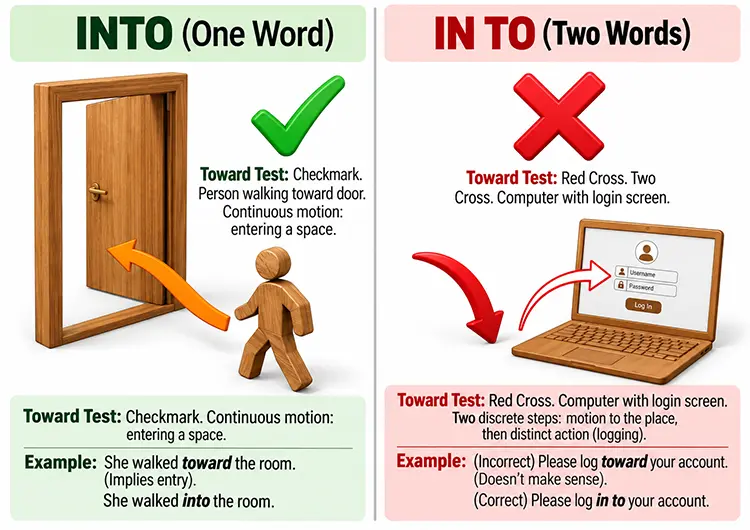
Another time, we can put 'in' with the verb: such as 'log in,' 'check in,' or 'hand in.' When the 'to' comes in between, it connects the action to a specific person or object. Choosing the correct words to reference individuals in these target phrases relies on applying basic grammar rules like who vs whose.
The pair could be seen as two jobs: the first indicates the verb, the second one relates to a target / purpose. This separation can be the reason why this choice is used as a grammar test rather than a style preference.
Into vs In To: The Key Differences
The two vary in grammar, meaning, and testability. Because into vs in to errors are nearly impossible to notice in rapid-fire third or fourth drafts, have the table below handy while editing. This table aligns the two forms so you can scan them rapidly.
| Feature | Into | In To |
| Word count | One word | Two words |
| Parts of speech | A single preposition | An adverb or verb particle, plus a preposition or infinitive marker |
| Core meaning | Movement, change, or interest | Two linked jobs: "in" finishes a verb, "to" adds a target or purpose |
| Object needed? | Yes, right after it | Not always, because "in" can stand alone |
| Typical pattern | Turn into, look into, bump into | Log in to, hand in to, tune in to |
| Sample sentence | She stepped into the lift. | She logged in to her account. |
Into is one tool with one job, while in to is two tools doing two jobs. The tests in the next section separate them in a few seconds.
The Quick Test: How to Know Which One to Use
You will need to learn about the three checks and tick them off to check which one you will have to use in your writing. Read it carefully and find out which one fits yours by using these checks whenever uncertainty about using into vs. in to hits you.
| Test Name | How to Run the Test | Example Sentence | Result | Use "in to" (Two Words) | Use "into" (One Word) |
| 1. The Split Test | Take away the word to and read what is left. | "She turned in [to] the teacher." | "She turned in her homework" still makes sense. | ? |
| "The caterpillar turned in [to] a moth." | "The caterpillar turned in a moth" sounds broken. | ? |
| 2. The "In Order To" Swap | Replace in to with the phrase in order to. | "They came [in to] fix the sink." | "They came in order to fix the sink" makes complete sense. | ? |
| "She walked [into] the house." | "She walked in order to the house" makes no sense. | ? |
| 3. The "Where?" Test | Ask the question "Where did it go?" to check for physical movement. | "She walked into the kitchen." | "Where did she walk?" gives a clear place ("into the kitchen"). | ? |
| "The caterpillar turned into a butterfly." | This describes a change, not physical movement to a place. | No Need | No Need |
When to Use "Into"
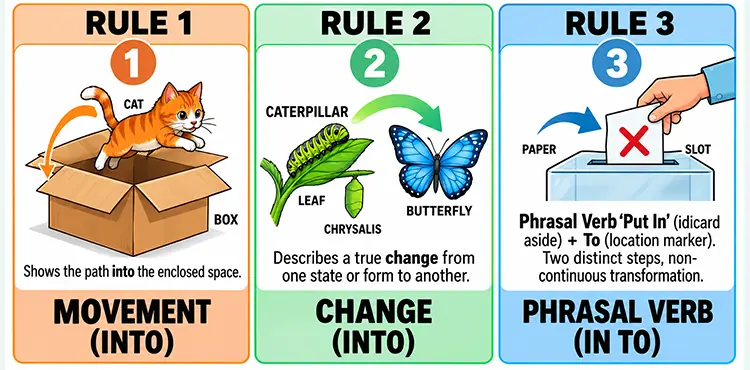
The word into can have three meanings: it signals physical movement inwards; it marks a fundamental change or transformation; and it indicates interest or involvement.
The 3 uses of 'Into'.
-
To Show Movement or Direction
Use into when something crosses a boundary to go inside a space, area, or container. This idea of crossing boundaries or moving across defined limits is similar to how prefixes function, such as understanding the difference between inter vs intra when describing internal versus external connections.
For Example: The cat jumped inside the box. (Crossing from outside to inside.)
Note: If the cat jumped in the box, then the cat was already in the box when it jumped.
2. To Show Transformation or Change
Apply into when something transforms in form, status or language.
Examples: The ice turns to water. / The English is translated into Spanish.
Verbs: turn, change, grow, develop, translate.
Note: When translating or adapting text, paying attention to denotation vs connotation ensures that both the literal meaning and the underlying tone carry over accurately into the new language.
3. To Show Interest or Involvement
For informal interests, physical contact, and official investigations use into.
Example: He's very fond of playing chess. / She ran into an old friend. / They investigated the issue.
Common Verbs: bump into, break into, look into.
When to Use "In To"
The difference between to and into in the word 'function' will be the difference between the two. To is used together with in in a phrase when the action verb is log in, drop in, etc., and to is used to shorten the phrase to.
Use of "to" with phrasal verbs.
If the word "in" is followed by the word for an action, use two words. When "to" is deleted, the result is a complete phrasal verb.
Pattern: Phrasal Verb ("in") + Target ("to")
Examples: Please log in to your account. Log in to your account (+) to access this.
Note about the Style: There are a lot of writers that will type in "log into" but that is wrong. Use 'log in to' for the verb and remember 'login' as a noun/adjective, like login page.
To Show Purpose (Short for "In Order To")
Use two words for 'in' used as an adverb and 'to' used at the start of an infinitive verb to explain why something occurs.
Action: "in" + Reason: "to + verb"
Example: Plumber came in to repair sink. (He came inside in order to fix it.)
Replace the word to with in order to in the following sentences. If this still makes sense to you, leave "in to" as two words.
Into vs Onto vs In To: What's the Difference?
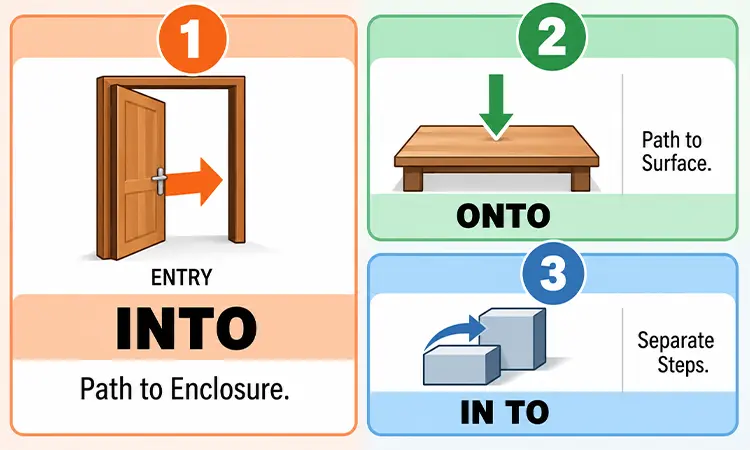
To understand the differences between these prepositions, then you have to consider if the preposition is a physical direction or a verb action. Would single words like into or onto be necessary to describe; into a space being into, onto a surface being onto. Or will you need two words such as in to or on to keep apart when the first word is an action verb?
| Word | Simple Direction or Function | Example |
| into | Going inside a space | The cat jumped into the box. |
| onto | Landing on top of a surface | The cat jumped onto the table. |
| in to | Action verb + purpose | Please sign in to your account. |
| on to | Action verb + next step | Let us move on to the next topic. |
Into vs In To: Example Sentences Side by Side
When putting pairs of them together it makes it easier to see, For example; say in to and into out loud and see the gap between the two words. The pair's below have similar words but in different structures.
- Into: She walked into the manager's office without knocking.
- In to: She walked in to meet the manager without knocking.
- Into: Her hobby grew into a business within two years.
- In to: Please log in to your account before you place an order.
- Into: The ice slowly melted into a shallow pool on the porch.
- In to: Several customers dropped in to ask about the weekend sale.
- Into: I ran into my old teacher at the market yesterday.
- In to: He turned the wallet in to the police station nearby.
Cut "to" and everything behind it from any "in to" sentence, and what remains still works. Do the same to an "into" sentence, and it changes meaning or breaks.
Quick Practice: Test Yourself
Fill each blank with "into" or "in to," then check the answers below.
- She dropped ___ say hello after her shift ended.
- The tadpole slowly turned ___ a frog over the summer.
- Please log ___ your account before you place an order.
- We looked ___ the missing invoice late yesterday afternoon.
- He came ___ check whether the room was ready.
- They walked ___ the museum to escape the heavy rain.
- She stepped ___ help resolve the dispute.
- You must sign ___ the system before accessing your employee files.
- The key fell ___ a deep crack in the pavement.
- He dropped ___ hand over his reports before leaving for the day.
A Simple Trick to Remember the Difference
The difference between "into" and "in to" is the movement of the body reaching the location versus the sentence structure. Since both can be correct, it is "if the going inside continues. " "In to" remains two words if the words can be attached to a verb.
The One-Breath Rule: Into vs. In To: One move, one word; two jobs, two words.
INTO (One Word): Write for a single one of what comes next: movements, changes, or interests:
IN TO (Two Words): Two-word splitting in the action word "in" and the purpose.
The House Test
One Motion: Visualize a house as having one front door. Entering the house is one motion through one opening.
Two Steps: Walking in to say hello to the host. Two actions: you walk in first, and then walk to something specific.
Quick Sentence Check
Say the sentence and count the number of jobs. Checks like these solve every sort of difficult case!
The Final Takeaway
The picture has been cleared that choosing between these two forms of preposition comes down to sentence structure rather than personal writing style. You must use the single word when describing movement, transformation, or personal interest. And you get a switch to two-word variation whenever the first word finishes a verb action and the second word introduces a target or purpose. In this guide, you have already got a quick test section with examples and simple rules. So there you have it. Of course, the difference between “into” and “in to” for you is clear now. But you can still choose this guide as your bookmark to keep it handy for the future.