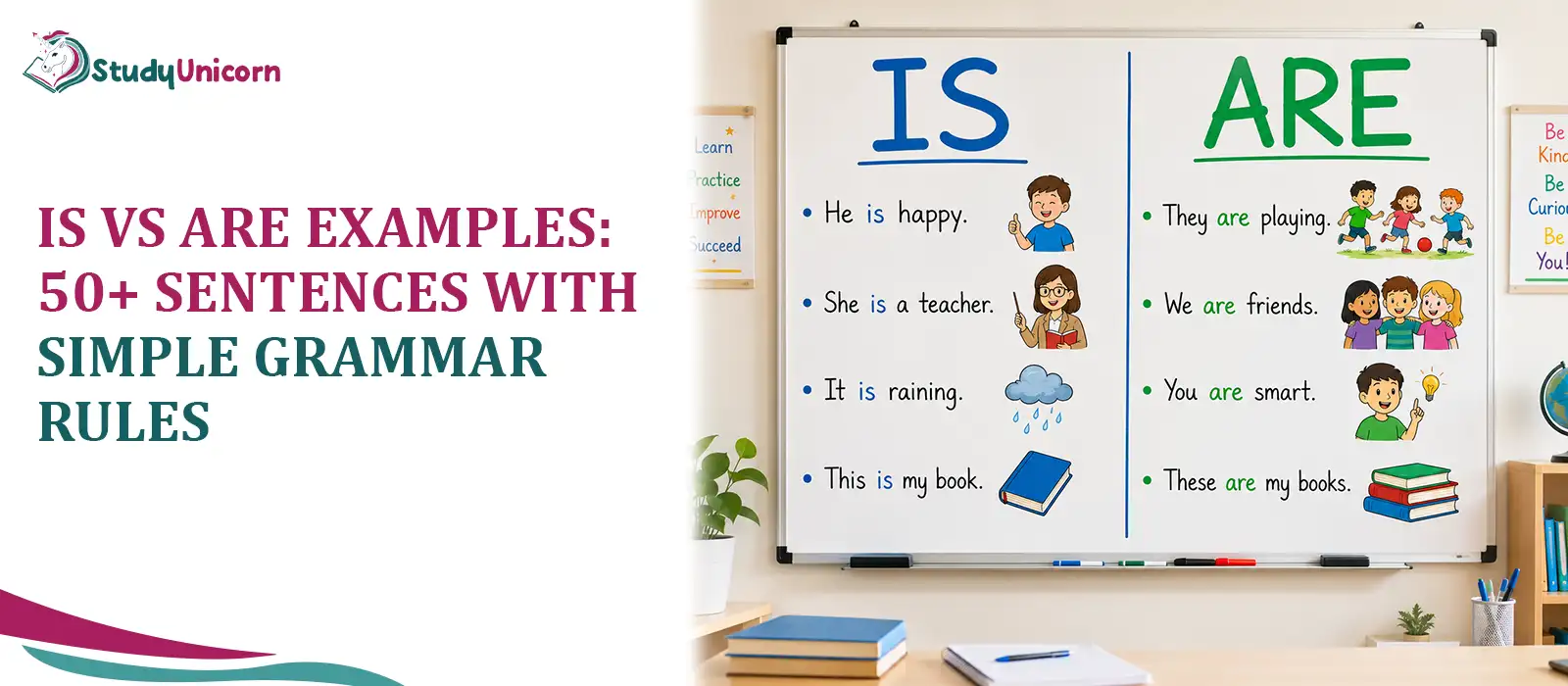
You are here as the wave of hesitation regarding is vs are hits you hard. But this moment is not about lacking basic grammar, as almost everyone knows that “IS” comes with singular subjects and ARE " with plural ones. The reality is that some sentences have kinds of confusing nouns and subjects that can bring the question mark in front of us to choose between IS or ARE.
And the true roadblock happens when you don't need an immediate answer but full clarity about this small but important aspect of grammar. Having such mistakes can show that you look careless and unprofessional. So, to keep you miles away from such mistakes, we bring this guide that gives you immediate clarity with 50+ examples of is and are. Along with it, a reliable rule you can apply instantly, and the confidence to hit "Send" without a second thought.
What Are “Is” and “Are”: A Quick Refresher
These two words belong to the verb “to be,” and that means they establish a connection of the subject to a state or description. If we look at it from a grammar perspective, then these are linking verbs and show no action. And when you search online, such as is are a verb, the answer is yes. The present tense gives the verb three forms: am, is, and are. For more details, you can check out these forms paired with specific subjects, as the table shows.
| Subject | Verb form | Example |
| I | am | I am ready to submit the lab report tonight. |
| you | are | You are early for the review session today. |
| he, she, it | is | She is finishing the outline before dinner tonight. |
| we | are | We are meeting in the study lounge at noon. |
| they | are | They are presenting their group project next Tuesday. |
Notice that “you” always takes “are,” even when the word addresses a single person. The same number logic is used for past tense swaps in was/were. This contractions reduce the length of these forms to he's, it's, and we're, while negative forms are given in the examples below.
The Simple Rule: When to Use Is vs Are
The basic rule is that the counting is first, and so is the form of the verb. If there is one subject the singular form of the verb is used; and if there are several the plural form of the verb is used. Knowing the subject name, but not certain whether the name is singular or plural, you may ask about the name of the subject, one or more than one.
Use “Is” With Singular Subjects
Single entities, singular pronouns, and indefinite pronouns call for “is,” as these samples show.
- He is waiting outside the registrar’s office with his transcript.
- She is organizing the study group for Thursday afternoon.
- Everyone is expected to submit the form before midnight.
Titles of books and courses count as singular, so “Pride and Prejudice is on the reading list” works despite the “and.”
Use “Are” With Plural Subjects
Learning is vs are plural forms requires only a short list: you, we, they, and any compound subject.
- We are reviewing chapter six before the quiz tomorrow.
- They are comparing sources for the research paper.
- Tom and Sara are presenting their findings on Friday.
Quick Memory Trick
Replace the subject with “it” or “they,” then say the sentence aloud.
Quick test: “The books on the shelf (is/are) overdue.” Swapping the subject produces “They are overdue,” which settles the question. Longer sentences benefit most, since the swap strips away every decoy phrase.
The Master Cheat Sheet: Is vs. Are Quick-Reference Matrix
Paragraphs slow down revision, so this grid sorts every common subject type by its verb. Clear subject-verb agreement starts with naming the subject category, and each row does that work.
| Subject category | Verb | Rule | Example |
| Singular noun | is | One person, place, or thing | Our professor is grading the midterm essays this weekend. |
| Plural noun | are | More than one item | Midterms are scheduled for the second week of October. |
| Singular pronoun | is | He, she, and it stay singular | Nobody is leaving before the final bell rings. |
| Plural pronoun | are | We, you, and they stay plural | Both of us are signing up for the workshop. |
| Subjects joined by “and” | are | Two subjects add up | Coffee and tea are free in the student lounge. |
| Subjects joined by “or” | nearest | Closest subject decides | Either the coach or the players are responsible. |
| Collective noun | is | The group acts as one unit | Our committee is voting on the proposal tomorrow. |
| Uncountable noun | is | Mass nouns stay singular | Advice from the writing center is completely free. |
| “A number of” | are | Means several | A number of seniors are graduating early this year. |
| “The number of” | is | Means a single count | Enrollment numbers matter, and the number of applicants is rising. |
Reading the matrix works best in three moves.
- Start by determining the noun in the left column. Then see the verb.
- Treat "the nearest" as an exception and look deeper at the more proximal noun.
- Ensure the draft sentence has the same shape as you wish to have as the example column.
Printing out the grid gives writers with a one-page is vs are reference to place next to a draft.
50+ Is vs Are Example Sentences
Seeing verbs in action builds fluency faster than rereading rules, so every sentence below carries a quick reason. Categories run from plain singular subjects to negative forms.
Sentences With “Is” (15 Examples)
Everyday campus and study contexts supply the singular subjects here.
- Maya is revising her thesis statement before office hours. [singular name]
- Nobody is allowed to leave the exam room before noon. [indefinite pronoun]
- Somebody is standing on the balcony of the study room to make sure to observe everything on the road. [indefinite pronoun]
- Our campus library is open until midnight during finals week of the exam. [singular noun]
- Each student is responsible for citing personal sources. [each is singular]
- Mathematics is the toughest subject on Priya’s schedule this semester. [subject name ending in -s]
- News about the schedule change is posted on the department website. [uncountable noun]
- Jordan is practicing his presentation loudly in front of the mirror to ensure his performance at its peak. [singular name]
- Another option is to resubmit the draft before Monday to be eligible to participate. [singular noun]
- Every seat is taken in the front row of the lecture hall, but it also has a high price tag. [every plus singular noun]
- Elena is the only student who has finished the take-home exam and also secured the top rank. [singular name]
- Pizza is the default order for any late-night study session of last year's batch students. [singular noun]
- Whoever is leading the lab gets first choice of equipment. [whoever is singular]
- Kevin’s essay is due on Friday before the library closes. [possessive, singular noun]
- Nothing is more stressful than a missing citation at midnight. [indefinite pronoun]
Sentences With “Are” (15 Examples)
Structures with plural subjects dominate this group, and these is vs are examples cover student life, lectures, and exams.
- Students are coming into the auditorium before the guest speaker arrives. [plural noun]
- Lectures are submitted electronically and made available to students ultimately. [plural noun]
- Exams are scheduled during the last two weeks of December. [plural noun]
- Textbooks are expensive, so many students rent them each term. [plural noun]
- Classmates are splitting the cost of the printing fees. [plural noun]
- Professors are available for questions during the final hour. [plural noun]
- Pairs of students are assigned to each microscope in the lab. [plural noun]
- Several seats are open near the windows in the reading room. [several is plural]
- Many applicants are waiting for decisions from the admissions office. [many is plural]
- Few candidates are prepared for the oral section of the interview. [few is plural]
- Mia and Noah are leading the debate team this semester. [compound with and]
- Flashcards are cheaper than most apps and work without Wi-Fi. [plural noun]
- Grades are posted by Friday evening on the student portal. [plural noun]
- Pencils, calculators, and water bottles are allowed in the testing center. [compound list]
- Labs are cancelled whenever the instructor is out sick. [plural noun]
Sentences With Both “Is” and “Are” (8 Examples)
Contrastive pairs projects how a change in number alters the verb and also make these is vs are sentences easy to drop in the comparison.
- Well, the lecture is so long that it would take about several hours that would be better to take breaks because of students and mental health [one singular, one plural].
- For a short answer, the explanations are usually longer because you're going to need that to describe practical knowledge. [one singular, one plural]
- Yellow highlighters are never far when the textbook is open to jot down some key points.[one singular, one plural]
- When the draft is ready, the edits are simple for the editor to look over for any kind of mistakes. [one singular, one plural]
- Whenever a printer is jammed, the assignments are going in the state of stuck in the queue that create a hectic schedule. [one singular, one plural]
Is vs Are in Questions (8 Examples)
Questions put the auxiliary verb first, so every is vs are choice depends on a subject that appears later.
- Is the study room on the third floor still available this evening? [singular subject]
- Are the lecture notes from Monday posted anywhere online yet? [plural subject]
- Where is the nearest printer that accepts student ID cards? [singular subject]
- Why are so many sections of the course already full? [plural subject]
- How is the final grade calculated for the lab portion? [singular subject]
- When are the scholarship applications due this year? [plural subject]
- Which professor is teaching the evening section of statistics? [singular subject]
- Who is responsible for booking the room for the group presentation? [who takes singular]
Negative Sentences (6 Examples)
Negation stays simple with is not, isn’t, are not, and aren’t.
- Maria is not attending the review session because of a lab conflict. [is not]
- Registration isn’t open to transfer students until the second week. [isn’t]
- These notes aren’t complete without the diagrams from the whiteboard. [aren’t]
- Late submissions are not accepted after the portal closes at noon. [are not]
- Required readings aren’t posted yet, so the syllabus is the only guide. [aren’t]
- Hallway lockers are not available to commuters this year. [are not]
Tricky Cases: Is vs Are Grammar Problems Students Face
Straightforward rules cover most sentences, yet exams and journal articles love edge cases. Traps in is vs are grammar appear below with a marked wrong version and its fix.
Collective Nouns (team, family, class)
American English treats team, family, and class as single units, so “is” follows them. British usage often splits the group into members and accepts “are,” which explains the conflicting textbooks.
- Incorrect: “The debate team are ready to begin the semifinal round.”
- Correct: “The debate team is ready to begin the semifinal round.”
- Her family is traveling three hours to attend the ceremony on Saturday. [family as one unit]
- Today the class is writing an in-class essay on the primary source. [class as one unit]
Subjects Joined by “and” or “or”
Subjects joined by “and” add up to a plural, while “or” points to a single alternative at a time.
- Incorrect: “Rice and pasta is served with every dinner special.”
Correct: “Rice and pasta are served with every dinner special.” - Incorrect: “Rice or pasta are served with every dinner special.”
Correct: “Rice or pasta is served with every dinner special.”
Correlative Proximity Rules: Either/Or and Neither/Nor
With either/or and neither/nor, the verb agrees with the subject closest to it. Checking are vs is in these structures means looking only at the second subject.
- Neither the manager nor the employees are happy with the new schedule. [closest subject is plural]
- Either the players or the coach is responsible for the travel forms. [closest subject is singular]
Words That Mislead (a group of, one of, the list of)
Phrases like these pull attention away from the true head noun, which sits at the front of the phrase.
- One of the students is still working on the proof. [head noun: one]
- A group of volunteers is waiting outside the registrar’s office. [head noun: group]
- The list of required readings is posted on the course website. [head noun: list]
Uncountable Nouns (water, advice, information)
Substances and abstract ideas default to singular verbs, because nothing about them can be counted one by one.
- Water is available in every building on the main campus. [substance]
- Furniture in the quiet room is arranged for solo study sessions. [mass noun]
- Information about summer internships is updated every Monday morning. [abstract idea]
The Great Confusion: “A Number of” vs. “The Number of”
Swapping a single article changes which noun controls the verb. Compare “a number of students are absent” with “the number of absent students is growing.” Expect the first phrase to mean several people, while the second points to one total.
- Incorrect: “The number of students are rising in every section.”
- Correct: “The number of students is rising in every section.”
There Is vs There Are: Another Confusion Between IS and ARE
Sentences that open with “there” hide the real subject behind the verb. Mastering there is vs there are takes one habit: find the noun after the verb, and match it.
- Inside the folder there are three drafts waiting for comments.
- Somewhere in the stacks there is a copy of the 1998 edition.
- Behind the gym there are two vending machines that take cards.
- There is a free tutor in the writing center today.
Knowing how to use prepositions in general will make your writing better, and knowing the difference between "there is" and "there are" will help you to understand the difference between them. For example, writers can lose points if they do not know what to choose between into or in to their instructor.
What Is vs What Are: Questions Made Simple
An information query is subject to the same number rule as statements: the noun following the verb has to be decided: what is vs what are.
- What is the deadline for the housing application?
- Exactly what are the requirements for the honors program?
- So what is the next step after the application conceal?
Count nouns immediately following "what" attract "are " while the uncountables (advice, equipment etc.) take "is. " Brief replies like "What's your major?"conceal the verb in the contraction, but the count remains.
Common Is vs Are Mistakes and How to Fix Them
Fast typing and autocorrect lead to many slips. You can tell a weak writer by all the is vs are mistakes when a long phrase comes between the subject and the verb.
| Incorrect | Correct |
| Everyone are invited to the awards ceremony on Friday. | Everyone is invited to the awards ceremony on Friday. |
| The list of required books are on the syllabus page. | The list of required books is on the syllabus page. |
| There is three open seats in the second row. | There are three open seats in the second row. |
| Neither the tutor nor the students is available today. | Neither the tutor nor the students are available today. |
| Each of the lab reports are due on Monday morning. | Each of the lab reports is due on Monday morning. |
Pro Tip: Subject-verb agreement is not the only trap in academic writing. Confusing words that sound identical, like possessives and contractions that can also undermine your clarity. See our detailed breakdown on how to master Whose vs. Who's to catch these errors before submitting your paper.
Three habits save most of these mistakes from heading for submission.
- Read the draft aloud slowly once and pay close attention to any verb that sounds wrong.
- Underline each subject, then draw an arrow to the verb.
- Go through the document for the phrase "there is" and make sure to state the noun that appears.
Quick Practice for IS and ARE: Test Yourself
Complete each space with is or are. Check your answer with the key below. Hide the key and do all five prompts, then score each answer.
- Fresh coffee ___ brewing in the faculty lounge at this moment.
- Two graduate students ___ organizing the poster session.
- Over the summer, the number of enrolled students ___ growing.
- Sandwiches and fruit ___ served after the guest lecture ends.
- Everybody in the study group ___ responsible for one chapter.
Answer key:
- 1 is (singular noun)
- 2 are (plural noun)
- 3 is (head noun is “number”)
- 4 are (and compound)
- 5 is (everybody is singular).
Conclusion
After reading this informative guide on these helping verbs and their uses, you must have got lots of insight. And we have to to sumup in the simple manners, singular subjects will always be followed by “is” when they are followed by a word that is not a noun. Words that are not nouns, such as indefinite pronouns and uncountable nouns, will always be followed by “is.” All plural subjects will use "are" when "and" is used to connect two or more subjects. Any sentence with "or", "neither/nor", or "either/or" will be matched with the closest verb. If you'd like to read about it in more detail, it might help to know that it is easier to "defend" limits as fully as possible if you understand, which pairs of prefixes such as inter- vs. intra mean.
 $10/page :